Yoga in the Archives
By Reina Gattuso•June 2026•31 Minute Read
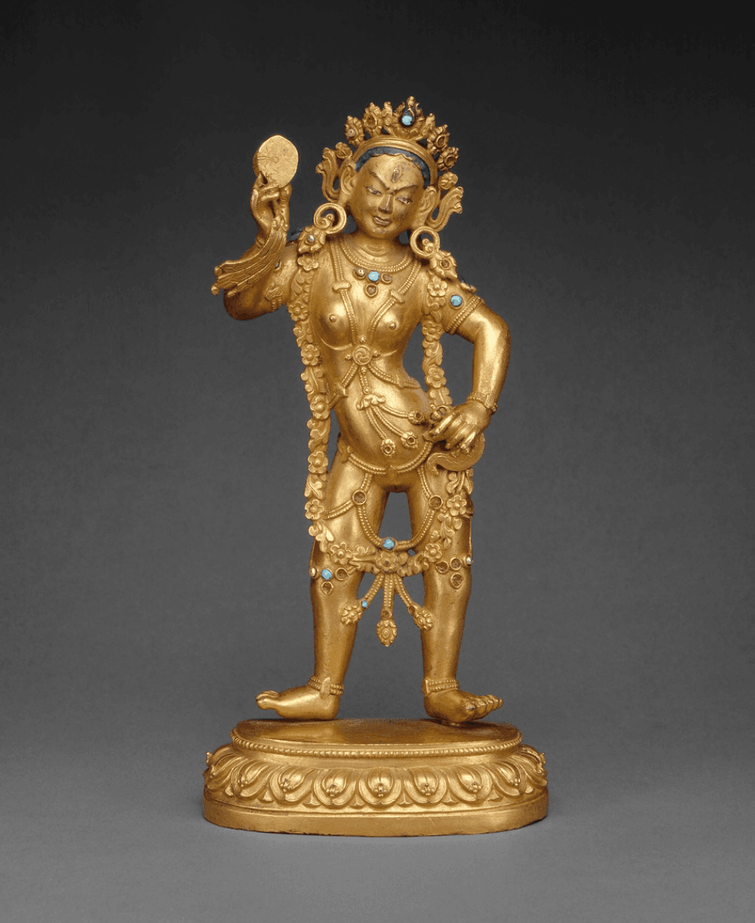
Tibet, Tantric Enlightened Being (Vajrayogini) Queen of Bliss (Dechen Gyalmo), 18th century, Art Institute of Chicago. Public Domain.
In much of the world today, yoga is synonymous with postural, asana-based practice. But this is just one piece of a multifaceted set of traditions. For more than two millennia, beginning in South Asia, scholars, artists, and practitioners have used the word “yoga” to indicate a broad range of political, physical, and philosophical practices.
Introduction
This feature draws on recent art historical and anthropological scholarship, as well as the insights of practitioners, to explore just a few of the many historical valences of yoga. We do this by surveying some of the objects associated with yoga in Curationist’s archives. These works span time periods, religious traditions, and artistic media. They include bronze sculptures from temples to Vishnu, illustrated Jain manuscripts of enlightened beings, Mughal depictions of gendered shapeshifting, and Buddhist tantric paintings of blissful sexual union. What emerges is a rich and diverse set of traditions that both contextualizes and extends far beyond today’s globally popular, posture-based practices.1
Situating Yoga History
The history of yoga is rich and contested. Dynamics of gender and caste oppression, European colonial knowledge production, and religious nationalism—most notably, Hindu nationalism—all shape what we now know as modern yoga. These histories also shape who can readily access and feel included in many yoga spaces around the world today. And, these factors continue to influence how we interpret the material culture associated with yogic practices.
Today, we see two dominant trends in interpreting yoga. The first, a globalized, exercise-focused approach, often decontextualizes yoga from its many historical valences by treating it as a commodity.2 This approach risks alienating yoga from its roots in South Asia. The second approach, championed by Hindu nationalist institutions, claims yoga as the exclusive property of an elite Hinduism. This outlook erases the diversity of religious orientations (such as Buddhism and Sufism), languages (such as Persian),3 and cultures (including interactions across Asia and Europe) that have shaped yogic practices and philosophies.4
Instead of the above two approaches, we rely on sources that pay attention to historical context and dynamics of social and economic power. To sift through some of this diversity, we searched for objects tagged “yoga,” “yogi,” and “yogini” in the Curationist archives. The terms used to describe people who practice yoga are often as contested as the word “yoga” itself. For example, the meanings of “yogi” range from—depending on the context—someone in a particular ascetic order, a magic practitioner, a member of a specific caste group, or someone who regularly does modern postural yoga.
To sift through this multiplicity of meanings, we asked: Why have archivists associated these objects with yoga? What facets of yoga and its many histories does each object reveal? To better delve into these varied perspectives, we’ll first survey a few key ideas that are important to understanding the historiography of South Asian art in general, and yoga specifically.
Religion
It’s impossible to talk about the history of religion in South Asia without accounting for how colonial scholarship and policy, and subsequent anticolonial religious nationalisms, transformed people’s notions of self, spirituality, and society. This is particularly evident in contemporary scholarly and political debates about Hinduism. With the ascendance of Hindu nationalism in recent years, these debates have taken on significant political importance, including in understanding claims to authority over yoga.
In ancient India, according to historian Romila Thapar, there were divisions between those who followed the religious authority of the brahmins, and those who—like Buddhists and Jains—founded sects outside of brahmanical authority. Scholars argue that at least until the mid-second millennium CE, people in South Asia tended to primarily identify themselves in relation to specific deities and sects as well as caste and regional groups.5 Scholars trace the word “Hindu” back to around 500 BCE, used in the Achaemenid Empire as an exonym to describe the lands near the Indus river.6 It likely wasn’t until around the 15th century CE that followers of the diverse sects of what we’d now call Hinduism began using the term to distinguish themselves from Muslims, Buddhists, and Jains.7 Because of this, we’ll identify traditions and practitioners with as much specificity as we can, using categories such as a Nath yogi, a Chishti Sufi, or a Shvetambara Jain monk.
Religious categories were further codified under British colonialism. Colonial officials began to survey and categorize Indian people in order to rule them. Through institutions like the census, the British catalyzed more rigidity in religious definitions by forcing communities that may have identified with regional and syncretic traditions to put their identities into a predefined box.8 This historical flattening is why we should approach objects in the archive with nuanced contextualization.
In present-day India, some people’s self-identifications, particularly those of marginalized groups, continue to challenge the strict legal and conceptual divisions between religions.9 For example, present-day members of the Muslim Jogi community identify with both Islam and devotion to Shiva; they continue to provide ritual healing services in North India.10
Caste and Gender
Caste and gender hierarchies shape religious identifications across South Asia. Caste is a “graded hierarchy” of social and economic privilege and oppression; caste groups with more power maintain the structure by systematically exploiting and excluding those with less. Because caste operates through control of women and sexuality, feminists call this system brahmanical patriarchy. Those most oppressed by the caste system are called Dalits, a term resulting from a movement of political emancipation.11 Dalit and anticaste scholars and practitioners have drawn attention to the ways that caste has structured access to different forms of yoga.12
Historically, brahmin men—those in the apex position of the caste and gender hierarchy—largely controlled access to literacy and, in particular, the written Sanskrit tradition. This includes many Hindu texts on yoga and asceticism.13 Indeed, many brahmanical texts explicitly prohibit oppressed caste people of all genders, and women across caste groups, from initiation into formal ascetic orders.14 As a result, it can be difficult to discern the yogic practices of women and oppressed-caste peoples from the written record.
At the same time, vernacular texts and oral traditions, art, and local practices are especially rich in references to yoginis—a complex term that can alternately mean a human woman yoga practitioner, a tantric ritual participant, or one of a host of feminine divinities. Scholars and practitioners believe that the yogini tradition contains practices originating with adivasi (indigenous) communities, such as the Santal people of eastern India.15
Brahmanical patriarchy includes discriminatory notions of bodily purity and pollution that shape somatic practices in South Asia. 16 Anticaste yoga practitioners protest these beliefs while emphasizing historical threads within yogic traditions that contest caste and patriarchal power.17
Keeping these critical perspectives in mind, we’ll survey a number of themes related to yoga as it emerges in the archives.
Royal Power
A major theme in religious literatures from South Asia is the relationship between spiritual and temporal power. These notions of power are embodied in the idealized figures of the ascetic, who abandons earthly relations, and the king, ruler of the everyday realm. The masculine pronouns are intentional, as these ideals typically center men, though we will encounter important exceptions later.
Yet the realms of spiritual and earthly power often intermingle, both ideologically and historically. One way scholars have defined yoga is as the practice of asserting power over an object—which can include the assertion of political power.18 From around 100 BCE to the present, texts emphasized yogis’ possession of supernatural powers or siddhis. Tales abound of yogis who channeled their siddhis as advisors and spies for kings. In the early modern period, yogis in what is now North India even formed armies to protect their political interests, often working as mercenary soldiers for warring kingdoms.19
This portrait of Man Dhata, a ruler of the North Indian kingdom of Nurpur in the 1600s, iconographically embodies yoga as political power. The use of gum tempera paint imparts a lush tactility to the king’s jewelled crown and the glowing gold background. This use of gold is common in court painting, and has also been used to depict the profound emptiness of enlightenment.20 Meanwhile, Man Dhata’s cross-legged posture, padmasana, is a hallmark of yogi representations and can denote a figure of both royal and spiritual power, such as the historical Buddha, who began life as a prince.21 Man Dhata’s body markings indicate the sukshma sharira, or subtle body, the physical-energetic channels described in textual traditions of Hatha yoga.22
As a royal portrait, which must have been approved by the ruler himself, it attests to how Dhata wished to be seen by his followers and by history: as embodying ideals of both metaphysical and kingly potency.
Ascetic Divinity
Even more than kings, South Asian artists have frequently portrayed deities as yogis and ascetics.
A pink sandstone sculpture, originating in the 10th or 11th century in what is now the Indian state of Madhya Pradesh, depicts a figure with the markings of an ascetic, including jata dreadlocked hair and a band securing his thighs in a cross-legged position. This strap is a telltale icon of meditative or asana-based yoga practice. Art historians speculate the figure either represents the ancient brahmanic god of the sacrificial fire, Agni; or a guru whom followers have elevated into a deity. He holds his oversized penis, referring to the spiritual and magical powers amassed by semen retention.23
Artists also depicted the god Vishnu as an ascetic. A bronze sculpture, made for a temple around 1250 in the Tamil Chola Empire and now at the Cleveland Museum of Art, depicts Narasimha, Vishu’s lion incarnation, as a yogi. The lion-god sits crosslegged with a yogic strap around his thighs.24 Bronzes like this were part of an elaborate temple-centered, caste-based patronage economy that included agricultural workers, artisans, priests, and wealthy donors.25
Shiva is perhaps the iconic ascetic divinity, whose iconography informs the bodily stylings of Indian ascetics (and international yoga practitioners) to the current day. This 17th-century painting, from the Basohli school of miniature illustration, depicts a lithe, slender Shiva with the goddess Parvati or Devi. Shiva’s iconography is on full display: a bun of jata hair crowned in a crescent moon; a prominent third eye; a snake and a necklace of skulls around his neck; a leopard-skin loincloth; and a double-sided damru drum clutched in one of his hands.
Liberation
Liberation, emerging from the self’s realization of universal truth, is another throughline of yogic practice in the history of South Asia.
In the 12th century in what is now Gujarat, Jain monk Hemachandra wrote the Yogashastra, or “treatise on yoga.” This yoga was a more general term for spiritual practice: Hemachandra outlined the Jain ratnatraya, the three jewels of right faith, right knowledge, and right conduct. While these practices were believed to potentially lead to the cultivation of supernatural powers, or siddhis, they ultimately helped the practitioner toward the goal of moksha, or liberation from the cycle of rebirth.26
The Yogashastra contains descriptions of kinds of yoga perhaps familiar to modern readers, including breathwork and physical asana. In describing these practices, Hemachandra dialogued with Shaivism and tantric Buddhism. The Yogashastra became a key text among Jain rulers, ascetics, and those laypeople who had access to literacy.27
W
This palm leaf folio from the Yogashastra, illustrated with tempera, depicts the Jain tirthankara Rishabha. He is given the honorific Jina for having conquered himself and gained a liberated soul. As befitting an enlightened being, Jina Rishabha is shown meditating in padmasana, with his feet hooked over opposite thighs. His golden body is smoothly and symmetrically stylized, an aesthetic common to Jain representations of the human form. Art historian Debra Diamond argues this formal convention is meant to evoke both “complete cessation of the mind’s functions and alert energy.”28
Play
Themes of transformation, shapeshifting, and play often characterize yogic representations.29 Muslim rulers of the Mughal dynasty, whose reign began in 1526 and whose origins lie in what is now Uzbekistan, were fascinated with Indian ascetics. Indeed, a long-standing Pesian and Arabic textual tradition translated and commented on yogic texts. There was also substantial cross-fertilization between Shaivite, Vaishnavite, tantric Buddhist, and Sufi traditions, with the figures of the fakir (Sufi ascetic) and the yogi heavily associated in popular imagination—even visualized together in some early modern illustrations.30
Mughal court artists, working primarily in the miniature painting tradition, frequently depicted yogis as tricksters or shapeshifters. These manuscripts were intended primarily for enjoyment of the courtly elite—a milieu which included royals as well as highly literate women tawaif courtesans and artists—and not for a devotional function.31
W
The Tutinama, or “Parrot Tales,” is a set of stories within stories, originally compiled in Sanskrit, which Mughal Emperor Akbar commissioned in an illustrated Persian rendition around 1560. This particular folio tells a story of the Raja of Ujjain, who—disguised as a yogi, wearing the signature fur cape associated with Shiva—tricks two brothers out of their inheritance.
Another illustration, from the late Mughal period, similarly associates yogic practice with masquerade—this time, play with gender. Here, a group of Mughal courtly ladies lavishly picnics in the forest, having encountered an ascetic prince performing yoga, identifiable by the masculine clothing and fine textile strap binding his legs. Upon closer inspection, however, we see—from the hennaed fingers and feet, jeweled payal or anklets, and high breasts—that the prince is a gender-bending courtly lady.
The masquerade alludes to another theme in yogic literatures and practices: the interdependency of masculine and feminine sexual energies, and the need to combine both in order to access spiritual liberation. We’ll explore this concept further below.32
Aesthetics
Yoga can also be thought of as a mood. The rasa system of Sanskrit aesthetics conceptualizes artistic emotions as a kind of “juice” or “nectar.” In Hindustani classical music, different ragas—a basic musical form similar to the Western key—are associated with specific moods, genders, and times of day. A genre of Indian painting, called the ragamala or “garland of ragas,” depicts ragas in visual form, often according to standardized tropes.
This section from a ragamala, painted around 1650 in the historical region of Malwa, portrays raga gandhara, which is associated with morningtime and a woman’s longing for her absent lover. Here, a woman ascetic, seated on a Shaivite tigerskin and contorted in an advanced asana, embodies the raga. While she is adorned in rich jewelry, her yogic practice has caused her body to become gaunt.
The trope of a longing lover who wastes away in the wilderness, either encountering or becoming an ascetic, is common in South Asian storytelling. This includes the male ascetic-heroes of the Arabic-origin Layla-Majnun and the Punjabi Heer-Ranjha, as well as the longing attitude of the Sanskrit nayika (heroine) and the yearning devotional poetry of Bhakti saint Mirabai.33 Glimpsing the gaunt yogi, an elite reader in the Malwa court may have immediately imagined a cascade of associations: a nagma (melody) in raga gandhara, the rasa sap of sringara (erotic love), and tales of famous lovers.
Esotericism
The relationship between eroticism and yogic transformation takes a literal form in tantric practice. Tantra is a vein of esoteric thought and ritual with origins in the first millennium CE. In this context, yoga is a set of practices including deliberate interaction with bodily substances associated with sex, food, and death. These rituals violated the taboos of the brahmanical caste order in order to demonstrate the illusory nature of the sacred-profane divide, and thus achieve power and liberation.34 Tantra has Vaishnavite, Shaivite, and Buddhist lineages; it is particularly widespread in Tibetan Buddhism, which we will examine here.
W
Women play a central role in tantric practice, both as historical practitioners and in the form of spiritually powerful feminine beings called yoginis.35 This bejeweled, gilt bronze statue of Dechen Gyalmo, “Queen of Bliss,” made in Tibet in the 18th century, portrays her as a fearsome divinity. Vajrayogini’s attributes—including an apron of bone and karttrika chopper—evoke tantric ritual. Tibetan Buddhist artists often made and continue to make such sculptures to aid in meditation.36
A painting of the yidam (a deity that serves as a focus for meditation) Vajrabhairava showcases the awe-inspiring, many-headed deity crowned in skulls, ringed with fire, and clutching ritual weapons. He is locked in a sexual embrace with Vajravetali, an animated corpse also crowned with skulls. Their union, which advanced practitioners have ritually reenacted, represents the coming together of masculine and feminine sexual fluids and energetic principles. Vajrabhairava stomps on representations of Hindu gods, a sharp claim to Buddhist authority.
Ethnography
Like others who came to the Indian subcontinent, European travellers, traders, and colonizers were fascinated with yogis. Starting from the writings of Marco Polo in the 1200s and continuing through the British colonial writings of the 1800s, Europeans repeated tales of yogis’ supernatural abilities and their involvements in political intrigues.37
In the late 1800s, colonial governments, including the British in India, promoted ethnography—the study of cultural groups—as a way to gather information about, and thus further repress, groups they ruled. This accompanied the advent of the camera and genres such as travel photography. Yoga and yogis, long a sensational trope in representations of India, were a popular subject.
W
A photograph by German adventurer Kurt Boeck, from turn-of-the-20th-century Calcutta, exemplifies this trend. The photograph of a “group of jogees” pictures ascetic practitioners in colonial Bengal. In this time period, the word “yogi” or “jogee” was most heavily associated with the Nath ascetic order, but could also signify a related caste group whose members often practiced magical healing.38 Such photographs were distributed in books or as postcards, with Europeans regarding them as both documentation and novelties.39 Yet the cumulative consequences of colonial categorization were quite harmful, with the British colonial governments legally labelling Nath yogis “Miscellaneous and Disreputable Vagrants” as part of broader efforts to criminalize marginalized populations.40
Nationalism
In response to colonial denigration, in the late 1800s and early 1900s Indian nationalists championed yoga as a uniquely Indian source of spiritual and political power—inventing modern yoga in the process. Figures like philosopher Vivekananda and yogi Krishnamacharya combined ascetic practices and Sanskrit philosophies with international influences including European physical culture and theosophy. This resulted in the modern postural practice most familiar to global audiences today.41
Thomas Harrison, Swami Vivekananda, 1893. Source: Wikimedia Commons. Public Domain. Indian nationalist Swami Vivekananda’s neo-Hindu ideas excited great interest at the 1893 Chicago Parliament of Religions, where this photograph was taken. https://commons.wikimedia.org/wiki/File:Swami_Vivekananda_1893_Scanned_Image.jpg.
While responding to colonial stereotypes, the creators of modern postural yoga typically centered a brahmanical and patriarchal vision of India. Vivekananda’s nationalist construction of Hinduism idealized the varna system and set an intellectual and political framework that later Hindutva groups took up.42 Krishnamacharya, and many of his students, emerged from a deeply exclusionary tradition of Brahmin male education,43 which many white and Global North students took up and further internationalized. In this process yoga became increasingly dissociated from the liminal and often marginalized bodies of folk magicians and tantrics, eventually yielding the idealized, elite “yoga bodies” popular today.44
Scholars and practitioners have pointed out the implications of these power dynamics within modern yoga, including systemic sexual violence,45 white supremacy and anti-Black racism,46 and appropriation by Hindu nationalist organizations.47
Conclusion
Despite modern efforts to homogenize yoga, however, its many streams of knowledge and practice continue to defy a singular definition. It feels appropriate, then, to the end with the words of the 15th-century mystic saint-poet Kabir, who lived in a world of wandering yogis and fakirs, and whose work similarly straddled and challenged both Hinduism and Islam. In one poem, he names the seemingly contradictory marvels he has witnessed: a guru humbling himself before his disciple, a dog embracing a cat, a tree with its roots in the sky. “This verse, says Kabir, is your key to the universe,” the poet-saint proclaims—still, centuries later, taunting the listener with mystical contradiction. “If you can figure it out.”48
Reina Gattuso is a content writer on the Curationist team, and an independent journalist covering gender and sexuality, arts and culture, and food. Her journalism connects analysis of structural inequality to everyday stories of community, creativity, and care. Her work has appeared at Atlas Obscura, The Washington Post, Teen Vogue, The Lily, POPSUGAR, and more. Reina has an MA in Arts and Aesthetics (cinema, performance, and visual studies) from Jawaharlal Nehru University in New Delhi, India, where her research focused on sexuality in Hindi film. She writes and teaches writing to high school students in New York City.
Citations
For a rich overview of yoga in art history, which I referenced heavily in writing this feature, see: Diamond, Debra, ed. Yoga, the Art of Transformation. Smithsonian Institution, 2013. Internet Archive, https://archive.org/details/yogaartoftransfo0000diam/mode/2up. Accessed 7 February 2026.
De Michelis, Elizabeth. A History of Modern Yoga. Continuum, 2004.
See Ernst, Carl W. “Being Careful With the Goddess: Yoginis in Persian and Arabic Texts.” In Performing Ecstasy: The Poetics and Politics of Religion in India, Pallabi Chakrovorty and Scott Kugle, eds. Manohar, 2009, pp. 189-204. Academia.edu, https://www.academia.edu/86594708/Performing_ecstasy_1_. Accessed 8 June 2026.
Patankar, Prachi. “Ghosts of Yoga Past and Present.” Jadaliyya, 26 Feb 2014. Accessed 11 September 2025.
Thapar, Romila. “Imagined Religious Communities?: Ancient History and the Modern Search for a Hindu Identity.” Modern Asian Studies, vol. 2, no. 2, 1989. JSTOR, https://www.jstor.org/stable/312738. Accessed 7 February 2026.
Truschke, Audrey. “Hindu: A History.” Comparative Studies in Society and Religion, vol. 65, no. 2, January 2023, p. 248. Cambridge Core, https://www.cambridge.org/core/product/identifier/S0010417522000524/type/journal_article. Accessed 7 February 2026.
Islam first came to the subcontinent through sea trade beginning in the 7th century via the western coast. It came overland from the north starting from the 10th century. For the impact of increased Muslim presence on Hindu identity see Thapar, “Imagined Religious Communities.” Scholar David N. Lorenzen helpfully sums up the dynamic thus: “What did happen during the centuries of rule by dynasties of Muslim sultans and emperors was that Hindus developed a consciousness of a shared religious identity based on the loose family resemblance among the variegated beliefs and practices of Hindus, whatever their sect, caste, chosen deity, or theological school.” Lorenzen, David N. “Who Invented Hinduism?” Comparative Studies in Society and History, vol. 41, no. 4, 1999, p. 655. Cambridge Core, https://www.cambridge.org/core/product/identifier/S0010417599003084/type/journal_article. Accessed 7 February 2026.
See Lorenzen, “Who Invented Hinduism?,” p. 639, on the colonial orientalist and Indian nationalist co-construction of identity categories.
For example, scholar Joel Lee, working with Dalit (oppressed caste) communities in what is now Uttar Pradesh, has found that until about a century ago many Dalit people in what is now North India, who are now considered Hindu, worshipped a local prophet, Lal Beg; some still do. (Lee, Joel. Deceptive Majority. Cambridge University Press, 2021.) Many Dalits, following the inspiration of B.R. Ambedkar, reject Hinduism and convert to Buddhism (Ambedkar, B.R. “The Buddha and His Dhamma.” Siddharth College Publication, 1956. Internet Archive, https://archive.org/details/in.gov.ignca.15980/page/n5/mode/2up. Accessed 8 June 2026.) And some Dalit and Bahujan people (a category indicating Dalit and other oppressed castes) identify with specific local practices (Ilaiah Shepherd, Kancha. Why I am Not a Hindu. Samya, 1996).
For example, Mukesh Kumar’s ethnography of modern-day Muslim Jogis importantly chronicles how both colonial and Hindu nationalist politics have tended to homogenize Indian identities and discipline more diverse and syncretic identities into the Hindu-Muslim binary. Muslim Jogis are a particular caste community who are historically largely farmers and also ritual healers associated with tantric and Nath yoga practice. Kumar writes that colonial census takers, who conceptualized the world according to bounded religious categories, could not conceptualize the reality of Muslim Jogis. Even in postcolonial India, nationalist census takers replicated this miscategorization. Moreover, Hindu nationalist politics have actively sought to envelop more and more caste and religious communities, which have historically been marginalized by or actively contested brahmanical Hinduism (see Lee, above), into the “Hindu” fold, as a demographic attempt to inflate Hindu vote banks against Muslim ones. Indeed, Kumar’s Muslim Jogi interlocutors describe being left out of government affirmative action programs for people from marginalized caste identities because, while the state accommodates Hindu Jogis within such programs, they do not accept Muslim Jogi as a legible community category. (Kumar, Mukesh. “Straddling Across Religious Borders: The Case of the Muslim Jogis.” Journal of the American Academy of Religion, 2025. Zurich Open Repository and Archive, https://www.zora.uzh.ch/server/api/core/bitstreams/a0b3e76b-2406-4afc-8fb3-f7f22e077e96/content?trackerId=cec1888064fe1729. Accessed 7 February 2026.)
Dr. B.R. Ambedkar, the lead author of the Indian Constitution, and one of the foremost anticaste leaders of the 20th century, sums up the economic exploitation of caste as “a hierarchy in which the divisions of labourers are graded one above the other.” (Ambedkar, The Annihilation of Caste, Section 4, 1937. Columbia Center for Teaching and Learning, https://ccnmtl.columbia.edu/projects/mmt/ambedkar/web/section_4.html. Accessed 20 May 2026.) He describes the social violence of the system as an “ascending scale of hatred and descending scale of contempt,” indicating the routine humiliation dominant castes inflict upon people in oppressed caste groups, particularly Dalits. (“Kalaram Temple Entry Movement.” In Dr. Babasaheb Ambedkar Writings and Speeches, Vol. 17, Part 1,Hari Narake et al., eds. Dr. Ambedkar Foundation, 2014, p. 200. Marxists Internet Archive, https://www.marxists.org/archive/ambedkar/writings-and-speeches/Volume_17_01.pdf.) For a foundational text on the political nature of the word “Dalit,” see: Dalit Panthers. “Dalit Panthers Manifesto, 1973.” In The Exercise of Freedom: An Introduction to Dalit Writing, K. Satyanarayana and Susie Tharu, eds., 2013, pp. 55-65. Internet Archive, https://archive.org/details/exerciseoffreedo0000unse/page/54/mode/2up. Accessed 9 June 2026.
See: Rao, Anjali. Yoga as Embodied Resistance. Penguin Random House, 2025; and Sood, Sheena. “Toward a Critical Embodiment of Decolonizing Yoga.” Race and Yoga, vol. 5, no. 1, 2020. eScholarship, https://escholarship.org/uc/item/9bx1x7wc. Accessed 9 June 2026.
Kalé, Sunila and Christian Lee Novetzke. The Yoga of Power. Columbia University Press, 2024, p. 17. Google Books, https://books.google.com/books?id=-S4eEQAAQBAJ.
Khandelwal, Meena. Women in Ochre Robes: Gendering Hindu Renunciation. SUNY Press 2004, p. 36. Internet Archive, https://archive.org/details/womeninochrerobe0000khan/page/36/mode/2up.
McDaniel, June. “Yoginis and Tribal Ritual.” In Yogini in South Asia. István Keul, ed., Routledge 2013, p. 136.
For an overview of Dalit feminism, a tradition centered around the experiences and knowledges of Dalit women living under and resisting brahmanical patriarchy, see: Paik, Shalaija. “Dalit Feminist Thought.” Economic and Political Weekly vol. 56, no. 2. June 2021. Academia.edu, https://www.academia.edu/51195224/Paik_Dalit_Feminist_Thought_EPW. Accessed 9 June 2026.
Rao.
Kalé and Novetzke.
White, David Gordon. Sinister Yogis. University of Chicago Press, 2009. Chicago Scholarship Online, https://academic.oup.com/chicago-scholarship-online/book/18182. Accessed 9 June 2026.
Diamond.
White.
Westoby, Ruth. “Yogic Body.” Sahapedia, https://www.sahapedia.org/yogic-body. Accessed 7 Feb. 2026.
“Ascetic Deity,” The Walters, https://art.thewalters.org/object/25.255/. Accessed 7 February 2026; Mallinson, James. “Hatha Yoga’s Early History.” In Hindu Practice. Gavin Flood, ed., Oxford University Press, 2020, p. 183. Internet Archive, https://archive.org/details/mallinson-hathayogas-early-history. Accessed 7 February 2026.
Dehejia, Vidya. Chola: Sacred Bronzes of Southern India. Royal Academy of Arts, 2006, pp. 120–123.
Dehejia. The Thief Who Stole My Heart, Princeton University Press, 2021, p. 4. JSTOR, https://www.jstor.org/stable/jj.5425907.
Quarnstrom, Olle. “Introduction.” Yoga Sastra of Hemachandra, Harvard University Press, 2002, pp. 4-6. Internet Archive, https://archive.org/details/yogasastraofhemacandraa12centuryhandbookofsvetambarajainismollequarnstromuniversityofharvard60__24_X. Accessed 7 Feb. 2026.
Quarnstrom.
Diamond, p. 27.
White.
White, p. 199.
Sharma, Preeti. “Dancing with Power: Courtesans as Cultural Patrons in Mughal and Deccan Courts.” The Rubrics, 6 May 2025, https://therubrics.in/index.php/journal/article/view/4. Accessed 7 February 2026.
Mallinson, p. 255.
Indeed, some versions of Heer-Ranjha open with an invocation of the wandering ascetic life of the yogi or Sufi fakir: “Come, if you will be a fakir!” Murphy, Anne. “Sufis, Yogis, and the Question of Religious Difference.” In Religious Individualism: Historical Dimensions and Comparative Perspectives, Fuchs et al., eds., De Gruyter, 2019, pp. 289-314. Google Books, https://books.google.com/books?hl=en&lr=&id=DbfNDwAAQBAJ&oi=fnd&pg=PA289&dq=yoga+and+the+jogi+caste&ots=pQuRzW2nkS&sig=x18SllTmpvqvkDPT8dg4FArDk7U#v=onepage&q=yoga%20and%20the%20jogi%20caste&f=false. Accessed 7 February 2026.
There is an ongoing debate on how tantric practice challenged or reinforced the brahmanical caste order. The debate is made even more complicated because, as an esoteric and frequently subaltern tradition, tantric practices were seldom written about and often conducted secretly. There is additional debate around what situations in textual descriptions of tantric rituals were meant to be taken metaphorically versus literally. When it comes to caste, on one hand, tantric practice certainly challenged the duality between disgust and purity associated with brahmanism—for example, the casteist notion that feces and meat are inherently polluting and thus those forced to labor handling them are ritually “impure.” Tantric practitioners likely handled, even ingested, such substances in order to transcend the illusory division between the sacred and the profane. There is also a school of thought that tantric practices represent Shaivite and Buddhist adoptions of subaltern, including indigenous/adivasi, practices. On the other hand, texts on tantric ritual in various times and places have sometimes ritually prescribed sex with women from oppressed caste groups. This raises serious questions of consent.
For relevant perspectives, see: Wedemeyer, Christian. “Beef, Dog, and Other Mythologies.” Journal of the American Academy of Religion vol. 75, no. 2, June 2007. Tibetan Buddhist Encyclopedia, https://tibetanbuddhistencyclopedia.com/en/images/7/7b/BeefdogAAR2007.pdf. Accessed 10 June 2026; Urban, Hugh. Tantra: Sex, Secrecy, Politics, and Power in the Study of Religion. University of California Press, 2003. JSTOR, https://www.jstor.org/stable/10.1525/j.ctt1pp4mm. Accessed 10 June 2026; White, David Gordon. Kiss of the Yogini: “Tantric Sex” in its South Asian Context. University of Chicago Press, 2006. Google Books, https://books.google.com/books/about/Kiss_of_the_Yogini.html?id=udZWwms7rgwC. Accessed 10 June 2026.
There is a debate over women’s roles in historical tantric practice. On one hand, a vein of scholarship centers male practitioners and casts women in the role of either sexually used “consorts” or mythical yoginis. On the other hand, feminist scholar Miranda Shaw argues in an influential work that women yoginis, as actual historical practitioners, occupied a position of substantial status in the Buddhist tantric tradition. See: Shaw, Miranda. Passionate Enlightenment. Princeton University Press, 1994. JSTOR, https://doi.org/10.2307/j.ctv1hw3xvb. Accessed 10 June 2026.
Work on recent history focuses on the self-accounts of modern Tibetan Buddhist women consorts, describing both the struggles and the potential advantages of occupying this prestigious yet highly gendered religious position. See, for example: Kragh, Ulrich Timme. “Appropriation and Assertion of the Female Self: Materials for the Study of the Female Tantric Master Lakshmi of Uddiyana.” In Journal of Feminist Studies in Religion, vol. 27, no. 2, fall 2011. JSTOR, https://www.jstor.org/stable/10.2979/jfemistudreli.27.2.85. Accessed 10 June 2026. See also: Gayley, Holly. “Revisiting the ‘Secret Consort’ in Tibetan Buddhism.” Religions, vol. 9, no. 6, 2018. MDPI, https://www.mdpi.com/2077-1444/9/6/179. Accessed 10 June 2026.
Brown, Kathryn Selig. “Tibetan Buddhist Art.” The Met, https://www.metmuseum.org/essays/tibetan-buddhist-art. Accessed 7 Feb 2026.
White, Sinister Yogis.
Ondračka, Lubomír. “The Search for the Jugi Caste in Pre-Colonial Bengal.” In The Power of the Nāth Yogīs: Yogic Charisma, Political Influence and Social Authority, Daniela Bevilacqua and Eloisa Stuparich, eds. Amsterdam University Press, 2022. Academia.edu, https://www.academia.edu/99022454/The_Search_for_the_Jugi_Caste_in_Pre_Colonial_Bengal. Accessed 7 February 2026.
Khan, Omar. “A Postcard from India: How a Colonial Worldview Travelled the Empire and Beyond.” Scroll, 15 Sept. 2024, https://scroll.in/article/1072969/a-postcard-from-india-how-a-colonial-worldview-travelled-the-empire-and-beyond. Accessed 30 May 2026.
White, Sinister Yogis.
De Michelis.
Unpacking Vivekananda’s position on varna is helpful to better understand key debates about caste, Hinduism, and nationalism. Vivekananda argued that in brahmanical Sanskrit texts from the first millennium BCE, such as the Bhagavad Gita, varna (the hierarchical, fourfold caste division) is meant to assign occupation based on aptitude or merit rather than heredity. He advocates for Hindu society (which he equates with Indian society) to return to this idealized fourfold division. For a discussion of Vivekananda’s position on caste, see: Sharma, Jyotirmaya. “Whose Society, What Religion? Section III.” In Cosmic Love and Human Apathy, HarperCollins India, 2013, pp. 171-190. Internet Archive, https://archive.org/details/cosmiclovehumana0000shar/page/n7/mode/2up. Accessed 9 April 2026.
In contrast, Ambedkar was abundantly clear that there can be no ethical justification of varna, whether by birth or guna (”worth”), as such a categorization system is inherently hierarchical and the problem is hierarchy itself: “A society based on varna or caste is a society based on a wrong relationship.” Ambedkar. “The Annihilation of Caste.” Dr. Babasaheb Ambedkar Writings and Speeches, Dr. Ambedkar Foundation, Ministry of Social Justice and Empowerment, Government of India, 2014, p. 89, https://baws.in/books/baws/EN/Volume_01/pdf/104. For Ambedkar’s argument against varna, see: "Annihilation of Caste” sections XIV-XVIII, pp. 57-64, https://baws.in/books/baws/EN/Volume_01/pdf/72. Accessed 10 June 2026.).
Writing in the Ambedkarite tradition, scholar and activist Gail Omvedt points out that the discourse of varna as based on aptitude—as well as the idealization of the brahmanical past this interpretation implies—is part of “all modern ideologies of Hindutva.” “I do not think this is what the ancient texts meant,” Omvedt writes. “But even if they did, the point remains that it is profoundly undemocratic to assign people, at whatever age, to certain tasks and responsibilities and rights according to some form of presumed ‘merit’ or ‘guna’ and then to treat them differentially. . . . Varna by merit is as abominable a conception as varna by birth.” Omvedt, “Is Hinduism Exclusive and Inherently Casteist? Discussion Map.” Economic and Political Weekly, 2003, https://www.epw.in/engage/discussion/hinduism-exclusive-and-inherently-casteist. Accessed 30 May 2026.
In their brief biography of Krishnamacharya, for example, Mark Singleton and Tara Fraser write that while later in his life, Krishnamacharya demonstrated “openness to change” by allowing women students to learn Vedic chanting, “it also makes clear how important orthodox Vedic religion is in his yoga system.” Singleton, Mark and Tara Fraser. “T. Krishnamacharya, Father of Modern Yoga.” In Gurus of Modern Yoga, Mark Singleton and Ellen Goldberg, eds., Oxford University Press, 2014, p. 95. Internet Archive, https://archive.org/details/gurusofmodernyogamarksingletonellengoldbergouparticles_288_H.
This is similar to the nationalist appropriation and sanskritization of classicized dance forms like sadirattam (renamed bharatanatyam) and kathak. See: Chakravorty, Pallabi. “The Body and the Contagion.” South Asian History and Culture, vol. 14, no. 2, 2023, pp. 250-262. Taylor and Francis Online, https://www.tandfonline.com/doi/full/10.1080/19472498.2022.2144329. Accessed 9 April 2026.
In the late 2010s, practitioners alleged that yoga guru Pattabhi Jois, who founded modern ashtanga yoga and who was a major disciple of Krishnamacharya, had committed widespread sexual assault against women students. As a result, many ashtanga yoga practitioners, particularly women, questioned the patriarchal authority embedded in the guru-shishya (teacher-student) system of transmission. (Priest, Jenny Wilkinson. “Sexual Assault in the Ashtanga Yoga Community.” Yoga Journal, 13 November 2018, https://www.yogajournal.com/lifestyle/sexual-assault-in-the-ashtanga-yoga-community. Accessed 9 April 2026.) Some writers in U.S. media seem to attribute the sexual violence of the guru-student system to a kind of cultural mistranslation as the system globalized and Western students treated gurus as “rock stars.” (Griswold, Eliza. “Yoga Reconsiders the Role of the Guru in the Age of #MeToo.” The New Yorker, 23 July 2019, https://www.newyorker.com/news/news-desk/yoga-reconsiders-the-role-of-the-guru-in-the-age-of-metoo. Accessed 9 April 2026.) This, however, neglects a robust Dalit feminist tradition of critique of the brahmanical patriarchal violence of “traditional” education systems in India—forms of violence which continue in modern Indian and diasporic educational settings. See: Salve, Mukta. “About the Grief of Mahar and Mangs.” Translated by Braj Ranjan Mani. In A Forgotten Liberator: The Life and Struggle of Savitribai Phule, Braj Ranjan Mani and Pamela Sardar, eds., Mountain Peak, 2008, pp. 70-75. Internet Archive, https://archive.org/details/forgottenliberat0000braj/mode/2up. See also: Paik, Shailaja. Dalit Women’s Education in Modern India. Routledge, 2014, https://www.taylorfrancis.com/books/mono/10.4324/9781315770741/dalit-women-education-modern-india-shailaja-paik.
For an important collection of work on race, racism, social justice, and yoga, see the archive of Critical Yoga Studies, formerly called Race and Yoga: https://escholarship.org/uc/raceandyoga. Some notable papers from the journal include: Justin, Tori Alexist. “‘Roll Out My Mat and Take Up Space:’ A Study of Black Women’s Resistance to Yoga’s White Normativity.” Race and Yoga_ vol. 7, no. 1, 2023, https://escholarship.org/content/qt80s4q74r/qt80s4q74r.pdf. Accessed 31 May 2026; Manigault, Bryant. “Yoga and the Metaphysics of Racial Capital.” Race and Yogavol. 1, no. 1, 2016, https://escholarship.org/content/qt9n70536b/qt9n70536b.pdf. Accessed 31 May 2026; Nair, Lakshmi. “When Even Spirit Has No Place to Call Home: Cultural Appropriation, Microaggressions, and Structural Racism in the Yoga Workplace.” Race and Yoga_ vol. 4, no. 1, 2019, https://escholarship.org/content/qt8mn5k1m1/qt8mn5k1m1.pdf. Accessed 31 May 2026.
Scholar Patrick McCartney, for example, has found that even when not conscious of doing so, yoga teachers of various, largely non-South Asian backgrounds, often begin using Hindu rightwing language to describe their practice. McCartney, Patrick. “Politics Beyond the Yoga Mat.” Global Ethnographic, May 2017, https://www.researchgate.net/profile/Patrick-Mccartney-2/publication/335749840_Politics_beyond_the_Yoga_Mat_Yoga_Fundamentalism_and_the_'Vedic_Way_of_Life'/links/5d7907c04585151ee4aee0a9/Politics-beyond-the-Yoga-Mat-Yoga-Fundamentalism-and-the-Vedic-Way-of-Life.pdf. Accessed 9 April 2026.
Kabir. “Brother, I’ve seen some.” Arvind Krishna Mehrotra, trans., Poetry Foundation, https://www.poetryfoundation.org/poetrymagazine/poems/54388/brother-ive-seen-some. Accessed 7 February 2026.
Reina Gattuso is a content writer on the Curationist team, and an independent journalist covering gender and sexuality, arts and culture, and food. Her journalism connects analysis of structural inequality to everyday stories of community, creativity, and care. Her work has appeared at Atlas Obscura, The Washington Post, Teen Vogue, The Lily, POPSUGAR, and more. Reina has an MA in Arts and Aesthetics (cinema, performance, and visual studies) from Jawaharlal Nehru University in New Delhi, India, where her research focused on sexuality in Hindi film. She writes and teaches writing to high school students in New York City.