Unseeing Egypt: The Value of a Flawed Photograph
By Farida Youssef•September 2026•24 Minute Read
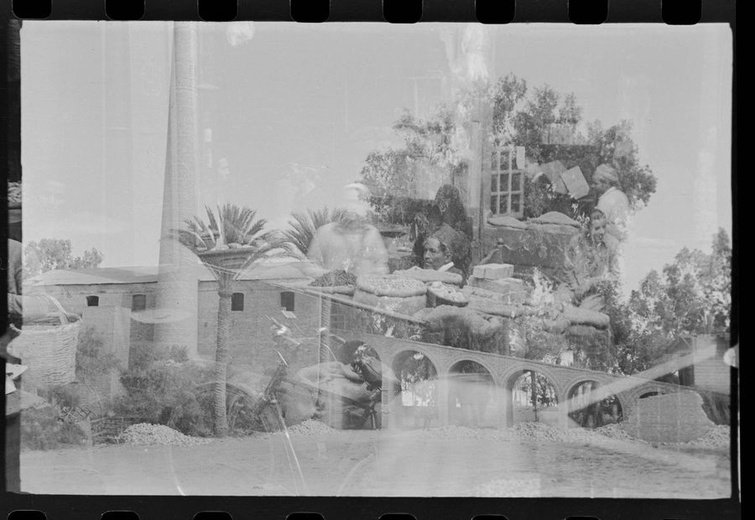
Hugh Cowan Gilmour, untitled, c. 1943. Auckland War Memorial Museum Tāmaki Paenga Hira. No known copyright restrictions.
When it comes to image-making, linear perspective creates the effect of order and certainty. What if you could take pictures that left you in doubt? Sergeant Gilmour’s flawed images offer different insights into Egypt than the colonial gaze.
To many, Egypt means the Pyramids of Giza, colossal statues of Pharaohs, or the Nile River. No tourist leaves without a photograph of one of these. Who could resist photographing the mask of Tutankhamen, on display in Cairo? The problem, however, is when such photographs produce stereotypes that simplify the reality in front of us.
Egypt’s relationship to photography is complex. When the country was briefly invaded by the French in 1798 and occupied by the British in 1882, curious European travellers visited—and photographed. The photographic medium was first introduced in this colonial context.
How would a traveller from London or Paris capture Egypt? How did they position the camera to see this strange and fascinating land? A single frame seems to contain the exotic chaos of a foreign scene. In photographic clichés of Egypt, everything seems to be standing still, odors are sanitised, and sounds are muted. This position is a derivative of linear perspective, which recreates the world as rational and ordered.
Clear and precise photographic images are the goal of linear perspective. If today a tourist takes a hazy or blurred photograph of the Pyramids of Giza, would you say this is a satisfying and good photograph? You might say it is flawed. You expect to see the Pyramids, not to squint hard. But what if there is another way to consider such photographs?
The Value of Flawed Aesthetics
This image was taken by Sergeant Hugh Cowan Gilmour, a New Zealand soldier who served in the Middle East during the Second World War, sometime between 1939 and 1945. Over 1,500 negatives, assembled in two albums which Gilmour brought back home, are today part of the Auckland War Memorial Museum Tāmaki Paenga Hira. Many of these photographs are from his time in Egypt. Before the war, Sergeant Gilmour was a carpenter, suggesting that photography was an interest but not his main occupation. Like someone who kept a diary, Gilmour took photographs of his encounters and visits. Some seem quite random and unimportant. Others are unfocused, making their subject matter unclear, or shot with a skewed perspective. These are not necessarily the snapshots that stand out, especially within such a large collection.
His flawed photographs do not meet visual standards nor cultural expectations about Egypt. Yet if a good or correct photograph of Egypt confirms stereotypes, what different view of Egypt would these flawed ones offer?
Intizam al-Manzar, or the West’s Obsession with Order
Egypt has a peculiar relationship to the history of photography. When the daguerreotype, the first publicly available photographic technique, was announced, it was promoted as an invention that could have aided the scientists documenting Egyptian monuments during the earlier three-year occupation of the country.1 It was presented in France in 1839 and it arrived in Egypt that very same year.2 At the time, Egypt was becoming a tourist destination for Western travelers. Photographs of its landmarks and cities began to be commissioned for illustrated books and postcards.3
Many European photographers sought a vantage point, such as a hill or minaret, at a remove from what they sought to capture, from which they could make panoramic or “complete” pictures.4 This distance implies a set of fixed relationships between the person making a photograph and what is depicted in that photograph.5 From such a position of visual rationality, making a photograph is no longer a matter of experiencing the view as much as it is about representing or framing it. As Timothy Mitchell, author of Colonizing Egypt, notes "The problem for the photographer or writer visiting the Middle East, however, was not just to make an accurate picture of the East but to set up the East as a picture.”6 Things pictured are arranged to conform to a photograph, not the other way around. This planning, setting up, and organizing of the view has an equivalent in Arabic, intizam al-manzar.
Intizam: An Egyptian Perspective on Perspective
In 1882, Ali Pasha Mubarak, a formidable Egyptian engineer, reformer, and minister of education and public works, published his novel Alam al-Din. It tells the story of an Egyptian scholar named Alam al-Din and an English traveler as they exchange views on various topics. In one chapter, they visit Paris. Compared to Cairo’s commotion and chaos, the French capital is portrayed as a rational city. While Alam al-Din is intrigued by the city’s boulevards and orderly architecture, the Egyptian scholar intuits Europe’s obsession with what he phrases as intizam al-manzar, meaning the “organization of the view” in Arabic.7
Mubarak’s protagonist is referring to the balance and order of Baron Haussman’s redesign of Paris. The French engineer exploited how we experience single-point perspective to rebuild the city, giving it a sense of balance and order. In fact, intizam in Arabic also means “regular.” Alam al-Din’s remark about intizam al-manzar might not be a harsh criticism so much as descriptive. Nevertheless, his comment is about an imposed or manufactured order and organization that leaves things as though they were fixed and predictable. He adds, “Everything seems set-up and meant to fall in place.”8 This intizam al-manzar is not just a question of visual arrangement but also implies that the view will be perceived in the same way. What we can read implicitly in the remarks about intizam is the conflation of vision and reason, of seeing and knowing. Mubarak’s term can help us understand how this conflation is also at work in a linear perspective. The latter is a technique of representation that creates the illusion of depth onto a flat surface but it also lays claim to rationality. Perspectival seeing implies a fixed position from which reality can be represented, from which the view can be set-up or organized. In the end it is the arrangement of a view according to someone’s perspective that caught the attention of Mubarak’s Egyptian scholar. He was intrigued by a fixed regime of seeing. In so far as linear perspective also operates in photography, its resulting images deliver visual rationality or intizam al-manzar. Coupled with the medium’s visual authenticity, photographic images become a marker of certainty and truth. A photographer’s point of view lends itself to an ideological one as well.
Colonial Lament
According to whose ideas is Egypt being framed? Colonialism creates a power imbalance of which the colonial gaze is a manifestation. Adrien Bonfils, a French photographer who was active in the Middle East in the late nineteenth century, lamented the modernization and construction spree in Egypt. At the time, many important infrastructure projects were transforming the country into a modern nation, including the building of the railway and sanitation systems. For Bonfils, these projects would interfere with the timeless pictures he wanted to make. Instead, he sought to “fix and immobilise [Egypt] in a series of photographic views.”9 Intizam is not only the organization of the view according to a visual order, but one that fixed and reduced the country to an ideological order. In fact, intizam shares a root with the word nizam which means discipline and regime. Colonized Egypt—now under a different political order—was reduced to balanced compositions of temples, monumental statues, and busy souks and bazaars. The linear perspective or visual ordering of intizam gave these ideology-driven representations of a “timeless” Egypt a truthful quality.
An Alternative to Intizam
The visual order that comes with linear perspective also supports a rational—or colonial—order of things. The more correct a photograph seems, the more truthful or certain we are of the representation. Should we take perspective out of the equation, what happens to what we thought we knew about Egypt? This is where Gilmour’s flawed photographs are interesting.
Daily Life as a Kiwi Soldier
New Zealand’s largest campaign in World War II was in the Middle East. Cairo housed a large military camp in the leafy district of Maadi, on the outskirts of the capital.10 For many of the soldiers, this was their first trip overseas. The chance to visit—and be tourists—in Cairo or other cities where they were stationed was probably something they looked forward to. They could spend their days off enjoying the cosmopolitan city’s bars, cinemas, and sporting clubs. They could equally engage with the history of the place and visit its museums, medieval quarters, and ancient monuments.11
Bombardier Martyn Uren compiled a rich account of experience at war in his memoir Kiwi Saga. Of his days in Cairo, he describes his leave as “a hot bath, shave, haircut… a look round then perhaps to the Zoo, the Citadel, a mosque or the Pyramids for a couple of hours, another large meal, some shopping, a cinema.”12 This account by Uren’s could have been shared by any other tourist in Cairo at the time, perhaps even today.
A Soldier’s Flawed Snapshots
The same could be said of Sergeant Hugh Cowan Gilmour’s pictures. Titles he gave to his snapshots often mention a famous monument, like the Sultan Hassan Mosque or the Coptic Museum. Gilmour also turned the camera towards his peers and himself to show the daily life of a Kiwi soldier: sleeping in a tent, eating in the cafeteria, or writing a letter. In this soldier’s visual diary, we encounter not rifles, tanks, or battlefields, but apartment buildings, animals at the zoo, and kittens playing in the sand.
The Egypt sought by colonial intizam is not prominent in those of Gilmour’s negatives discussed here. In fact, the apparent banality of many of these snapshots presents a challenge to intizam. Blurry, askew photos describe Egypt not from a fixed, authoritative position, but rather from the margins of a soldier’s private life. From here, we see vernacular views of Egypt, such as “Maadi beautiful timber house,” “Date plantation in Memphis,” and “Making bricks with straw and mud.”13
As objects, these snapshots lived private lives. At most, they would have been discussed among family and friends. In fact, Gilmour’s albums were donated by his children, according to a notice about provenance on the Auckland War Memorial Museum website. They were not meant for publication, let alone this level of analytical scrutiny. Maybe this personal take allowed for alternatives to the stereotypical image of Egypt.
Perhaps what best characterizes a view of Egypt from the margins is the skewed perspective of some of Sergeant Gilmour’s pictures. Take this picture of a large home and the surrounding land. There is nothing identifiable or remarkable about the plot or the photo. The home is neoclassical in style, borrowing elements from European rather than Egyptian or local architecture. Without the context of Gilmour’s presence in Egypt, it could have just as easily been a snapshot taken in Europe.
Most probably, he captured this from a moving vehicle. To take a “proper” picture of this building, Gilmour would have had to stand facing the house, holding the camera firmly, aligned to his waist, reminiscent of what Russian photographer Alexander Rodchenko called “belly button photography.”14 Rodchenko was a prominent figure of twentieth century Russian constructivism. He broke with linear perspective in his practice. Rodchenko encouraged taking photographs “from above and from below up.”15 As a result many of his works feature a diagonal line to renew perception. Without the guidance of a vanishing point, the viewer’s eye becomes active and moves across the picture, releasing the viewer from any fixed position and, more importantly, any fixed ideas.
When he photographed this building, Gilmour was probably positioned on its margins. There is actually something ambiguous and uncertain about this particular picture, and that’s where its value comes from. Our eyes are also moving across the picture, only to land on a seemingly ordinary building. Without intizam, this unimportant image stops the viewer from confirming assumptions and stereotypes: One might wonder, “Could there be more to Egypt than its golden Pyramids?”
What if a Bad Picture could Be Good?: Reading Photography through Nietzsche
While Friedrich Nietzsche did not write about photography, he is interested in the question of perspective. Nietzsche was a late nineteenth century German philosopher whose project gravitated around the critique of objectivity. Timeless or objective knowledge runs the risk of simplifying and reducing the reality of things, he argued.16 Adopting a timeless or fixed way of seeing things places us in a "simplified, thoroughly artificial, suitably imagined, and suitably falsified world.”17 In On the Genealogy of Morals, written in 1887, Nietzsche is critical of moral truth that we perceive to be timeless and absolute. He even described this cognitive fixity as a “dangerous and ancient mythology.”18 This mythological thinking aptly describes the stereotypes that European travelers had of Egypt in the nineteenth century. What Nietzsche meant by objectivity and the idea of an imposed order is not far from Mubarak’s intizam. But the German philosopher wanted his readers to play the devil’s advocate so that they would not take fixed ideas for granted.
“More Eyes, Different Eyes”
He encouraged a sort of vigilance and prescribed an active way of looking at things. He called this critique perspectivism. “There is only a seeing from a perspective, only a ‘knowing’ from a perspective,” he wrote, “and the more emotions we express concerning a thing, the more eyes, different eyes, we train on the same thing, the more complete will be our ‘idea’ of that thing.”19
Perspectivism is an optical metaphor. Nietzsche employs a vocabulary related to eyes and sight to counter a way of thinking that readily accepts an opinion as timeless. His “more eyes, different eyes” advocates active vision as the antidote to the fixed perspective, to intizam. Nietzsche’s perspectivism offers an interesting challenge to a medium bent on framing and immobilising.
We can imagine Nietzsche being appalled by the likes of Bonfils who captured Cairo from the top of a minaret, framing the city as stable and unchanged, promoting “dangerous ancient mythology” and fabricating certainty.20 The more perspectives we can offer, the more interpretations we’ll have, and the fuller picture we can construct.
Where Nietzsche and Gilmour Meet
In one image from Sergeant Gilmour’s album, we see two snapshots simultaneously. If we focus, there is the interior of a shop, with spices in jute sacks. There is also a brick factory, as we can see a kiln on the left. This image is a double exposure, meaning two images occupy the same frame of film. If this particular juxtaposition is likely an accident, it is a revealing one.
The image of the shop interior, lined with fragrant spices, speaks to a more “exotic” Egypt. There’s a man wearing a gallabeya, a traditional garment worn by farmers; a veiled woman; and another man wearing a fez or tarboosh, a felt hat worn by men in the Middle East. The combination of elements in this picture could confirm orientalist stereotypes about Egypt. In fact, shops and bazaars have been repeatedly captured by many Western painters and photographers. If that picture were seen alone, it would probably have fared well in terms of the demands of Western intizam al-manzar.
However, the image of the brick factory speaks to a very different Egypt. Bricks allude to construction: new buildings, new infrastructure, a new Egypt. Factories like the one pictured by Gilmour catered to a burst of urban development in Cairo that began in the 1930s and continued beyond the war with newer neighbourhoods and real-estate projects planned.21 Factories like the one pictured by Gilmour catered to these new constructions.
Gilmour’s double exposure manifests Nietzsche’s perspectivism. The double exposure calls on our eyes to engage with the image differently. We are trying to decipher this curious picture, seeking clues that would help us distinguish each snapshot. Why is there a jute sack at the bottom of a chimney? Is there a floating window between the palm trees at the top? The visual uncertainties return the eye to its “active and interpreting functions” suppressed by objectivity and intizam.22 This speculative engagement is the Nietzschean solution to combatting cognitive fixity. Here, we have different perspectives, different interpretations that expand the idea one might have about Egypt.
A Good Flaw: Unseeing the West’s Egypt
Gilmour called one snapshot, also lacking in visual intizam, “Skyscrapers - Ancient and Modern.” Given the clichés circulating about Egypt, it would not have been typical to pair Egypt with the term modern. But there is a constellation of images in Gilmour’s albums that points to a modernizing country. There are modernist apartment buildings captured by his lens, in styles focused more on function and less on ornament. Architects from that period adapted “construction materials such as concrete and brick,” to new modern methods allowing them to build higher.23
In this picture in particular, we see a mosque flanked by two modernist buildings. It was taken in Agouza, a new district of Cairo that was part of its urban development in the 1920s. Known today as the Nile Mosque, it was not at all ancient as Gilmour’s title suggests. The mosque’s construction began in the 1910s.
The building in the background, known as the Bishara building and designed by the modernist pioneer Charles Aryout, dates to 1937. Notably, all apartments in this building had hot water and central heating.24 This building was featured in Majallat Al-Imara (The Architectural Magazine).25 The magazine was published in the late 1930s through the 1950s, a time during which Egypt sought and gained its independence. It was founded by Egyptian architect Sayed Karim, another pioneer of modernism in Egypt. Each issue of the magazine featured a closer look at modernist buildings that had just been finished in Cairo or Alexandria, discussing floor-plans, construction materials, and amenities. In his preface to the first issue, called “What is Architecture?,” Karim strikes a nationalist tone. “Our role as architects is to follow our modern age,” he writes. “We need to participate in the research and advancements that will lead us to perfection.”26 Imara means “architecture” but the Arabic root also gives the word “flourish.”27 Hinting at this polysemy of imara, in Karim’s opening piece, modern architecture becomes a path towards securing a better future.
There is another building from Gilmour’s snapshots that appears on the cover of an earlier issue of Majallat al-Imara: the Aziz Bahari Buildings, on the right of the snapshot above. Built in 1934, it was designed by Antoine Selim Nahas as a complex of three apartment blocks. It overlooks Khedive Ismail Square, known today as Tahrir Square in Downtown Cairo. In the article presenting the project, one reads, “Let this building be an example of modern architecture for the future.”28 Actually, this photograph seems to illustrate this statement. While Gilmour’s snapshot might be a classic example of linear perspective, the work it does when we look at it is not what the colonized gaze does when deploying linear perspective to visualize Egypt. “Cairo,” as Gilmour himself named it, sets the record straight—literally—about Cairo. The title itself might seem like an error: none of the famous pyramids, temples, or gallabeyas appear here. What makes this photograph surprising is how the visual technique organizes seeing and knowing differently. Now, linear perspective delivers new ideas: high rises, roads and cars. If colonial intizam fixed Egypt to the past, this snapshot allows for how Egypt saw itself at the time.
This Is Not an Arab Building
How can these flawed photographs of Egypt help challenge what we know about Egypt today? Photographs claim to be faithful, authentic conveyors of truth. This is based on what semioticians call indexicality. Like a footprint in the sand, a photographic image is a physical trace left behind by light reflecting off an object. This is central to how photography operates in a colonial context. If photographic images of colonised territories sought “to set-up the East as a picture,”29 that East also becomes a product of this representation. With their claim to authenticity, these “set-up” pictures became indices that competed with the real East and transformed how it is perceived.
Gilmour’s flawed images are worth exploring in light of photography’s truth claim. Take this unfocused picture entitled “Arab Type of Building.” We can guess that he took it quickly, perhaps from a moving vehicle, as if he wanted to snatch something that caught his attention. In a way, Gilmour was not wrong in his choice of title. The building seems inspired by Arab or Islamic architecture. But it is also not possible to confirm how Gilmour’s title is correct. Unfocused and skewed, the picture on its own no longer has the credentials of accuracy or certainty. The flaws in this picture become an opportunity to pause and ask is this really an Arab type of building?
In fact, the building in question is the American University in Cairo’s Ewart Memorial Hall, located in downtown Cairo, overlooking Khedive Ismail Square, known today as Tahrir Square. The Hall which opened in 1928 was described as being built in the “best style of Arabesque architecture.”30 This revival of Islamic architecture, called Neo-Mamluk, was not uncommon in the late nineteenth and early twentieth century, a period of increased interest in the study and conservation of Islamic architecture. This inspired Egyptian and especially European architects to borrow decorative features from Mamluk buildings, like pointed arches and floral and geometric patterns, to adorn new constructions.31 The University’s building might have reminded Gilmour of something he had seen during his visits to medieval Islamic monuments in Cairo.
Now that we know this as a picture of the American University in Cairo, Gilmour’s snapshot is no longer an “Arab Type of Building.” It is thanks to the picture’s flaws that we can pause to recognise the gap between the architecture pictured and the reductive assertion made by the title. Had this picture been sharper and more focused, there wouldn’t be a reason to doubt Gilmour’s title. But, the poor quality of the snapshot disturbs its truth claim and as a result raises questions about the information delivered by the title. There is nothing Arab about this building, it was an American institution. It is not just a random building, it was more specifically a university campus. The flawed image points to a flawed title.
Refining the Metadata of a Flawed Photograph
This weakened truth claim might actually be a good thing. In fact, this leaves more room for metadata to give us a “fuller picture” rather than confirm—and conform—to the title. Now that this snapshot is no longer part of a private album but a public archive, the metadata attached to it carries an interpretative value. Beyond architecture, there are new elements to add to the metadata of this poor-looking photograph. We can include a precise location, “Khedive Ismail Square [Tahrir Square],” add “higher education” as a category, and emphasise “Neo-Mamluk” as its architectural style, as well as mention William Dana Ewart, after whom the hall was named. All of this points to a modern Egypt with urban squares and universities.
In a way, the metadata’s sections might fulfil Nietzsche’s speculative approach, his call for an “active and interpretive eye.” The metadata would add a layer—a perspective—on this technically poor photograph that pushes it beyond the confines of an “Arab Type of Building" and the consequences of this generic claim. For instance, we can start to wonder why there is a foreign university in Egypt? Who were the students there? Who funded their construction? What about other Egyptian universities, what did they look like? The metadata answers the questions of the “active and interpretative eye” observing this unfocused photograph. Our eyes might be even more perplexed once we realise that the modern Aziz Bahari building pictured in an earlier snapshot is actually right next to this “Arab Type of Building.” Today, both overlook the same modern square.
From Intizam to Ambiguity
Where Sergeant Gilmour’s snapshots succeed is not in a test of likeness or truth value. Each picture above laid out an alternative to intizam, to a fixed regime of seeing and knowing. Be it because they were banal, skewed, or unfocused, each snapshot eschews photography’s claim to grand narratives and truth. Instead, they embrace ambiguity. This lack of visual certainty enacts the Nietzschean perspectivism in which viewers open their eyes to questions, doubts, and interpretations. In these snapshots, Egypt’s relationship to photography is not managed by intizam. Each flaw is like a new perspective onto Egypt in which the myth of ancientness is overwritten by views of modernisation. What might have been a bad picture of the Pyramids was in fact a good picture of modern Egypt.
Farida Youssef is a researcher and curator based in Cairo. She is interested in the value of spatial theory for artistic inquiries. She was a Merut fellow at the British Museum where she examined the Egyptian collection through the lens of contemporary philosophy.
Citations
Golia, Maria. Photography and Egypt. American University in Cairo Press, 2009, p. 15.
Close, Ronnie. Decolonizing Image: A New History of Photographic Cultures in Egypt. Manchester University Press, 2024, pp. 30, 44.
Golia, p. 28.
Mitchell, Timothy. “The World as Exhibition.” Comparative Studies and History, vol. 31, 1989, p. 229, https://doi.org/10.1017/S0010417500015802. Accessed April 2026. See also Abaza, Mona. Cairo Collages: Everyday Life Practices after the Event. Manchester University Press, 2020, p. 35.
Close, p. 11.
Mitchell, p. 229.
Mubarak, Ali Pasha. Alam al-Din. Alexandria: Al-Mahrousa, 1882, p. 817.
Mubarak, p. 818.
Golia, p. 29.
King, Joshua. “‘Certainly Getting About the World’: New Zealanders’ Experience of the Middle East as a Place During the Second World War,” Journal of New Zealand Studies, vol. 30, 2020, pp. 116–139, https://doi.org/10.26686/jnzs.v0iNS30.6501. Accessed 20 May 2026.
King, p. 124.
Uren, Martin. Kiwi Saga: Memoirs of a New Zealand Artilleryman. Auckland: Collins, 1943, p. 42.
Both albums begin with a table of handwritten titles of some images inside, listing vistas of daily life. Gilmour even makes a note of the film he used. These details show the level of care he gave these negatives.
Rochenko, Alexander. “The Paths of Modern Photography.” Novyi lef, vol. 9, 1928, pp. 31–39.
Rochenko.
Nietzsche, Friedrich. Beyond Good and Evil. Walter Kaufman, trans., New York: Vintage Books, 1966, ch. 1, aph. 10, p. 16.
Nietzsche, Beyond Good and Evil, ch. 2, aph. 24, p. 35.
Nietzsche. On the Genealogy of Morals. Michael A. Scarpritti, trans., London: Penguin, 2013, ch. 3, aph. 12, p. 106. In fact, in an aphorism of his Twilight of the Idols, Nietzsche invents the term “Egyptianism” to qualify thinkers who attribute a timeless quality to beliefs.
Nietzsche, On the Genealogy of Morals, ch. 3, aph. 12, p. 106.
See Nietzsche, On the Genealogy of Morals, ch. 3, aph. 12, p. 106. and Beyond Good and Evil, ch. 2, aph. 24, p. 35.
El-Shahed, Mohamed. Cairo Since 1900, American University in Cairo Press, 2019, p. 27.
Nietzsche, On the Genealogy of Morals, III.12.
Shahed, p. 35.
Shahed, p. 231.
Karim, Sayed, ed. “The Bishara Building in Agouza.” Majallat al-Imara, vol. 2, no. 3, 1940, p. 178.
Karim. “What is Architecture?” Majallat al-Imara, vol. 1, no. 1, 1939, p. 13.
Arafa, Waleed. “Imara.” Translating: Architecture, Katie Filek and Marc-Antoine Durand, eds., Paris: Pavillon de l’Arsenal, 2026, p. 33.
Karim. “Aziz Bahari Buildings.” Majallat al-Imara, vol. 1, no. 10, 1939, p. 517.
Mitchell, p. 229.
“Ewart Hall: A Contemporary Classic.” The American University in Cairo, https://auctoday.aucegypt.edu/news/ewart-hall-contemporary-classic. Accessed 25 May 2026.
Volait, Mercedes. “Islamic Revival on Mamluk Terms: The Impact of Historical Cairo on 19th-Century Design.” SGMOIK Bulletin, vol. 44, 2017, pp. 31–39, https://doi.org/10.12685/bul.44.2017.1062. Accessed 17 June 2026.
Farida Youssef is a researcher and curator based in Cairo. She is interested in the value of spatial theory for artistic inquiries. She was a Merut fellow at the British Museum where she examined the Egyptian collection through the lens of contemporary philosophy.