The Racial Dissonance of Post-Civil War American Minstrel Music
By Ekemini Ekpo•September 2026•17 Minute Read
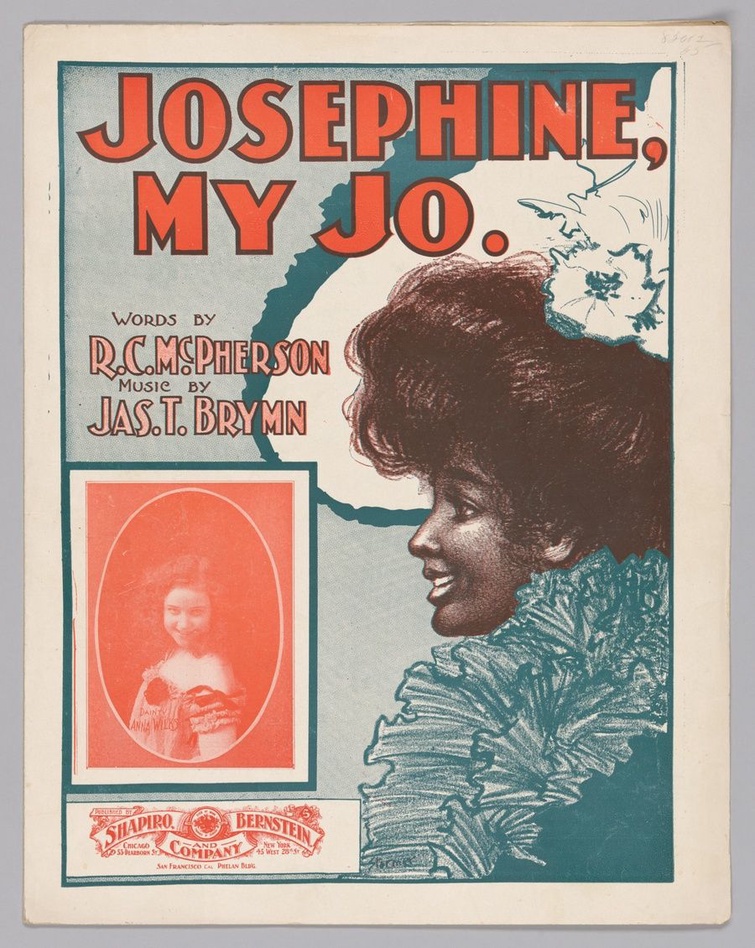
James T. Brymn, “Josephine, My Jo,” 1901. National Museum of African American History and Culture, Smithsonian Institution. CC0.
Minstrelsy was among the first homegrown American art forms. Both white and Black musicians wrote minstrel music. The lyrics of these songs reveal the ways in which race, and anti-Black racism, informed a writer’s personal and professional life.
Before Emancipation, enslaved African Americans would perform “cakewalks”—exaggerated parades that poked fun at white formality.1 The white enslavers didn’t get the joke. Instead, they saw the cakewalk as a sincere representation of African American culture, and therefore something to be demeaned. Eventually, the cakewalk became a part of minstrel canon.2
Blackface minstrelsy is a distinctly American art form in which mostly (but not exclusively) white actors presented allegedly comedic theater featuring Black characters.3 Regardless of their race, actors typically darkened their faces with burned cork or shoe polish before stepping on stage. Minstrel shows were performed as early as the late 1820s and continued well into the 20th century.4 5
Many white people, audience members and performers alike, believed that minstrel shows portrayed African Americans in an authentic way.6 In reality, these theatrical productions were filled with racist stereotypes that claimed that Black people were “lazy, ignorant, superstitious, hypersexual, and prone to thievery and cowardice.”7
Prior to the American Civil War (1861–1865), almost everyone who wrote or appeared in a minstrel show was white.8 This near-total homogeneity changed with the ratification of the 13th Amendment in 1865, which abolished chattel slavery.9 10 After this point, Black entertainers began making significant contributions to the art form, both as performers and as writers.
Just as the cakewalk meant something different to white minstrel actors than to the African Americans they imitated, Black and white musicians had different approaches to writing minstrel music. These differing modes stemmed, in large part, from the social consequences of these musicians’ respective races, ethnicities, and economic classes. These nuanced relationships led writers toward lyrics which variously doubled down on anti-Black notions, passively reaffirmed the status quo, or actively pushed back against racist narratives.
Leaning In
The most derogatory minstrel songs were often the most popular. As a result, musicians of all races knew they might make more money if they leaned into racial stereotypes. This can certainly be said of “coon songs”—a subgenre of ragtime music that peaked in popularity during the 1890s.11 Coon songs were especially replete with racial slurs and stereotypes, and were typically written and performed in an exaggerated “Negro” dialect.12
“Take Your Clothes and Go” (1897) is an example of such a song. It depicts a severe falling out between an overbearing wife and a lazy husband, both common anti-Black tropes. The song also perpetuates the colorist stereotypes of light-skinned women and dark-skinned men, and freely uses racial slurs. It was written by a Black man named Irving Jones.
Jones was among a number of Black composers who found professional success by authoring these particularly disparaging songs. This list includes James A. Bland, who has been referred to as “The World’s Greatest Minstrel Man,”13 and Ernest Hogan, who wrote the 1896 smash hit “All Coons Look Alike to Me”14—widely considered the most popular “coon song” in history.
It may seem counterintuitive that a Black person would write a song that insulted African Americans so directly. However, Black entertainers were underpaid compared to their white counterparts.15 They would have been especially incentivized to write the most commercially viable version of a minstrel song.
Though these songs enriched their Black writers financially, they cost them in other ways. Hogan’s “All Coons Look Alike to Me” inspired dozens of racist copycats,16 elevated the racial slur in its title to catchphrase status,17 and angered an unknowable number of Black people.18 19 By the end of his life, he regretted having written his most lucrative composition.20
Building Out
While some Black lyricists directly engaged with the racial dynamics of minstrelsy, some white minstrel artists used the form’s anti-Black foundation as the platform on which to explore other ideas. One example of this is J. Brandon Walsh and Ernest Breuer’s 1914 song “When the War Breaks Out in Mexico I’m Going to Go to Montreal.”
J. Brandon Walsh and Ernest Breuer, “When the War Breaks Out in Mexico I’m Going to Go to Montreal,” 1914. Smithsonian National Museum of African American History and Culture, Gift of Sylvia Alden Roberts, public domain. This sheet music cover depicts a caricature of an African American man running in the direction of Montreal, Canada, as well as a photograph of Sophie Tucker, a popular entertainer who performed in blackface during the early parts of her career.
Even though the sheet music’s cover states that it was “written for laughing purposes only,” the work levels a serious critique against United States foreign policy—specifically, the U.S. occupation of Veracruz, Mexico in 1914. The song’s protagonist must leave “Miss Vera Cruz” to her own devices, as he “couldn’t go to any war with just one pair of shoes.” He even makes an ironic callback to “Break the News to Mother,” a war song that was popular during the Spanish-American War of 1898.21 These witticisms as criticisms echo the feelings of many Americans at the time: they felt that the U.S. had no business involving itself in Mexico’s affairs.22
If not for the cover’s caricature of a Black man, “When the War Breaks Out” may not have been categorized as a minstrel song at all. Its lyrics do not include any racial stereotypes, nor do they imply the speaker’s race. One explanation for this cover, given the song’s content, lies in the nature of blackface itself.
The blackface mask, while debasing to Black people, could be “liberating” to white people.23 Because Black people were already excluded from mainstream society, the Black characters in minstrel shows could behave in ways that contradicted white norms without risking their social status. In other words, the writers of minstrel music could inhabit the world of plausible deniability. If someone were to question the song’s criticism of U.S. intervention in Mexico, Walsh could pin the protagonist’s unwillingness to fight on the supposed spinelessness of Black people rather than on the faultiness of President Woodrow Wilson’s decision-making.
The use of blackface as a mask extended to the critique of classism within American borders. Minstrelsy emerged as a form of working-class entertainment,24 and its earliest versions forefronted “rascality”—a kind of self-possessed masculinity, innovated by Black rivermen, that defied social elites.25
Even though the white working class used blackface minstrelsy to process their economic exploitation, minstrelsy did not necessarily engender empathy for or solidarity with African American people. This is evidenced by Black people’s persistently negative representation in the art form. Instead, the 19th century saw the emergence of the concept of “white slavery” or “slavery of wages,” which drew a clear dividing line between Black and white workers, while also conflating white men’s economic mistreatment with the much more comprehensive subjugation that was chattel slavery.26 27 This ideological two-sidedness helps to explain why Black people did not play any significant role in minstrelsy until after the Civil War: the working man was tacitly white.28
Or, if not white, then perhaps working to become so. For ethnic and religious minorities, minstrelsy was a way to Americanize. By putting on blackface, Catholic, Jewish, and Irish Americans were all able to access whiteness more easily.29 30 31 Some scholars have argued that de-othering wasn’t always the goal, and that white ethnic participation in minstrelsy was also an attempt to identify with African Americans.32 33 Even so, any such attempt was compromised by minstrelsy’s inherently racist nature.
Changing the Rules
As the era of minstrelsy wore on, the medium’s broad stereotypes coalesced into specific characters. The earliest archetype was Jim Crow,34 an enslaved man who epitomized ignorance and slothfulness and eventually loaned his name to the cadre of laws that enforced racial segregation in the post-Reconstruction South.35 Subsequent characters included the Zip Coon, a free man who tried and failed to be sophisticated;36 Uncle Tom and Aunt Jemima, both content to live in service to white people;37 38 39 the Sapphire, the loud and overbearing Black woman;40 and the Buck and the Jezebel, who each possessed insatiable sexual appetites.41
“Jessamine” (1906) and “Josephine, My Jo” (1901) are two minstrel songs that directly address the Jezebel trope, albeit in different ways.
The difference in approach is evident from the cover pages. While each cover features a benign illustration of a Black woman, the cover for the white-authored “Jessamine” also features a photograph of a popular performer in blackface. In contrast, the Black-authored “Josephine, My Jo,” features a photograph of a performer out of costume. By choosing not to disseminate minstrel imagery on its cover, “Josephine, My Jo” foreshadows that its content is subversive in a way that “Jessamine” is not.
Indeed, the lyrics of “Jessamine,” written by Albert Gumble, confirm the archetype of an oversexed Black woman. The titular character claims, “where there’s loving why there’s kissing.” The male protagonist then abandons his work to fool around with Jessamine, potentially “all day long.”
Meanwhile, “Josephine, My Jo” is far more romantic. Lyricist Richard Cecil McPherson, better known as Cecil Mack, describes Josephine’s voice as “sounding sweet on the breeze.” And, unlike in “Jessamine,” the banter between the characters in this song does not center on sexual activity. The overall sense is that this tryst is driven by sincere love rather than the exaggerated lust common in the genre.
Refusing to propagate stereotypes outright was one way that Black musicians undermined minstrel convention; another was the use of parody—the deployment of another’s language (such as the racist language common in minstrelsy) with “an intention which is directly opposed to the original one.”42 43 Through rhetorical sleights of hand, Black entertainers were able to write and perform songs that affirmed the stereotypical views of white audiences while undermining those stereotypes for Black audiences.44
One plausible example of this is “He’s Up Against the Real Thing Now” (1898), written by Edward Furber, composed by Bert Williams, and performed by Williams and George Walker. Each verse describes a different villain, including a domineering Sapphire and Satan himself, and concludes that the song’s protagonist is “up against the real thing now.” The song recites many familiar anti-Black tropes: lasciviousness, slothfulness, a penchant for slinging razor blades. But it also takes on a double meaning in the context of Williams’s and Walker’s careers.
Edward Furber and Bert Williams, “He’s Up Against the Real Thing Now,” 1898. The New York Public Library, public domain. This sheet music cover features three images: headshots of Bert Williams and George Walker, and a photograph of the two of them together, in costume as their minstrel act “Williams and Walker.” Notably, the pair subverted minstrel tropes by having the lighter-skinned Williams don blackface and portray the comic characters, while the darker-skinned Walker played the straight man, sans blackface.
Williams and Walker were one of the most popular minstrel acts of their time, in spite of the broadly racist treatment directed towards Black entertainers45 and the particular targets on their backs as well-known “disruptors of the social order.”46 Importantly, their Blackness was central to their act; they even dubbed themselves the “Two Real Coons” to separate themselves from a mostly white field.47
In this light, the tagline at the top of the sheet music cover tells one truth and obscures another. Yes, this song, dubbed “Williams and Walker’s Latest Comic Coon Craze,” would satisfy an audience’s desire to see an underarticulated, knife-wielding Black male character, but it could just as well serve as a fully realized critique of the minstrel industry. In the decades following Emancipation, this genre, which had attempted to claim expertise over Black culture, was now forced to make space for actual Black people—some of whom became the industry’s biggest stars. White minstrels were up against the real thing now.
It’s not clear if these subversions effected the change that these entertainers might have hoped to see. For one, the satire may have been too subtle to influence white audiences, as argued by Colin L. Anderson with respect to James A. Bland’s “Carry Me Back to Old Virginny.”48 More cynically, Black entertainers may have lent credibility to minstrelsy’s racism by performing in minstrel shows at all—regardless of their personal acts of resistance.49 50
Open Questions
The one-act Clorindy, or The Origin of the Cake Walk opened in July 1898. The New York Dramatic Mirror, a theatrical trade newspaper, reported that while Clorindy’s songs “were of the coon song order, the musical as a whole was of a much higher class than the average ragtime ditty, and the orchestration was full of effects seldom heard outside of grand opera.”51
As the first all-Black musical in a Broadway house (technically, on one, in the rooftop garden), Clorindy inaugurated over a century of popular Black shows, including Tony Award-winning hits such as Dreamgirls (1981), The Color Purple (2005), and Passing Strange (2006).
But it’s not just Black works. Whether we consciously acknowledge it or not, all American theatermakers sing and dance on the bones of the minstrel show. Sometimes, creatives purposefully engage with this history, as did Jackie Sibblies Drury with her Pulitzer Prize-winning play Fairview (2018), or John Kander, Fred Ebb, and David Thompson with their Lucille Lortel Award-winning musical The Scottsboro Boys (2010).
Other times, a piece’s creators don’t fully realize the connection, and audience members are left to identify the parallels with minstrelsy in critical reviews. This has been the case with The Book of Mormon (2011),52 53 the tenth-longest-running Broadway show of all time.54
Theater artists in the U.S. might avoid carelessly invoking minstrelsy’s specter by asking questions that minstrel entertainers, especially Black ones, likely asked themselves. What systems am I aligning myself with in the making of my art? To what extent can I avoid making stereotypical art, and instead create work that transposes Black folks’ real-life multiplicity onto the stage? Is it even possible to make art that’s subversive—or simply worth making—inside fundamentally flawed industries? And if not, what should I do instead?
These are open questions, as much a part of America’s artistic legacy as burned cork and shoe polish.
Ekemini Ekpo is a writer from the American and Nigerian Souths. She writes most frequently about arts, culture, and the built environment. Her byline can be found in The Brooklyn Rail, The New York Review of Architecture, The Architect’s Newspaper, Urban Omnibus, 3Views on Theater, and elsewhere.
Citations
Sussman, Rachel. “The Carnavalizing of Race.” Etnofoor, vol. 14, no. 2, 2001, pp. 81–83. JSTOR, http://www.jstor.org/stable/25758014. Accessed 14 July 2026.
Gandhi, Lakshmi. “The Extraordinary Story Of Why A ‘Cakewalk’ Wasn’t Always Easy.” Code Switch, 23 December 2013, http://www.npr.org/sections/codeswitch/2013/12/23/256566647/the-extraordinary-story-of-why-a-cakewalk-wasnt-always-easy. Accessed 7 July 2026.
Hughes, Richard L. “Minstrel Music: The Sounds and Images of Race in Antebellum America.” The History Teacher, vol. 40, no. 1, 2006, pp. 27–29. JSTOR, http://www.doi.org/10.2307/30036937.
Dormon, James H. “Shaping the Popular Image of Post-Reconstruction American Blacks: The ‘Coon Song’ Phenomenon of the Gilded Age.” American Quarterly, vol. 40, no. 4, 1988, p. 451. JSTOR, http://www.doi.org/10.2307/2712997.
Toll, Robert C. “From Folktype to Stereotype: Images of Slaves in Antebellum Minstrelsy.” Journal of the Folklore Institute, vol. 8, no. 1, 1971, pp. 38–47. JSTOR, http://www.doi.org/10.2307/3814062.
Hughes.
“Blackface: The Birth of An American Stereotype.” National Museum of African American History and Culture, http://nmaahc.si.edu/explore/stories/blackface-birth-american-stereotype. Accessed 14 July 2026.
Jones, Douglas A. “Black Politics but Not Black People: Rethinking the Social and ‘Racial’ History of Early Minstrelsy.” TDR, vol. 57, no. 2, 2013, p. 23. JSTOR, http://www.jstor.org/stable/24584792. Accessed 14 July 2026.
Walsh, Colleen. “Unmasking Minstrelsy.” Harvard Gazette, 12 February 2015, http://news.harvard.edu/gazette/story/2015/02/unmasking-minstrelsy/. Accessed 14 July 2026.
Significantly, the 13th Amendment includes an exception that allows for slavery “as a punishment for crime whereof the party shall have been duly convicted” and has allowed for slavery-like working conditions for incarcerated people that persist into present day. See: “13th Amendment to the U.S. Constitution Is Passed,” National Museum of African American History and Culture, http://nmaahc.si.edu/explore/stories/13th-amendment-us-constitution-passed. Accessed 13 September 2026. See also: Selby, Daniele. “How the 13th Amendment Kept Slavery Alive: Perspectives From the Prison Where Slavery Never Ended.” Innocence Project, 17 September 2021, http://www.innocenceproject.org/news/how-the-13th-amendment-kept-slavery-alive-perspectives-from-the-prison-where-slavery-never-ended/. Accessed 13 September 2026.
Salem, James M. “African American Songwriters and Performers in the Coon Song Era: Black Innovation and American Popular Music.” The Columbia Journal of American Studies, http://www.columbia.edu/cu/cjas/salem1.html. Accessed 14 July 2026.
Abbott, Lynn, and Doug Seroff. Ragged but Right: Black Traveling Shows, “Coon Songs,” and the Dark Pathway to Blues and Jazz. University Press of Mississippi, 2007, p. 11. Project MUSE, http://muse.jhu.edu/pub/201/monograph/book/9959.
Walsh.
Lemons, J. Stanley. “Black Stereotypes as Reflected in Popular Culture, 1880–1920.” American Quarterly, vol. 29, no. 1, 1977, pp. 105–07. JSTOR, http://www.doi.org/10.2307/2712263.
Toll, Robert C. “Black Men Take the Stage.” Blacking Up: The Minstrel Show in Nineteenth Century America, New York : Oxford University Press, 1974, pp. 219–25. Internet Archive, http://www.archive.org/details/blackingupminstr00toll.
Woll, Allen. Black Musical Theatre: From Coontown to Dreamgirls. Baton Rouge : Louisiana State University Press, 1989, p. 2. Internet Archive, http://www.archive.org/details/blackmusicalthea00woll.
Woll, p. 2.
Lemons, p. 107.
Dormon, p. 470.
Lemons, p. 107.
Brooks, William. “The Rehearsal.” American Music, vol. 34, no. 4, 2016, p. 510. JSTOR, http://www.doi.org/10.5406/americanmusic.34.4.0507.
“From Woodrow Wilson’s Inauguration to the Invasion of Veracruz - The Mexican Revolution and the United States | Exhibitions - Library of Congress.” Library of Congress, http://www.loc.gov/exhibits/mexican-revolution-and-the-united-states/wilson-to-veracruz.html#obj016. Accessed 6 August 2026.
Sussman, p. 83.
Roediger, David R. “Class, Coons and Crowds in Antebellum America.” The Wages of Whiteness: Race and the Making of the American Working Class. Verso, 1991, pp. 95–111. Internet Archive, http://www.archive.org/details/wagesofwhiteness00roed.
Jones, pp. 23–25.
Roediger, pp. 65–87.
Jones, pp. 28–29.
Jones, p. 23.
Rogin, Michael. “Blackface, White Noise: The Jewish Jazz Singer Finds His Voice.” Critical Inquiry, vol. 18, no. 3, 1992, pp. 440. JSTOR, http://www.jstor.org/stable/1343811.
Blake, George K. “A Strictly American Institution: Neil O’Brien, Blackface Minstrelsy, and the Invention of White Catholic Identity.” Popular Music, vol. 38, no. 3, 2019, pp. 379–98. JSTOR, http://www.jstor.org/stable/26861851. Accessed 14 July 2026.
Nowatzki, Robert. “Paddy Jumps Jim Crow: Irish-Americans and Blackface Minstrelsy.” Éire-Ireland, vol. 41, no. 3, 2006, pp. 162–84. Project MUSE, http://muse.jhu.edu/pub/41/article/207996. Accessed 21 July 2026.
Brenner, Lisa Silberman. “Blackface as Religious Expression.” CrossCurrents, vol. 53, no. 3, 2003, pp. 458–60. JSTOR, http://www.jstor.org/stable/24460867. Accessed 14 September 2026.
Alexander, Michael. “Al Jolson.” Jazz Age Jews, Princeton University Press, 2018, pp. 136–38. Project MUSE, http://muse.jhu.edu/pub/267/monograph/book/61147.
Dormon, p. 451.
Dormon, p. 464.
Lemons, p. 102.
Lemons.
Manring, Maurice M. “Aunt Jemima Explained: The Old South, the Absent Mistress, and the Slave in a Box.” Southern Cultures, vol. 2, no. 1, 1995, pp. 20–22. Project MUSE, http://muse.jhu.edu/pub/12/article/423704. Accessed 8 August 2026.
“Popular and Pervasive Stereotypes of African Americans.” National Museum of African American History and Culture, http://nmaahc.si.edu/explore/stories/popular-and-pervasive-stereotypes-african-americans. Accessed 8 August 2026.
Churcher, Kalen. “Minstrel Show (Minstrelsy).” EBSCO, 2023, http://www.ebsco.com/research-starters/social-sciences-and-humanities/minstrel-show-minstrelsy. Accessed 7 July 2026.
Churcher.
Krasner, David. “Parody and Double Consciousness in the Language of Early Black Musical Theatre.” African American Review, vol. 29, no. 2, 1995, pp. 317–23. JSTOR, http://www.doi.org/10.2307/3042310.
Bakhtin, Mikhail. "Discourse Typology in Prose." Readings in Russian Poetics: Formalist and Structuralist Views, Ladislav Matejka and Krystyna Pomorska, eds., Cambridge: MIT Press, 1971, p. 185.
Krasner.
Toll, “Black Men Take the Stage,” pp. 219–25.
Halley, Catherine. “When Black Celebrities Wore Blackface.” JSTOR Daily, 12 August 2020, http://daily.jstor.org/when-black-celebrities-wore-blackface/. Accessed 14 July 2026.
Halley.
Anderson, Colin L. “Segregation, Popular Culture, and the Southern Pastoral: The Spatial and Racial Politics of American Sheet Music, 1870–1900.” The Journal of Southern History, vol. 85, no. 3, 2019, pp. 592–593. JSTOR, http://www.jstor.org/stable/26754967. Accessed 14 July 2026.
Bloomquist, Jennifer. “The Minstrel Legacy: African American English and the Historical Construction of ‘Black’ Identities in Entertainment.” Journal of African American Studies, vol. 19, no. 4, 2015, p. 414. JSTOR, http://www.jstor.org/stable/44508238. Accessed 14 July 2026.
Toll, “Black Men Take the Stage,” pp. 195–196.
Carter, Marva Griffin. “Removing the ‘Minstrel Mask’ in the Musicals of Will Marion Cook.” The Musical Quarterly, vol. 84, no. 2, 2000, pp. 207–08. JSTOR, http://www.jstor.org/stable/742564. Accessed 7 August 2026.
Alexander, Andrew. “Review: ‘The Book of Mormon’ Picks Low-Hanging Fruit for Basket of Small Expectations.” ARTS ATL, 31 January 2014, http://www.artsatl.org/review-the-book-mormon-picks-low-hanging-fruit-basket-expectations/. Accessed 7 August 2026.
Mueller, Max Perry. “A Cringe-Worthy Depiction of Africa.” Harvard Divinity Bulletin, Summer/Autumn 2012, http://www.bulletin.hds.harvard.edu/a-cringe-worthy-depiction-of-africa/. Accessed 7 August 2026.
Miller, James. “Longest-Running Shows on Broadway.” Playbill, 4 Augst 2026, http://playbill.com/article/long-runs-on-broadway-com-109864. Accessed 7 August 2026.
Ekemini Ekpo is a writer from the American and Nigerian Souths. She writes most frequently about arts, culture, and the built environment. Her byline can be found in The Brooklyn Rail, The New York Review of Architecture, The Architect’s Newspaper, Urban Omnibus, 3Views on Theater, and elsewhere.