On the Sexing of Plants
By Lauren Burns-Coady•August 2025•20 Minute Read
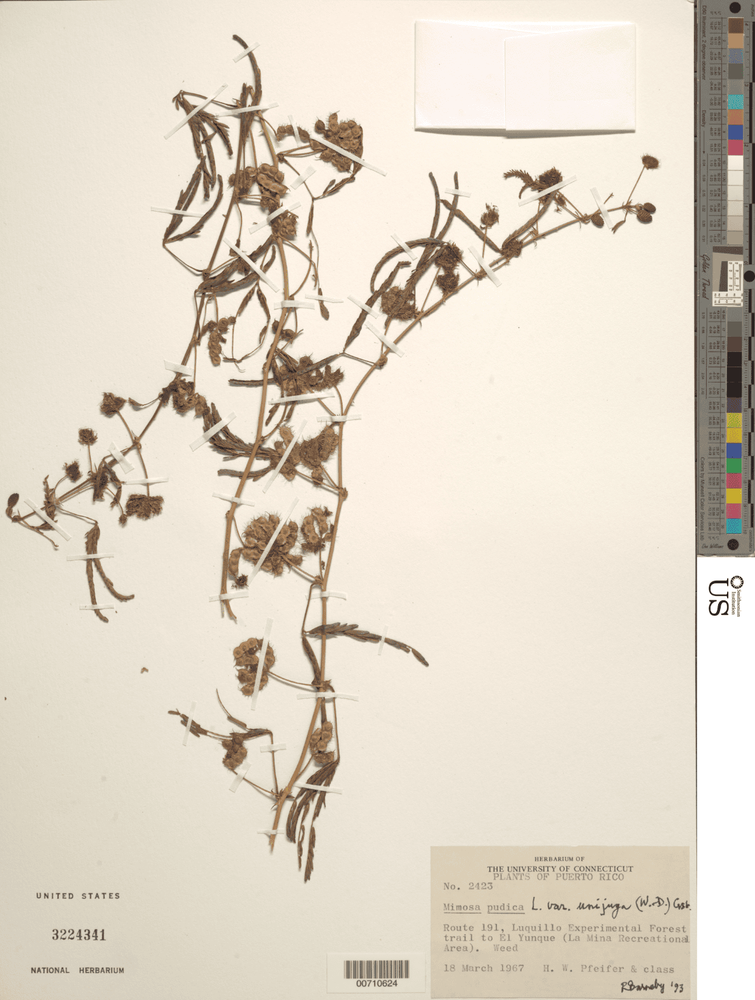
81 - Caribbean, Mimosa pudica L., 18 Mar 1967, Smithsonian Institution. CC0.
The impulse to identify similarity in nature reveals less about nature than about how we attempt to know it, and why.
“In the beginning, the vegetable kingdom was chaos; people everywhere called the same things by a name that made sense to them, not by a name that they arrived at by an objective standard. But who has an interest in an objective standard? Who would need one?” –Jamaica Kincaid, “In History”
The Project of Projecting
Understanding plants is an interpretive endeavor as much as an empirical one. In the 17th and 18th centuries, as botany began to cohere into a formal scientific discipline, an anthropomorphic gaze directed accumulating empirical data into predictably human-coded categories. In a kind of conceptual espalier, analogies and metaphors from human life became the framework along which plant terminology would tend most to grow.
This interpretive guidance was especially evident in efforts to describe vegetal sex and reproduction. Morphological features and apparent behaviors were trained to the existing explanatory structures of human sexuality. Analogy grew into identity. Loaded concepts were projected into a domain of flora unmoved by our social baggage, suffusing the vegetal world with characteristics that weren’t really there.
Familiar binaries such as male/female, self/other, subject/object, and passive/active were extended to unfamiliar aspects of plant life forms. In her 2022 book Vegetal Sex, the philosopher Stella Sandford surveyed the study of plants, tracing contemporary botanical science back to ancient plant philosophy. She examined how the language and logic of plant sexuality came to resemble those used to describe human sex and gender. Her account of what that resemblance obscured or distorted revealed striking epistemic and metaphysical implications. Among the most salient is the recognition that a persistent anthropocentrism, extending from the history of botany into contemporary discourse, continues to shape how plants are understood.
That reflex to overlay human categories onto plant life, a habit of anthropocentric excess, was nowhere more evident than in Carl Linnaeus’s classification of plant sexuality. Linnaeus was an Enlightenment-era naturalist and arguably the most influential figure in the history of botany. He translated floral anatomy into the language (and therefore conceptual region) of heteronormative domestic life, specifically the concept of marriage. Stamens (male) became “husbands,” pistils (female) “wives,” and their shared vegetal structures a “bridal bed.” The result was a florid taxonomy that projected the moral architecture of 18th-century European society onto the reproductive processes of plants. In his description of Polygamia, which are plants with male, female, and hermaphroditic flowers, he wrote that “husbands live with wives and concubines,” further classifying the arrangement as “Superfluous” when the concubines were unnecessary, “Frustraneous” when they were barren, and “Necessary” when the “wives” weren’t fertile but the “concubines” were. Reproductive complexity was dismantled, leveled, and fixed to Linnaeus’s Enlightenment-era conception of human sexual order, which was somewhat limited and confused.1
Since the late 20th century, researchers, environmental ethicists, and advocates for plant life have increasingly sought to challenge the classificatory habits and anthropocentric assumptions that shaped botanical science for centuries. Even as these efforts aimed to correct historical distortions and more fully recognize the astounding capacities of plants, they often fell back on anthropomorphism, too. As Sandford writes, “appreciation of the complexity of plant life rested on it being able to show that plants see, hear, smell, taste, touch, think, are rational, process information cognitively, are conscious, make decisions, and assess future returns on the investment of energy.”2 3 For instance, the phenomenon of volatile organic compound signaling through which plants can chemically respond to herbivory or environmental stress is often described as plants “talking” to one another. Granting plants these intellectual and behavioral attributes fosters a sense of affinity, but it also risks reaffirming various ideological vestiges that shroud what is sui generis about plant life. Extending a gesture of kinship to plants therefore implies a degree of abandonment or erasure of the dynamic, profound, peculiar intricacy of the vegetal realm. “The specificity of plant life is neglected,” Sandford writes, “and the possibility that study of it might give rise to ideas the very terms of which are unfamiliar to us is foreclosed.”4 It’s an injustice to plant life and a hindrance to our epistemic progress.
Each time we default to inadequately examined metaphors, we risk narrowing the scope of inquiry before it has even begun. What might otherwise prompt deeper investigation could, by virtue of being framed in familiar terms, be treated as an outlier or rejected altogether. Plants are not merely symbols of our concepts. What is set aside is not only the possibility of a more attentive account of plants themselves, but the practical consequences that might follow: discoveries with implications for ecological preservation, material culture, and the ways we imagine our place in the living world.
Among the researchers whose work has underscored the stakes of these interpretive habits is Monica Gagliano. Gagliano’s 2014 study, “Experience teaches plants to learn faster and forget slower in environments where it matters,” documented something remarkable about Mimosa pudica’s capacity to adapt to its environment. Mimosa pudica (pictured above), which translates in English to “the bashful mimic,” named by Carl Linneaus, is known by a wide variety of common names in its various regions of indigeneity, such as as moriviví (die-live) in Puerto Rico. It can rapidly close in on itself when touched or disturbed, such as by wind, a movement thought to help deter herbivores and prevent damage.5 Gagliano devised an experiment in which potted Mimosa pudicas were repeatedly dropped a short distance onto a padded platform, a stimulus strong enough to trigger leaf closure but causing no harm. Each plant experienced a series of sixty drops in one session. Many began reducing their response after only five or six drops, and by the end of each session, most had stopped closing their leaves altogether, suggesting they had learned the stimulus did not represent a threat. This change persisted for nearly a month, which Gagliano interpreted as evidence of both learning and memory.
Reading about this study at the time of its publication in 2014 affirmed a curiosity I had been entertaining for a long time. Maybe plants possessed forms of awareness far greater than we previously thought. The idea that they could learn, remember, and forget just like us was alluring, even as I sensed that such provisional terms might be either too much of a reach or ultimately inadequate to describe the magnitude of vegetal life’s capacities. Comparing them to us seemed to beg the question of whether we were overestimating or underestimating them. Gagliano’s work was met with a great deal of skepticism. The field was largely dismissive of her findings, laughing at the very notion in her conclusions and believing she was grossly overstating the meaning of what she saw. As a result, further inquiry into a highly remarkable set of observations was denied and delayed. In the same way we may find Linnaeus’s metaphors laughable by today’s standards, he believed at the time that his comparisons made sense and brought plant reality into closer proximity, without realizing the mistake. But his assertions were widely accepted, and the discipline is still working to correct the distortions they produced. In both cases, the failure to meet plants on their own terms has narrowed what might be known, including the radical distinctiveness of their sexuality and what it could teach us about how we interpret our own. As Sandford reminds us, “Vegetal sex implies no duties, no right or wrong. It has no moral or social implications at all. Vegetal sex just is, without the burden of any ought.”6 If we can suspend our human-centric gaze and attempt to see plant sex for what it is, in itself, we stand to learn a great deal.
Similarity in Difference
If we are to approach plant life on its own terms, we must consider the categories we use, as well as the ways we create, enforce, and rely on them to make sense of the world. Sandford’s handling of this question invites us to reflect on the constitutive categories, such as male/female, self/other, subject/object, passive/active, that form the basis for many other distinctions and what they really offer to our understanding. Among them, the distinction between self and other seems especially relevant here, because it underlies the human relationship to nature that is fundamental to this discussion.
The mimetic faculty, introduced by early 20th-century philosopher Walter Benjamin, demonstrates a human inclination to simultaneously affirm and undermine the line between self and other through our intellectual engagement with nature. Benjamin describes the mimetic faculty as complex, innate human ability to perceive and designate similarity across different forms. Built into that relation is the idea that, by seeing something as other, we are then able to see it as the same. When we engage the mimetic faculty, enacting mimesis, we draw on this faculty to identify likenesses and correspondences that may or may not be causally linked, meaning we both passively observe and actively create similarity.
By comparison, mimicry, a related phenomenon, refers to surface-level resemblance, often observed in flora and fauna. Take the bee orchid, Ophrys apifera, for example: the patterns of color on its labellum precisely resemble the appearance of a female bee, and it emits allomones that match the scent of a bee’s pheromone profile. The interpretive step that often follows from this observation is to invite a teleological explanation: that the flower imitates the bee to attract male pollinators for reproductive success. Though it seems logical, that assumption is wrong. The bee orchid is self-pollinating and doesn’t depend on insect interaction to reproduce. The bee orchid reveals our reflexive interpretation—our readiness to impose narrative and function where we detect resemblance, as if creating another layer of sameness. Mimicry operates at the level of visible form; mimesis and the mimetic faculty, in Benjamin’s sense, implicate deeper subjective and relational affinities. In both cases, the impulse to apprehend our environment means that we tend to see ourselves reflected everywhere.
But only mimesis offers the potential to penetrate deeper into the nature of something. The mimetic faculty allows for expansive, intuitive insights and generative relations to emerge through the recognition of something shared, even if that shared thing is difference itself. It’s not simply the tendency to see ourselves in everything, but the capacity to recognize other beings as having their own perspectives, their own realities—like we do. It reflects a basic cognitive orientation, like theory of mind, that enables us to apprehend difference without subsuming it. Perceiving resemblance can mean recognizing affinities while respecting distinctness without mistaking identity. In this way, mimesis can help resist bias rather than reinforce it. This orientation becomes especially important when considering how plants have been classified through analogy, utility, or visually observable resemblance.
Philosophers have argued that, during the Enlightenment, mimesis was increasingly marginalized in the dominant thought paradigm.7 The methodical detachment of objectivity was considered superior. Subjective interpretation of resemblance was discredited, considered an indication of distortion. Walter Benjamin argues, however, that the mimetic faculty didn’t disappear; it was repressed and relocated and, in some cases, continued to operate underground, unexamined. The rejection of a mimetic praxis was merely in theory. Recall the “bridal bed” of Linnaean botanical reproductive taxonomy designed for an “objective” scientific field: moralized human arrangements ensconced within botanical classification. When the mimetic impulse is denied, it doesn’t go away, it becomes a latent mechanism for distortion. The pioneering botanists who set up the systems still in use today continued to interpret the natural world through comparison, but with no acknowledgment that, in doing so, they undermined the very objectivity that their broader field pedestaled.
In disavowing mimesis as a legitimate mode of thought, Enlightenment science relinquished an integral aspect of discerning between projection and perception. There is a paradox at the heart of this disavowal. A science that aimed to transcend subjectivity proliferated unchecked analogies and cast anthropocentric bias as empirical truth. Enlightenment botanists did not escape subjectivity by rejecting mimesis; they simply forfeited the means to interrogate their object fully. The resulting discrepancy seems like a problem of mimicry: surface-level resemblance misinterpreted as deeper truth, unexamined and unaccountable, with a cascade of projections disguised as objectivity leading to a crisis of credibility.
Plant Reality
The aforementioned confusion has consequences that ripple through the scientific record and linger in our everyday language. The lexicon we use to describe plants is laden with residue from an outmoded conceptual paradigm and fails to accommodate the truth of the lives it presumes to describe. Sandford argues that plant reproduction is more varied and complex than conventional categories allow, so much so that it fundamentally destabilizes them. Many plants reproduce without fertilization, through fragmentation—as seen in Bryophyllum (leaf of life), which produces new plantlets along its leaf margins; or apomixis, as in Taraxacum officinale (common dandelion), which can generate viable seeds without pollination. Others change sex over time, like Arisaema triphyllum (Jack-in-the-pulpit), which may shift from male to female depending on age and environmental conditions. Lythrum salicaria (purple loosestrife) exhibits multiple reproductive strategies simultaneously.8 Because these characteristics defied the classificatory frameworks of Enlightenment botany, they were often described as “irregular,” “imperfect,” “anomalous,” or even “monstrous”—labels that cast what was simply another form as somehow defective.
These misunderstood reproductive phenomena challenge the binary of male and female, and with it, the deeper assumptions that underlie such stark distinctions: that biological sex is always stable, that it aligns with fixed functions, and that identity can be read from form. For centuries, plants were conscripted into conceptual architectures—natural theology’s orderly creation, Linnaean taxonomy’s sexual essentialism, Enlightenment rationalism’s demand for clear oppositions—that sought to organize all life into coherent hierarchies. When those categories fail to hold, the structures they support begin to crack as well. But, without using the language of subversion or resistance, Sandford reminds us that plants are not actively defying our comprehension; they just are. The onus is on us to give up the insistence on tying plant existence to a structure that is not, and never was, adequately accommodating or attentive.
Recognizing plants as radically other while also acknowledging our shared conditions is not simply a problem of classification; it echoes in philosophical debates about how to approach plant life on the ground of its own reality. The French agriculturalist Jacques Tassin, for instance, has called for the recognition of plants in their “full alterity”—to refuse to project human characteristics onto them, and instead to accept their radical unknowability.9 However, as Sandford notes, this gesture toward alterity can reinscribe another form of anthropocentrism: the belief that we can never truly know anything but ourselves. Drawing on the work of Brazilian anthropologist Eduardo Viveiros de Castro, she wonders whether it is “possible that, beyond the choice between traditional anthropomorphism and absolute alterity, something of the structure of perspectivist anthropomorphism might open a new path for plant philosophy.”10
Sandford recognizes a fresh conceptual opening in Viveiros de Castro’s theory, a way to rethink how life forms are positioned within systems of knowledge. Viveiros de Castro provides a compelling alternative to dominant Western models of knowledge and classification. In his influential book Cannibal Metaphysics,11 he outlines the concept of Amerindian12 perspectivism: a theoretical model derived from cosmologies held across multiple Indigenous communities throughout Amazonia. The central claim of Amerdindian perspectivism is that reality itself is multiple, each iteration shaped by the position and embodiment of its inhabitants. All beings are understood to possess a perspective, a kind of interiority, such that each experiences its own world. What counts as a being is therefore contextual and contingent upon the relations in which it’s entangled, the perspectives that recognize it, and the cosmological framework that gives it legibility. A being takes shape through how it’s encountered, engaged, and made intelligible within a given world. In other words, beinghood arises through relation.
In this view, the nature of a thing is inseparable from the conditions in which it lives and is perceived by all entities, not just humans. What something is can’t be abstracted from how it exists in the world. By contrast, the objective standpoint of scientific classification often depends on precisely this kind of abstraction: isolating traits from context, stabilizing meaning through detachment, and subordinating complexity to legibility.
While Amerindian perspectivism focuses on animals and spirits—beings culturally understood to see the world as subjects—its logic can be carefully extended to the vegetal domain. Sandford’s work takes up this possibility, exploring how plants expose the premises that overdetermine and delimit which entities can be recognized as having a perspective at all. She is not arguing that plants have perspectives in the same way animals or humans do. Her point is more structural: it is about how our conceptual systems are set up to recognize some forms of life as knowable subjects endowed with interiority, agency, or perspective, while excluding others, like plants, from that status.
By inviting us to inhabit the mode of thinking that Amerindian perspectivism affords, Sandford offers a reorientation of the problem—one that puts pressure on Eurocentric systems of legibility without requiring plants to conform to familiar models of perception or agency. Her analysis opens the possibility of approaching plants in accordance with their own kinds of involvement while acknowledging that they participate in realities we don’t fully understand. Vegetal forms of life very likely operate outside our habitual frameworks for perception and meaning.
The mimetic faculty is recollected by this notion of other realities. It is the capacity to register likeness as an attunement to difference. Just as Viveiros de Castro’s perspectivism recognizes the integrity of different realities without demanding that they conform, the mimetic faculty perceives resemblance as a way of honoring distinction. Both modes invite a kind of relational truthfulness. You, me, and a tree could all be in the same place and still be living in distinct realities. Amerindian perspectivism is about recognizing that cohabitation does not necessitate conformity or alienation. It reminds us that sharing space does not mean experiencing it the same way; it calls for inquiry and observation, not projection or assumption.
As Sandford frames it, plants exceed our categorical boundaries. The excess is precise, material, and patterned—but it does not lend itself to the forms of intelligibility we have grown used to. It operates through rhythms and relations that unsettle the categories designed to tame it. Classification tends toward stasis, organizing at the cost of obscuring how things hang together.
Attention, Attunement, and Apprehension
By now, it’s clear that classification, though undeniably useful, can obscure as much as it clarifies. It satisfies a longstanding human desire to stabilize knowledge—organize, categorize, contain. But no claim to objectivity can fully suppress mimetic faculty, the capacity and impulse to notice resemblance, to sense kinship across the different things we encounter. These two tendencies can certainly work together, and often do. But when the urge to fix categories based on superficial similarities takes priority and nuance is neglected, the generative possibilities of perception are compromised. The mimetic faculty encourages us to account for the full integrity of the other by following our impulse further into individuality through recognizing that individuality as a shared characteristic.
In Vegetal Sex, Sandford offers a case for doing justice to the complexity of vegetal life by adopting a standpoint more attentive to nuance and idiosyncrasy. She proposes a reorientation away from epistemic rigidity and convenience and toward a more capacious, responsive mode of inquiry. The reorientation would engender a relational form of knowing that expands the potential for apprehending something's total complexity without overly circumscribing it. Albizia julibrissin (Persian silk tree) folds its feathery leaves in each night and opens them up again each morning. _Puya raimondii _(Queen of the Andes) blooms once in a hundred years before collapsing. The giant sequoia, Sequoiadendron giganteum, can live for more than three thousand years and reach a volume of over 52,000 cubic feet, as seen in the General Sherman Tree in California. And then there is Populus tremuloides (quaking aspen), or Pando, the world’s largest tree, a clonal colony spanning over 100 acres, appearing as a forest of 40,000 individual trees, though it’s genetically a single organism. Estimated to be at least 80,000 years old, Pando regenerates underground, sending up new shoots from its root system long after older trunks die. Plant life operates at temporal, spatial, and material magnitudes far beyond human norms, generously pointing us toward more flexible, expansive schemas. If we can resist the urge to submit to an old habit of fixing knowledge in place, we are likely to be rewarded with conceptually rich and inspired new views of our shared world and of ourselves.
Citations
Sandford, Stella. Vegetal Sex: Philosophy of Plants. Bloomsbury Academic, 2022, pp. 90–92.
Sandford, p. 27.
Sandford, p. 21-36.
Sandford, p. 19.
Local and vernacular names for Mimosa pudica are numerous and vary by region. In Puerto Rico, moriviví (“to die and to live”) and morir vivir; in the Dominican Republic, moriviví and dormilona (“the sleepy one”); in Cuba, dormidera (“the sleeper”) and dormilona; in Jamaica, shame old lady, shame lady, and shamey darling; in Barbados, shame lady; in Trinidad and Tobago, ti marie (“little Mary”) and shame bush; in Guyana, sensitive plant and shame plant; in Haiti, dormez-vite (“sleep quickly”) and sensitiva (“sensitive”); in Martinique and Guadeloupe, sensitive, dormante (“sleeping one”), and mimosa pudique (“modest mimosa”); in St. Martin, sensitive and mimosa pudique; in St. Maarten, sensitive plant and shame bush; in St. Barthélemy, sensitive and mimosa pudique; in Belize, sensitive plant and shame bush; in Honduras, Nicaragua, Costa Rica, and Panama, dormilona, moriviví, and sensitiva; and in Venezuela and Colombia, moriviví, dormilona, and sensitiva. For additional documentation of these and other regional names, see the Useful Tropical Plants database, http://tropical.theferns.info/viewtropical.php?id=Mimosa+pudica, and USDA Plants Database, https://plants.usda.gov/home/plantProfile?symbol=MIPU.
Sandford, p. 158.
Adorno, Theodor and Max Horkheimer. Dialectic of Enlightenment: Philosophical Fragments. Edited by Gunzelin Schmid Noerr. Translated by Edmund Jephcott. Stanford, Stanford University Press, 2002.
This information is drawn from Stella Sandford’s discussion of plant reproductive variation in Vegetal Sex, especially chapter 4.
Sandford, p. 36.
Sandford, p. 150.
Castro, Eduardo Viveiros de. Cannibal Metaphysics: For a Post-Structural Anthropology. Translated by Peter Skafish, Univocal, 2014.
The term “Amerindian” is used here in reference to Eduardo Viveiros de Castro’s theoretical formulation “Amerindian perspectivism,” which draws from Indigenous cosmologies in lowland South America. While “Amerindian” is contested and outdated in many contexts, it is retained here for consistency with the name of Castro’s concept.