On Refusing to Be a Monument
By Yasi Alipour•October 2022•9 Minute Read
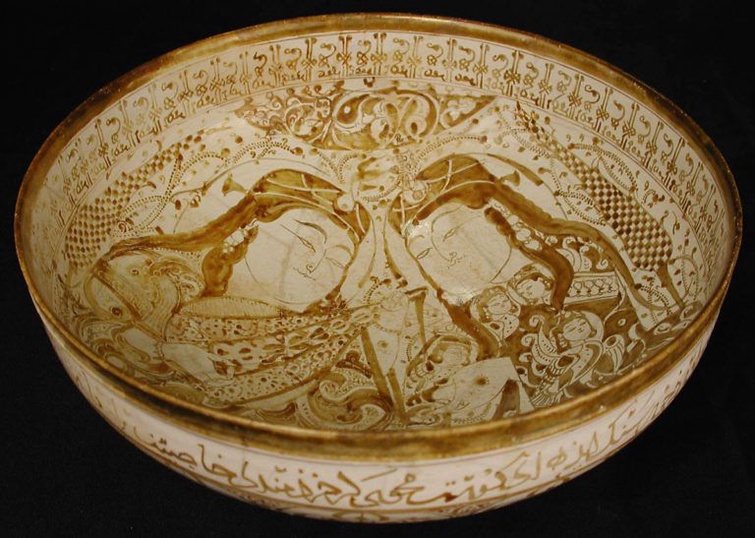
A decorated bowl in the Metropolitan Museum of Art’s collection prompts the author’s reveries about Marzieh, a popular singer silenced by the 1979 Islamic Revolution.
To Pamela Sneed, to be a poet and not fit in language.
This is how stories begin in Farsi:
(not with a once upon a time. We say,)
یکی بود One was
One was not یکی نبود.
Marzieh, the protagonist of our story, was a female singer. Those two words, female and singer, become her signifiers in a history of erasure. As Iran’s 1979 revolution came to fruition, an unwritten but heavily enforced law banned female vocals. This silencing, which continues to this day, is what makes the telling of Marzieh’s story as necessary as it is impossible. Repression is living in contradictions. Welcome. Call it poetry.
Marzieh became a household name in Iran long before all this. She was among a young generation of poets, singers, and musicians who joined forces in 1954 to create Gulha. It became a popular program in the early years of the national radio station, and resulted in one of the most significant archives of Iranian music.1 They brought together the old words, the rural musical traditions, and the new (imported Western) notions of classical music to voice the people’s modern hopes.
Their sound accompanied a period of transition. The old empire of Iran was becoming a nation state disguised by the same name. What followed was to be expected: imperialism from the west and the north, loss of land and resources, the anti-colonial demand for nationalization, the independence uprisings, the political awakening of all who had been oppressed for far too long; even the coup d’etat, even the dictatorships—the Western puppet military regime and the anti-imperialist leftist ones alike. Yet it has never stopped hurting that the revolution the female singers had narrated, sung, and imagined into being celebrated its power by silencing them.
Decades later, I face Marzieh in a video on YouTube. A meager caption is all the context this format offers: “1995 مرضیه کنسرت لندن (Marzieh, London Concert).” To find this video, one must know exactly what to search for. After 16 years of forced silence, Marzieh finally made the decision to leave Iran, to enter “self-imposed” exile. This concert was destined to be a symbolic moment.
“I used to go to the countryside and sing to the mountains,” she said of those years of silence. I find her words in one of the only articles about her life, a New York Times obituary. “I sang for the birds, for the river, the trees and the flowers.”2
The video has 312,000 views, 1.7 thousand likes, 255 comments, and was posted seven years ago. I stare at the video in the chaotic database of YouTube. Marzieh’s voice is my evidence for an unnamable history. She is not archived. This platform holds no ethical obligations when it comes to her. As millions of videos continuously upload and pile up, she waits to be silenced again.
The desire for the archive is literal.
Could I write you a love letter in the form of subtitles for a random film? Can I translate the story just enough so you can see beyond the sexist policies, the repressive laws, even the memories of imprisonment, war, and love under uncertainty? Can I find words that let you see the wind as she takes her next step: defiant, unstoppable, gentle?
I search the (absent) archives
to find you
what made us possible.
I search the (existing) archives.
The desire is urgent. I meet you under globalism where historical context is anything but shared. I desire an archive to hold what was queer, what was femme, what could not be colonized, what was underground, what was ungovernable, what was too slippery to write down, what was our many accents, what was criminal, insignificant, irresponsible…
The keywords mock the desire. A familiar, futile cycle begins: searching with English words, facing the many pages of empty results, returning, optimizing my words, my expectations, return, simplify, always, evermore.
I search for a whole modern nation state: Iran.
This is how I meet the bowl. The Metropolitan Museum of Art names the object “Bowl with Musicians in a Garden” (late 12th to early 13th century, attributed to Iran). Two figures face each other on the interior of the bowl, playing musical instruments. They are surrounded by bird-like figures or perhaps human faces with wings. I am happily lost in the image.
I could write a poem dedicated to all the mountains and rivers you hold inside.
“Checkerboard cypresses, a stylized canopy, and a flying bird on this luster bowl symbolize the garden pavilion where two women play the lute and possibly sing. They sport tattooed hands and wear earrings…”3 The provided information—with confidence in the language of art history and facts—sets the scene. The written words fix the intoxicating figures and their flirtations neatly within the museum’s archive. The bowl becomes MMA 56.185.13.
3½ inches tall, 8⅜ inches across, 16½ ounces in weight. I imagine holding the ceramic in the palm of my hand at a family gathering. In the midst of chitchat at an elder’s home, the bowl is passed around. As it grows empty, the bored child finds the faces, the musical instruments, and the miniature birds.
But all I have are photographs on a screen; the bowl is carefully lit, placed, neutralized, documented. The two musicians sit politely in a vitrine in a corner of the museum. The website provides a map, a link pointing me to the exact location: “Gallery 453: Medieval Iran and Central Asia.” There is a vitrine with dozens and dozens of similar objects. I know this corner. I have passed it many times and never paid any attention.
It takes courage for my imagination to think of the bowl,
outside.
The archive announces.
“Two women play the lute and possibly sing.”
I become hyper aware of the English language’s gender binary. The museum’s discourse draws its faultlines.
The two drawn bodies gaze at one another, within and surrounded by Farsi, a genderless language. My genderless language. The bowl contains its defiance, a silent reminder. There is Farsi script, poetry, wrapping the interior and exterior of the bowl.
I find refuge. These are not the acts of monuments.
After years of silencing Marzieh, the Islamic Republic made her an offer. She could perform for a female-only audience. She refused.
Not long after, she left the country forever.
It’s a song you have never heard,
one you have always known.
It’s a grandmother humming in the other room.
It’s Tehran in the 1990s. You’re a kid in your grandmother’s living room. Light warms the wooden furniture. Your grandmother slowly moves her soft hands on the cherished blue glass vase. She takes a moment to be lost in her thoughts. You stare at the particles of dust dancing in the air. As her hands move, your grandmother whispers a familiar song.
The tune dances around the room. All else is silence. You know the words and hum. You’re too young to need meaning to know a poem. For now, language is only music.
It is one of Marzieh’s songs. You’ve never heard the original. You weren’t yet born when her voice became too distracting for the revolutionaries. It was not enough to silence the singer. Officers hunted down and confiscated all recordings. People hid their cassettes in the ground. It was an act of protection that made the objects impossible to hear. The singer’s voice gradually vanished, nearing silence.
But you know the song as an echo, the voice of a grandmother flirting with old memories.
The grandmother hums, dancing gently in her living room. At this moment, she is the sovereign of this small house.
Draw me a map that can capture this.
I dare you.
What I find on Youtube is the digitization of a VHS made for the diaspora’s library of wounded pride. In 1995, when Marzieh took the stage in London, she found herself surrounded. Behind her stood a full western classical orchestra. Uniformed members of an infamous political party play acted as the audience. What was to be her heroic return had been turned into desperate propaganda.
Marzieh was no longer accompanied by her community of Radio Tehran, when they imagined their history, their listeners, their people into being.
Her mountains no longer held her.
When she finally took the stage, her voice broke. The old love poems had suddenly turned into empty political one-liners. The once improvised music, now orchestrated, stifled the air. Everything had been co-opted. One watches the video to find Marzieh’s voice out of tune, misbehaving, failing, escaping. To hear her, one has to sit with many layers of loss.
But she did take the stage. Marzieh stood tall, firm. Watching her sing, I witness the way my grandmother used to move her lips.
There are traces to be encountered amid archives
of the refusal to be a monument.
It is two bodies, two line drawings, fluid intimacies in customs of femininity.
It is an empty bowl flirting with music.
It is many faces, it is flight.
Citations
Mostyn, Trevor. “Marzieh Obituary.” The Guardian, 12 June 2019, www.theguardian.com/music/2010/oct/19/marzieh-obituary. Accessed 15 June 2022.
Fox, Margalit. “Marzieh, Iranian Singer and Voice of Dissent, Dies at 86.” The New York Times, 16 Oct 2010, www.nytimes.com/2010/10/17/world/middleeast/17marzieh.html. Accessed 15 June 2022.
“Bowl With Musicians in a Garden,” The Metropolitan Museum of Art, https://www.metmuseum.org/art/collection/search/451358. Accessed 15 June 2022.