Nuclear Entanglements: Atomic Imperialism and the Infrastructure of Erasure
By Helen Colton•September 2026•23 Minute Read
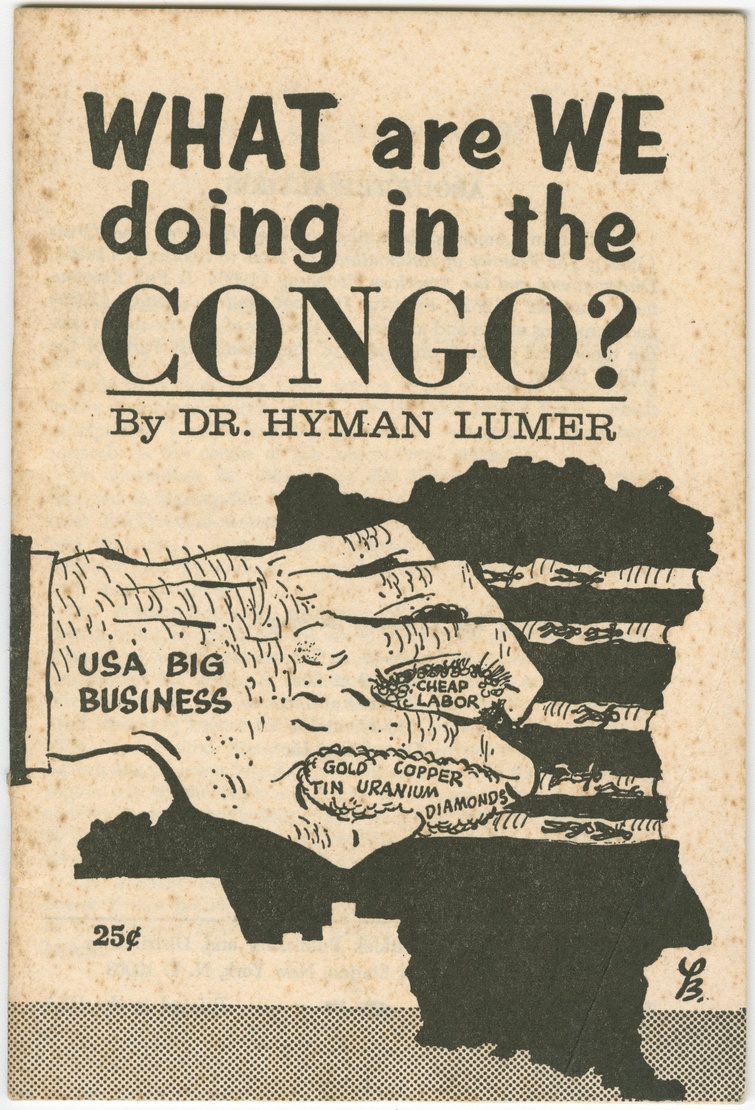
New Outlook Publishers, American, What Are We Doing in the Congo?, 1960s, National Museum of African American History and Culture, Smithsonian Institution. CC0.
The suppressed history of atomic imperialism warrants a closer look at the geopolitics surrounding the Manhattan Project. The overlooked consequences of nuclear weapons development reveal the impacts of uranium mining, exploitative labor, detrimental land use, and radioactive contamination.
The first nuclear bomb was detonated at the Trinity Test Site in the Tularosa Basin of New Mexico on 16 July 1945. This date is written into the historical canon as the dawn of the atomic age. But this timeline omits the large-scale uranium extraction and exploitative Manhattan Project policies that preceded this first atmospheric test. To fully comprehend the nuclear-industrial complex requires an analysis of sociopolitical, environmental, health, and economic factors that have been marginalized or excluded from the public record.
The profound impacts of atomic warfare on civilians and, especially, Indigenous populations were omitted from mainstream narratives. World War II-era atomic imperialism relied on the politics of invisibility to hide the human and ecological toll of nuclear weapons under the guise of protecting national security. Institutionalized secrecy is intertwined with the geopolitics of uranium extraction in the Congo during Belgian colonial rule, and the legacy of environmental racism in the Western United States, where Native American and Hispano communities were disproportionately mistreated in the process of designating territory as “sacrifice zones.”1 Degradation of ancestral lands was considered an acceptable loss in pursuit of the Manhattan Project mission.
The consequences of radioactive contamination, atmospheric testing, uranium extraction, toxic waste disposal, and weapons production are the cumulative effects left in the wake of the Manhattan Project and the ongoing arms race. The 24,000 year half-life of Plutonium-234 radionuclides dispersed after a nuclear explosion leave an indelible mark on humans, animals, plants, earth, water systems, and the environmental record.2
The overlooked narratives of nuclear history are critical to understanding the vast reach of America’s military-industrial complex.
The Advent of Atomic Imperialism
From 1942 to the end of World War II, the U.S. government operated a covert initiative commonly known as the Manhattan Project. Its sole mission was to invent the first nuclear weapon. From the outset, securing a monopoly on uranium resources and keeping the science hidden were of the highest priority.
The only mine in the world that had uranium of the purity essential for making an atomic bomb was in the colony of Belgian Congo.3
Scientific competition and national interests
When German scientists at the Kaiser Wilhelm Institute for Chemistry in Berlin discovered nuclear fission in 1938, the potential use of uranium in an atomic bomb became apparent. On 2 August 1939, after hearing about the discovery, Albert Einstein and Leo Szilard wrote a letter to President Franklin Roosevelt. They informed him that research on nuclear fission using uranium made it probable that large amounts of power could be produced by a chain reaction and that harnessing this power could lead to the invention of "extremely powerful bombs." Einstein believed the German military was dangerously close to developing an atomic weapon and urged the United States government to seek a sufficient supply of uranium ore: “The United States has only very poor ores of uranium in moderate quantities. There is some good ore in Canada and the former Czechoslovakia, while the most important source of uranium is Belgian Congo.”4
Einstein-Roosevelt letter, 1939. Wikimedia Commons, user: Schutz, public domain. The August 2, 1939 letter, drafted by physicist Leó Szilárd and signed by Albert Einstein, warned U.S. President Franklin D. Roosevelt that Nazi Germany could potentially harness uranium to construct an atomic bomb. The letter prompted Roosevelt to launch the nuclear program, which ultimately evolved into the Manhattan Project.
Geopolitics of Uranium Extraction in Africa
Maintaining secrecy ensured that the Manhattan Project retained atomic energy dominance. President Roosevelt assembled the Advisory Committee on Uranium in October of 19405 and officially approved the classified atomic program in 1942, which paved the way for the Manhattan Project.6
Shortly after Nazi occupation of Belgium in 1940, 1,200 tons of the world’s purest uranium ore was covertly shipped to a warehouse in Staten Island, NY, by Edgar Sengier, the director of African Metals Corp., a company owned by the government of Belgium and the commercial arm of Union Minière. Sengier secretly moved the uranium to prevent the stockpile from being seized by Germany, with the foresight that he would be approached by the U.S. military as the war progressed. In September of 1942 Lieutenant Colonel Kenneth Nichols met with Sengier, who granted exclusive access to the NYC uranium stockpile and agreed to transfer an additional 400 tons per month of uranium from the Shinkolobwe mine in the Katanga province to the U.S. military.7
Mining in the Congo
Ultimately the U.S. received 2,792 tons of uranium extracted by Congolese miners, who were subjected to forced labor in the Belgian colony, without any protection from the known risk of radioactive contamination.8 Shinkolobwe was formally erased from maps to protect U.S. national security interests. The mine location and its role as the primary source of uranium for the Manhattan Project was gradually revealed by historians in the late 20th century, after the release of classified government intelligence documents.9
Uranium ore, pre 1940. Smithsonian, National Museum of American History, CC0. Uranium ore from the Shinkolobwe mine in the Congo, Africa, typically yielded up to 65% purity. This sample is historically significant because it is part of the ore reserve secretly sent to New York by mining executive Edgar Sengier and later sold to the U.S. Army's Manhattan Project.
Legacy Contamination in Staten Island
The Manhattan Project name is derived from the New York City location at 270 Broadway, where government offices first managed the monopoly of uranium at the Staten Island warehouse. The site where the warehouse once stood, directly below the Bayonne Bridge, was known to be contaminated as early as 1980, with toxic levels of radiation in the soil confirmed by the Environmental Protection Agency (EPA) in 2008. Now referred to as the Richmond Terrace Radiological Site, the area has been undergoing remediation since 2009 under the Formerly Utilized Sites Remedial Action Program (FUSRAP).10
Project Y Headquarters in New Mexico
From 1942 to 1946 the atomic research and development project was led by the U.S. Army Corps of Engineers, in close collaboration with the United Kingdom and Canada. Nuclear physicist J. Robert Oppenheimer was named the director of Project Y, which evolved into the Los Alamos National Laboratory (LANL), now operating under the U.S. Department of Energy (DOE) in northern New Mexico.11
The Manhattan Project: Domestic Nuclear Colonialism
Nuclear colonialism is a term first coined by environmentalist Winona LaDuke and activist Ward Churchill to describe a system of domination where governments and corporations disproportionately target, exploit, and devastate Indigenous peoples and their lands to maintain the global nuclear production process. This involves uranium mining, weapons testing, and nuclear waste disposal that disproportionately burdens marginalized communities.12
Environmental racism, in part, guided Manhattan Project decisions to designate certain areas as sacrifice zones and people as “negligible.”13 Nuclear sites were established in secret locations to protect national security, impacting vulnerable populations in New Mexico, Washington, and Tennessee. These sites are to this day saddled with radioactive contamination and legacy waste environmental hazards. Indigenous, rural, and working-class communities in these areas have endured the lasting effects of displacement and generational disease.14
Downwinders
Individuals exposed to radioactive contamination or nuclear fallout from atmospheric or underground nuclear weapons testing, and nuclear accidents are known as Downwinders.15 Historical scholarship on environmental racism and nuclear colonialism, highlights the low income, Black, Indigenous, and migrant worker communities, who bear the burden of hazardous nuclear policies. Downwinders face significant long-term health risks, most notably elevated rates of cancer and immune system dysfunction caused by inhaling or ingesting radioactive fallout. The most common illnesses include thyroid cancer, leukemia, and other malignancies.16
Displacement by Eminent Domain
The Pajarito Plateau of Northern New Mexico was chosen in 1942 for the Los Alamos National Laboratory. Hispano settlers were forcibly displaced from their land and Indigenous populations were restricted from their ancestral sites when the U.S. Military enforced eminent domain to claim territory for the Manhattan Project complex. Mexican-American homesteaders and Pueblo communities were subsequently exploited as a disposable blue-collar labor force.17
Los Alamos-Homestead Cabin near Pajarito Site, n.d. From The Manhattan Project, U.S. Department of Energy, public domain. In 1942, the U.S. government seized homesteader properties in the area now known as Los Alamos, NM. This photograph of a log cabin home at the Pajarito Site is located in Technical Area 18 (TA-18), which was used for critical nuclear research during the top-secret Project Y (Manhattan Project).
Manhattan Project expansion also claimed 670 square miles in Richland, Washington, along the Columbia River to establish the Hanford Nuclear Reservation. The Nez Perce, Umatilla, Wanapum, and Yakama tribe evictions forcibly displaced approximately 2,000 people from their homes, agricultural lands, river fisheries, and sacred sites that sustained their cultural traditions.18
Hanford N Reactor, 2008. Wikimedia Commons, user: Cacophony, public domain. Photograph of the N Reactor at the Hanford Nuclear Reservation, Richland, WA., along the Columbia River, which provided an uninterrupted supply of cold water essential for cooling the plutonium production nuclear reactors. The twin KE and KW reactors can be seen in the immediate background, with the B Reactor in the distance. The River Corridor is a designated Superfund site, where contamination is still under remediation.
Sacrifice Zones: Environmental Injustice
In the rush to build the atomic bomb project leaders prioritized wartime production over civilian and environmental safety. Regulations did not exist to properly monitor release of radioactive and chemical waste into local populations and ecosystems.
The early handling and disposal practices for hazardous chemicals and radioactive isotopes led to long-term "legacy contamination." Beginning in 1943, untreated radioactive and toxic liquid wastes were discharged into local waterways. As a result, weapons-grade plutonium and heavy metals persist in areas near LANL, such as Acid Canyon in New Mexico. Pueblo communities, along with Hispano homesteaders, unknowingly absorbed dangerous radioactive byproducts from the air they breathed, the water they drank, and the livestock they consumed.19
Farmers and agricultural laborers downwind from Hanford ingested and inhaled various radioactive isotopes dusted on vegetation. Tribal peoples consumed irradiated fish as well as game. Pregnant women who consumed locally-produced food exposed their unborn babies. Infants and children who drank fresh milk from local cows ingested radioactive iodine, as did families who grew and ate their own vegetables.20 This declassified photograph of a hazard sign on a Hanford Reservation roadway warns government employees of contamination. However, officials did not publicly warn residents living outside of restricted-access areas about radioactive pollution. Downwinder community activism eventually contributed to the U.S. DOE large-scale declassification release program, which began in December 1993.21
A sign at Hanford warning of contamination, n.d. Wikimedia Commons, user: Very Polite Person, public domain. US Department of Energy photograph of a radiological hazard road sign, released by Declassified Document Retrieval System. During the Manhattan Project the Hanford Sign Shop hired journeyman painters to produce employee hazard and radiation exposure warning signage.
Hanford, now a Superfund site, produced the B Reactor, which was the first full-scale plutonium production reactor in the world. Plutonium manufactured from uranium at Hanford was used in the first atomic bomb test at the Trinity Site in New Mexico and the WWII nuclear attacks on Japan. Several severe adverse health effects, such as increased incidence of cancers, thyroid diseases, Central Nervous System (CNS) neoplasms, and female reproductive cancers that can lead to congenital malformations, have been observed in the downwind communities in the Richland, Washington area.22
Trinity Test: The First Atomic Bomb Detonated in New Mexico
Germany surrendered unconditionally to the Allied forces in May of 1945. Despite the end of the war in Europe, the Manhattan Project moved forward with the Trinity atomic bomb test.
Relocation and Agricultural Land Seizure
The Schmidt family was forced to leave the McDonald Ranch, located two miles from ground zero of the Trinity Test site. Their adobe ranch house was converted into a work space to assemble the plutonium core for the bomb.23 The plutonium implosion bomb nicknamed the “Gadget” was detonated on 16 July 1945, in an area of New Mexico also known as the Joranda del Muerto, or Journey of Death, as described by Spanish Conquistadors who originally colonized the region.
Berlyn Brixner, Trinity Test Fireball 16 ms, 1945. Wikimedia Commons, user: Upload Bot (Magnus Manske), public domain. Manhattan Project photograph of the first atomic bomb explosion 0.016 seconds after detonation. On July 16, 1945, the Manhattan Project conducted the Trinity test, 35 miles from Soccoro, New Mexico. Photographer, Berlyn Brixner, documented the 25 kiloton explosion across 50 cameras at varying speeds. The plutonium implosion bomb called Gadget, was the same as the Fat Man bomb later dropped on Nagasaki, Japan.
Legacy of Contamination
The U.S. Military did not warn civilians living near the Trinity site before or after the test, nor were any efforts made to evacuate people at risk of contamination. Post-Trinity Test research determined that fallout from the bomb exposed 500,000 people living within a 150-mile radius to radiation levels up to 10,000 times the normal threshold. The Tularosa Basin, where the bomb was detonated, was home to a largely Hispano population whose agricultural land, drinking water, livestock, and family members were contaminated. The plutonium deposited by the Trinity Test has impaired New Mexico with illness and environmental degradation for generations.24
Suppressing Evidence of Civilian Impact
A mere three weeks after the Trinity Test, the USA launched nuclear attacks on Nagasaki and Hiroshima. The uranium bomb was detonated over Hiroshima on 6 August 1945. The explosion had a yield equal to 15,000 tons of TNT. It razed and burnt around 70 percent of all buildings in the city and caused an estimated 140,000 deaths by the end of 1945. A slightly larger plutonium bomb exploded over Nagasaki three days later, levelling 6.7 square kilometers of the city and killing 74,000 people by the end of 1945.25
Occupation Forces and Censorship
Japan was occupied and administered by the Allies of WWII after surrender in September.26 In the aftermath of the nuclear attacks U.S. authorities suppressed medical case notes, photographic documentation, and physicians' reports. Official U.S. investigations minimized the effects of radiation and kept their findings classified to control the narrative and manage public panic.27
Classified Information Policies
President Harry S. Truman formed the Atomic Bomb Casualty Commission (ABCC) on 26 November 1946 and assembled a group of scientists who agreed to execute a detailed and long-range study of the biological and medical effects of radiation illness. The Commission was tasked with researching the impacts of nuclear contamination on Hiroshima and Nagasaki survivors. However, their mission did not include providing medical care or compensation to the research subjects.28 Photojournalist Carl Mydans documented ABCC activities while serving as head of Time-Life's Tokyo bureau. At the time the magazine published very few of Mydan’s photographs of atomic bomb survivors. It was not until 2014 that the Time & Life Pictures archive posthumously featured the collection in the online article, “After Hiroshima: Portraits of Survivors.”29 Wartime censorship policies demonstrate how information hierarchies misinform and impede public knowledge.
National Archives: A Gateway to Secrecy
Immediately after the attacks, Japanese filmmaker Akira Iwasaki documented much of the immediate devastation affecting Hibakusha, or atomic bomb survivors. However, the U.S. military seized his footage for their own use in a Department of War propaganda film. The majority of Iwasaki’s film reels were determined to be politically damaging to the U.S. and were hidden from view in the National Archives and Records Administration (NARA). Decades later Erik Barnouw used Iwasaki’s confiscated footage in an independent production, Hiroshima Nagasaki August, 1945, released in 1970.30 Barnouw’s documentary ends with the voice of J. Robert Oppenheimer, recorded during a 1965 NBC broadcast, in which he recounts moments following the Trinity Test: "We knew the world would not be the same . . . I remembered the line from the Hindu scripture, the Bhagavad-Gita. Vishnu . . . takes on his multi-armed form and says, 'Now I am become Death, the destroyer of worlds.'"
Shinkolobwe Uranium: WWII Nuclear Supply Chain and Postwar Arms Race
Nearly all of the Congo’s output of uranium was secretly exported by Belgium to the United States. The Manhattan Project would not have been possible without control of the Congo’s uranium, which enabled the U.S. Military to design, test and detonate the first atomic weapons. Shinkolobwe uranium passed through every location along the WWII nuclear fuel chain between Africa, the USA, and Japan. Declassification of early Manhattan Project records and the publication of official histories in the late 1960s revealed that Shinkolobwe produced approximately two-thirds to eighty percent of the raw uranium used for the bombs dropped on Hiroshima and Nagasaki.31
What Are We Doing in the Congo?
In the 1965 pamphlet What Are We Doing in the Congo?, Dr. Hyman Lumer writes: “In their efforts to dominate the Congo mines, the American atomic trusts confront one of the most thoroughgoing monopolies ever established by a colony.” Lumer was a prominent Marxist theoretician, labor organizer, and Educational Director for the Communist Party USA (CPUSA). A dedicated anti-imperialist, he authored key political texts that heavily critiqued Western exploitation in Africa.32 Lumer’s essay interrogates the protracted history of U.S. intervention in the Congo to control uranium resources and prevent the Soviet Union from gaining access to the Shinkolobwe mine. Following independence from Belgium in 1960, Patrice Lumumba became the Congo's first democratically elected Prime Minister. Both the U.S. and Belgium viewed Lumumba as a threat to their interests due to his nationalist policies and perceived sympathies toward the Soviet Union. Both governments were complicit in Lumumba’s assassination in 1961 and the installation of subsequent military dictators who supported U.S. mineral wealth and military interests in the Congo.33
Uranium Monopoly and Growth of Nuclear Arsenal
The Manhattan Project monopoly holdings of Shinkolobwe’s uniquely rich uranium provided fissile material for the plutonium nuclear reactor at the Hanford Site. Plutonium does not occur naturally in significant quantities, and must be manufactured from uranium inside a nuclear reactor. Hanford plutonium was used in the atomic bomb test at the Trinity Site in New Mexico and the “Fat Man” plutonium bomb dropped on Nagasaki. Shinkolobwe ore was also critical to the production of the “Little Boy” uranium bomb detonated over Hiroshima. The United States continued to source and process thousands of tons of Shinkolobwe uranium throughout the 1940s and 1950s to secure a position of nuclear dominance.34 By 1967 the U.S. arsenal reached a peak of 31,255 warheads.35
Atmospheric Tests in the North Pacific Ocean
Between 1946 and 1958, the United States conducted 67 nuclear tests in the Marshall Islands, which they occupied after Japan’s defeat. Prior to these bomb tests, the Marshallese were relocated 125 miles away. They were told use of their atoll for atomic weapons tests would prevent future wars and temporary displacement from their homeland was “for the good of mankind.” Due to contamination, some residents were permanently exiled, while many returned at their own risk. Today the Marshallese face cumulative existential threats of rising sea levels, radiation related cancers, and birth defects.36
In 1950, President Truman relocated the bulk of the nation’s nuclear testing to a more accessible location: the Nevada Test Site.37 The site was the United States' primary location for bomb tests producing less than 1 megaton explosive yields. Westerly winds routinely carried the fallout from atmospheric nuclear tests, increasing rates of cancer in Utah and elsewhere.38
Nevada Proving Grounds
Between 1951-1992 there were 100 atmospheric tests and 828 underground nuclear bomb tests conducted at the Nevada National Security Site (NNSS) in the Southwestern United States. The APPLE II 29-kiloton nuclear test, pictured below, was detonated on 5 May 1955. Part of Operation Teapot, this atmospheric bomb test in the Yucca Flat area was intended to evaluate the effects of a nuclear blast on structures in a mock town known as Doom Town.39
Yucca Flat is among the most irradiated places on earth, having hosted 659 underground nuclear tests between 1951 and 1992. These tests created hundreds of subsidence craters and contaminated over 1.6 trillion gallons of groundwater with radioactive byproducts, which the U.S. DOE is currently managing. Yucca Flat radioactive contamination has severely impacted Western Shoshone and Paiute tribal lands. These tests caused widespread cancer, health issues, water pollution, and destroyed traditional food sources.40
Nuclear Weapons Critique in Media Culture
The immediate post-war period was driven by a tense interplay between national security imperatives. Deterrence, technological superiority, complex moral dilemmas, and the looming threat of nuclear annihilation were at the forefront of geopolitical discourse. In the early months that followed the August bombings of Hiroshima and Nagasaki, the U.S. military sanitized official information released to journalists, especially downplaying the devastating effects of nuclear radiation. Charles Loeb, a well-regarded Black journalist with a medical background, was one of the first American journalists to write a truthful account of radiation effects, published in the Atlanta Daily World, 5 October 1945. Slowly media critiques began to highlight the catastrophic human toll of WWII and enduring ethical implications of the atomic age, attesting to the important role journalists play in challenging misleading narratives.41
The above illustration from a Dutch magazine, created shortly after the Hiroshima and Nagasaki bombings in 1945, emphasizes a "moral" choice facing the victors of WWII. Figures representing the Allies (the U.S., U.K., and USSR) are surrounded on one side by Christian iconography, and on another by gravestones, suggesting the horrific implications of the atomic bomb pictured in the lower right corner. The caption reads: “For he is the one who will save the nations.”
Rube Goldberg, Peace Today, 1947. Wikimedia Commons, user: Toohool, public domain. illustration commenting on the dangers of the atomic bomb. Winner of the 1948 Pulitzer Prize for Editorial Cartooning.
Rube Goldberg’s illustration for The New York Sun, "Peace Today" (22 July 22 1947), commented on the dangers of atomic weapons and the precarious position of world peace. The iconic illustration depicts a family outside their home, perched on top of an atomic bomb teetering on the edge of a cliff. This stark, early anti-nuclear warning won the 1948 Pulitzer Prize for Editorial Cartooning.
Nuclear Memory and the Cost of Complacency
In March of 1948, when the Soviet Union officially withdrew from the Allied Control Council, dissenting views challenging the rationality of nuclear proliferation gained momentum as arguments mounted by scientists, ethicists, and peace activists became more visible in the media.
Decades of Downwinder activism and the gradual declassification of documents, including the release of early Manhattan Project records and the publication of official histories during the period 1962-2013,42 has resulted in more government transparency surrounding early atomic tests, revealing the true scope of civilian radioactive exposure.43
We continue to live with an unprecedented arsenal of atomic weapons, but without the nuclear memory to process the existential threats they pose. Contextualizing previously classified and suppressed atomic histories involves shifting from heroic narratives of technological exceptionalism to a critical examination of the human, environmental, and geopolitical costs of the nuclear age.
Helen Colton is an independent contemporary art curator based in New Mexico. Her research explores art discourse on social repair, environmental justice, and the visual culture of resistance movements. She earned her B.A. in Studio Arts from San Francisco State University and an M.A. in Philosophy, Art, and Social Thought from the European Graduate School.
Citations
Juskus, Ryan. “Sacrifice Zones: A Genealogy and Analysis of an Environmental Justice Concept.” Environmental Humanities, Duke University Press, 1 March 2023, https://doi.org/10.1215/22011919-10216129. Accessed 23 August 2026.
U.S. Arms Control and Disarmament Agency, “Radioactive Fallout,” Worldwide Effects of Nuclear War, 1975, https://www.atomicarchive.com/resources/documents/effects/wenw/chapter-2.html. Accessed 26 May 2026.
Williams, Susan. Spies in the Congo: America’s Atomic Mission in World War II, 2016. Internet Archive, https://archive.org/details/spiesincongoamer0000will/page/n7/mode/2up. Accessed 26 May 2026. Dr. Williams is a leading scholar on America’s Office of Strategic Services (OSS) activity in the Congo and the joint program with the United Kingdom and Canada to develop an atomic weapon. The book details how the OSS (precursor to the CIA) ran covert operations in Africa to secure the Shinkolobwe uranium supply and deny Nazi Germany access to the vital ore.
In a 1947 interview with Newsweek Einstein regretted signing the letter. He stated, "Had I known that the Germans would not succeed in developing an atomic bomb, I would have done nothing.” “Einstein-Szilard Letter.” Atomic Heritage Foundation, ahf.nuclearmuseum.org/ahf/key-documents/einstein-szilard-letter/. Accessed 7 May 2026.
Smyth, Henry DeWolf. “The Official Report on the Development of the Atomic Bomb Under the Auspices of the United States Government,” 1 July 1945, www.atomicarchive.com/resources/documents/smyth-report/smyth_iii.html. Accessed 7 May 2026.
“S-1 Executive Committee.” Wikipedia, https://en.wikipedia.org/wiki/S-1_Executive_Committee. Accessed 7 May 2026.
“Edgar Sengier.” Wikipedia, https://en.wikipedia.org/wiki/Edgar_Sengier. Accessed 14 June 2026.
“Shinkolobwe.” Wikipedia, https://en.wikipedia.org/wiki/Shinkolobwe. Accessed 7 May 2026.
Swain, Frank. “The forgotten mine that built the atomic bomb.” BBC, 4 August 2020, https://www.bbc.com/future/article/20200803-the-forgotten-mine-that-built-the-atomic-bomb. Accessed 26 May 2026.
United States Environmental Protection Agency. “Staten Island Warehouse Site (AKA Richmond Terrace Radiological Site),” 21 February 2008, https://response.epa.gov/site/site_profile.aspx?site_id=3814. Accessed 28 June 2026. See also: US Department of Energy Office of Legacy Management. “Formerly Utilized Sites Remedial Action Program,” October 2024, https://www.energy.gov/lm/articles/lm-fusrap-fact-sheet. Accessed 10 July 2026.
This overview of the period 1939–1947 summarizes significant dates and events referred to throughout this essay. “Timeline of the Manhattan Project.” Wikipedia, https://en.wikipedia.org/wiki/Timeline_of_the_Manhattan_Project. Accessed 14 June 2026.
Churchill, Ward, and LaDuke, Winona. “Native America: the Political Economy of Radioactive Colonialism.” Insurgent Sociologist, vol. 13, no. 3, 1986, pp. 51–78, doi.org/10.1177/089692058601300306. Accessed 1 June 2026.
The Borden sisters recount how their father advocated for the Wanapum community after forcible relocation. Glenna Cole Allee, "Borden Sisters," Hanford Reach, 05:30, https://glennacoleallee.net/artwork/5343378.html. Accessed 23 August 2026.
Bullard RD. “Sacrifice Zones: The Front Lines of Toxic Chemical Exposure in the United States.” Environ Health Perspect, vol. 119, no. 6, June 2011, p. A266, https://pmc.ncbi.nlm.nih.gov/articles/PMC3114843/. Accessed 30 May 2026
“Downwinders.” Wikipedia, https://en.wikipedia.org/wiki/Downwinders. Accessed 12 June 2026.
Mishra, Sylvia and Wardah, Amir. “Racial Inequalities and Nuclear Policy.” Stanley Center for Peace and Security, February 2022, https://stanleycenter.org/wp-content/uploads/2022/02/CRNW-SPC21-AB-2-1-22.pdf. Accessed 12 June 2026.
Gómez, Myrriah. Nuclear Nuevo México: Colonialism and the Effects of the Nuclear Industrial Complex on Nuevomexicanos, 2022, pp. 28–45.
Cannan, S. D. “History of the Plutonium Production Facilities at the Hanford Site Historic District 1943-1990.” Report sponsored by USDOE Office of Environmental Management, Pacific Northwest National Laboratory (U.S.), 14 December 2001, http://digital.library.unt.edu/ark:/67531/metadc737111/. Accessed 8 May 2026.
Spaulding, Dylan K. “Plutonium Pit Production: The Risks and Costs of US Plans to Build New Nuclear Weapons.” Union of Concerned Scientists, May 2025, p. 141, https://www.ucs.org/sites/default/files/2025-05/Plutonium-Pit-Production-report.pdf. Accessed 26 May 2026.
McClure, Elizabeth. “Justice for Downwinder Communities in Washington.” The Equation, 12 April 2025, https://blog.ucs.org/elizabeth-mcclure/justice-for-downwinder-communities-in-washington/. Accessed 26 May 2026.
“Downwinders.” Manhattan Project National Historical Park, https://www.nps.gov/mapr/learn/historyculture/downwinders.htm. Accessed 26 August 2026.
Grossman, Charles M., et al. ”Cancers among Residents Downwind of the Hanford, Washington, Plutonium Production Site.” Archives of Environmental Health, vol. 58, issue 5, 2010, pp. 267–274, https://doi.org/10.3200/AEOH.58.5.267-274. Accessed 8 May 2026.
“Trinity (nuclear test).” Wikipedia, en.wikipedia.org/wiki/Trinity(nucleartest). Accessed 8 May 2026.
Gómez, pp. 88-110.
“Hiroshima and Nagasaki Bombings.” The International Campaign to Abolish Nuclear Weapons, www.icanw.org/hiroshimaandnagasaki_bombings. Accessed 26 May 2026.
“Occupation of Japan.” Wikipedia, https://en.wikipedia.org/wiki/Occupation_of_Japan. Accessed 23 August 2026.
For an exposé on the U.S. government public relations campaign to conceal the true human cost of Hiroshima and Nagasaki by sanitizing media and promoting a narrative of technological triumph, see: “How the Press Reported on the Atomic Bomb.” American Experience, 9 January 2026, https://www.pbs.org/wgbh/americanexperience/features/how-press-reported-atomic-bomb/. Accessed 26 May 2026.
“Atomic Bomb Casualty Commission.” Wikipedia, https://en.wikipedia.org/wiki/Atomic_Bomb_Casualty_Commission. Accessed 22 June 2026.
Cosgrove, Ben. “After Hiroshima: Portraits of Survivors.” Life, 20 March 2014, https://www.life.com/history/hiroshima-portraits-of-survivors/. Accessed 22 June 2026.
Barnouw, Erik. “Iwasaki and the Occupied Screen.” Film History, vol. 2, no. 4, 1988, pp. 337–57. JSTOR, http://www.jstor.org/stable/3815151. Accessed 13 June 2026.
Bele, Jean, “The Legacy of the Involvement of the Democratic Republic of the Congo in the Bombs Dropped on Hiroshima and Nagasaki.” MIT Faculty Newsletter, vol. 33, no 3, January/February 2021, https://fnl.mit.edu/january-february-2021/the-legacy-of-the-involvement-of-the-democratic-republic-of-the-congo-in-the-bombs-dropped-on-hiroshima-and-nagasaki/#identifier_1_1965. Accessed 7 May 2026.
“Hyman Lumer.” People’s World, https://peoplesworld.org/authors/dr-hyman-lumer/. See also: Jewish Affairs, vol. 6, no. 4, July–August 1974, https://partyofcommunistsusa.net/wp-content/uploads/2024/02/JA_JUL_AUG_76_HYMAN_LUMER.pdf. Accessed 12 May 2026.
Owens, Jasmine and Drozdenko, Tara. “An assassination, uranium and the fate of a country.” Beyond Nuclear International, 5 January 2020, https://beyondnuclearinternational.org/2020/01/05/an-assassination-uranium-and-the-fate-of-a-country/. Accessed 13 June 2026.
“The U.S Nuclear Weapons Stockpile.” U.S Department of Energy, www.energy.gov/nnsa/us-nuclear-weapons-stockpile. Accessed 13 May 2026.
Swain, “The Forgotten Mine that Built the Atomic Bomb.”
Barad, Karen. “After the End of the World: Entangled Nuclear Colonialisms, Matters of Force, and the Material Force of Justice.” Theory & Event, vol. 22, no. 3, 2019, pp. 524-550. Reprinted in The Polish Journal of Aesthetics, 58 (3/2020), pp. 85–113, https://pjaesthetics.uj.edu.pl/documents/138618288/146593216/pja-58-5-barad3.pdf/de1ddf29-e374-463e-8153-452bbd6c0c47. Accessed 8 May 2026.
“Our History.” Nevada National Security Site (NNSS), nnss.gov/about-the-nnss/nnss-history/. Accessed 8 May 2026.
“Nevada Test Site.” Wikipedia, https://en.wikipedia.org/wiki/Nevada_Test_Site. Accessed 31 August 2026.
“Operation Teapot.” Wikipedia, https://en.wikipedia.org/wiki/Operation_Teapot. Accessed 7 May 2026.
“Yucca Flat.” Wikipedia, https://en.wikipedia.org/wiki/Yucca_Flat. Accessed 13 May 2026.
“How the Press Reported on the Atomic Bomb.”
“Manhattan Project Historical Ressources.” U.S. Department of Energy, https://www.energy.gov/lm/manhattan-project-historical-resources. Accessed 31 August 2026.
Almalhodaei, Aria. “Opinion: Nuclear Fallout and the Downwinders’ Dilemma.” Undark, 1 August 2019, https://undark.org/2019/08/01/nuclear-testing-downwinders-new-mexico/. Accessed 15 June 2026.
Helen Colton is an independent contemporary art curator based in New Mexico. Her research explores art discourse on social repair, environmental justice, and the visual culture of resistance movements. She earned her B.A. in Studio Arts from San Francisco State University and an M.A. in Philosophy, Art, and Social Thought from the European Graduate School.