Molded Under Pressure: Plywood Furniture and the Continuity of Modernism
By Nanase Shirokawa•December 2025•19 Minute Read
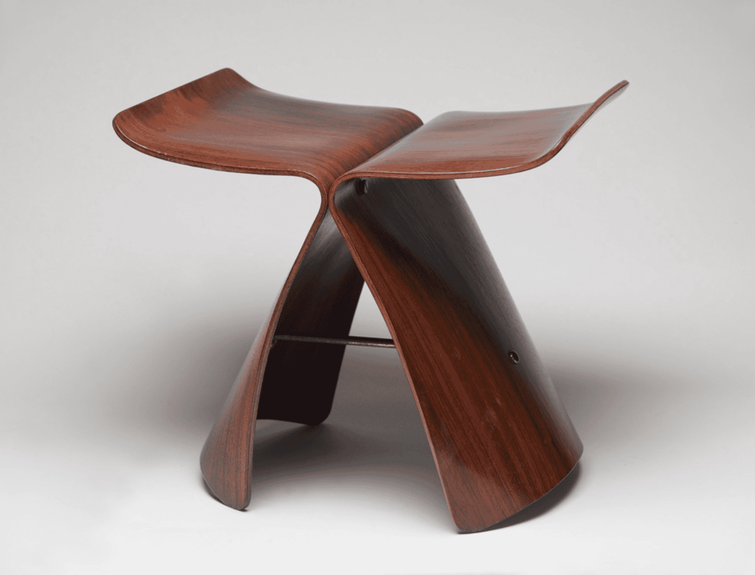
Yanagi Sori, Butterfly Stool, 1954 (designed), Brooklyn Museum. Creative Commons-BY.
Whether raw or worked, wood shapes the spaces we inhabit. Of course, we also shape wood. With water, steam, and pressure, artists and builders have long bent lumber in all manner of directions, expanding the horizon of functional applications and expressions of this common material.
Introduction
The widespread implementation of the steam engine in the 19th century spurred the rapid development of woodbending techniques and motivated furniture designers to innovate fabrication methods that could be scaled for mass production. These developments reached a transformative apex in the mid-20th century, when designers and manufacturers began pioneering methods of molding plywood—a composite product that represents the capacity of modern industrial processes to reconfigure the structural and aesthetic properties of natural materials.
As mediators between bodies and built environments, articles of furniture reveal the cultural, technological, and political ideologies that shape the ways we engage with our surroundings. A close look at molded plywood furniture and its many mutations across the 20th century discloses the complex network of innovation, influence, and power that underlies this deceptively simple product. This history of woodworking also illustrates how the broader trajectory of modernism is not a narrative of rupture and transformation that hinges upon 1945, but one of continuity, threading together the wartime and postwar decades.
Manipulating Wood
While wood bending technologies have been used across cultures for centuries—even dating as far back as ancient Egypt—their application in the furniture industry was largely confined to the domain of skilled makers creating specialized designs.1 Bending wood could help create a sense of lightness, mold to the user’s body, and more efficiently create curvilinear forms that would have otherwise needed to be formed by carving away a larger piece of wood.
American furnituremaker Samuel Gragg integrated these properties into his “elastic chairs,” which were made by individually molding thin strips of wood into curved forms using steam and clamps.2 In the 1808 patent issued for his creation, the chairs are described as having a “very comfortable & agreeable seat” and as “very light, durable (& not) expensive.”3
In the mid-19th century, when Austrian furniture maker Michael Thonet received a patent for his technique of bending solid wood using steam and cast iron rods, the manufacturing of bentwood furniture shifted from painstaking, handcrafted curvatures to standardized, packable parts made on an assembly line.4 Thonet’s simple, sinuous curves and lightweight, easily assembled components anticipated the modernist impulses to privilege efficiency and economy over excess and ornament that would follow in the 20th century.
Similarly, evidence of veneering and cross-grain lamination have been found in ancient Egypt, though the latter remained uncommon in the western world until the 18th century.5 The advent of the rotary cutter in the mid-19th century largely displaced laborious practices of hand-cutting veneer in Europe, making veneers more affordable and more widely used in lower-cost furniture.6 As a result, the material began to be associated with lesser quality furniture, and even deception—hence the vernacular use of the term “veneer” to refer to a superficial facade that masks ill intentions.7
The invention of the hydraulic hot press in 1896 and the development of water-insoluble adhesives enabled manufacturers to create modern plywood—a composite material formed by arranging sheets of veneered wood in alternating grain directions, fused together to create a durable, mass-produced product that can withstand a range of climates.8
Though the groundwork for the innovative bent-plywood designs of 20th-century furniture was in place by this point, plywood manufacturers initially faced challenges when marketing the novel material to woodworkers and furniture companies. Ingrained associations between veneers and low quality were difficult to shake among the furniture making community, and plywood companies instead found markets in shipbuilding, aircraft manufacturing, and construction. The use of plywood in furniture, particularly before World War I, was reserved primarily for concealed areas like cabinet backings and drawer bottoms.9
Early 20th-Century Experiments in Plywood
During the mid-20th century, designers began experimenting with plywood in buildings and furniture, foregrounding the material rather than relegating it to a support role. In the 1930s, Alvar Aalto designed the Paimio Sanatorium, a tuberculosis treatment facility that sought to counter the sterile, rigid nature of traditional medical environments and instead foster recovery through breathable, light-filled spaces and design strategies that foregrounded the patients’ comfort.10 Aalto also developed interior designs and accompanying furniture, including the Model No. 31 armchair, which features a single piece of bent plywood that cascades to form the seat and back, supported on both sides by thinner strips of curved laminated beechwood that act as the armrests and legs.
Alvar Aalto, Model No. 41 “Paimio”, 1931-1932. The Wolfsonian–FIU. A molded plywood lounge chair designed for use at the Paimio Sanatorium, featuring a large single sheet of wood connected to a thin frame of laminated wood loops. The seat is connected to the frame at just four points.

Though initially Aalto experimented with tubular steel like many of his modernist peers, in the late 1920s and 1930s he began to shift increasingly towards using bent plywood for both seats and supports. For Aalto, wood was a “form-inspiring, deeply human material,” whose warmth stood in contrast to the highly reflective, heat-conductive, and acoustically harsh qualities of metal.11 With gently reclining seats and generous apertures for airflow, the plywood armchairs he developed for Paimio reflect his commitment to a more humane language of modernism that responded to the needs of the human body.
Kazam! The Eameses, Molded Plywood, and Wartime Innovation
While Aalto’s bent ply furniture marked a shift towards an increasingly human-centered modernism expressed through organic materials and biomorphic forms, existing technology allowed designers to make bends only along the axis of the plywood sheet. One major challenge remained—how could plywood be carefully molded to sustain both concave and convex curves in different directions, without cracking? The grammar of possible forms remained limited as the escalation of World War II brought furniture manufacturing to an abrupt halt.
Yet this very context of creative limitations and military-industrial production enabled Charles and Ray Eames to radically expand the vocabulary of plywood to include molded forms composed of compound curvatures.
Trained as an architect, Charles Eames had already demonstrated his commitment to pushing the boundaries of plywood manipulation in a successful submission to MoMA’s “Organic Design in Home Furnishings” competition in 1940. Eames, in partnership with fellow architect Eero Saarinen, developed a proposal for a “wood shell” that continuously curved across the back, seat, and arms, cradling the sitter to provide comfort purely through form and materiality rather than any additive upholstery.12 A plan to partner with the plywood manufacturer Haskelite to create a mass-produced model fell through when the U.S. officially entered the war, and Charles retreated to the drawing board with his wife, artist Ray Eames, in their home studio in Los Angeles.
The pair devised a homemade machine dubbed the Kazam!, which used heat and pressure to shape sheets of plywood against curved plaster molds. Though the machine was imperfect and the results inconsistent, an acquaintance brought their DIY project to the attention of the U.S. Navy, which had been struggling to find a more practical alternative to the stiff and weighty metal splints that were being used for injured soldiers.13 The promise of molded plywood alternatives led to a series of contracts that enabled the Eameses to experiment with industrial machinery that would otherwise have been inaccessible to designers. Using Charles’s leg as a model, they developed a plywood splint that was lighter and contoured to better support injured limbs, with open slats that helped prevent cracking during the bending process and also could be used for threading straps to secure the splint.
Charles and Ray Eames, Leg splint, 1941-1942. RISD Museum. A molded plywood leg splint with several openings, developed for injured soldiers during World War II.
The viability of this initial splint quickly prompted the Eameses to scale up their manufacturing. By the end of the war, the Eameses had partnered with a wood products manufacturer and produced around 150,000 splints.14 They also took on additional contracts to produce various aircraft parts.15
These experiences in industrial manufacturing were foundational to the Eameses’ furniture-making practice, which began to formalize in the spring of 1945 as the war drew to a close. Two wood-legged chairs, dubbed the DCW (“Dining Chair Wood”) and LCW (“Lounge Chair Wood”), along with the metal-legged DCW (“Dining Chair Metal”), were among the first pieces of furniture to be scaled up for mass production in 1946.16 All were fashioned with molded plywood seats and backs. Designed to be light, easy to pack and ship, and responsive to the contours of the human body, Eames-designed chairs would become icons of the postwar American home, cast in the universalizing promise that embracing the technological advances of modernity and applying them to solve the crises of an imagined public could lead to a more efficient, rational, and democratic world.
Good Design in the US and Japan
The rhetoric that scaffolded the technological marvels and design sensibilities of the Eameses’ plywood designs fell under a broader system of cultural institutions, corporations, and state-run agencies that mobilized design to further their agendas.
MoMA and the Inception of Good Design
The Good Design tastemaking campaign, first initiated by MoMA in the late 1930s, gained momentum in the 1950s through a series of exhibitions held in conjunction with the Merchandise Mart in Chicago.17 The cheerful yet vague descriptor of “good” sought to articulate a link between consumer goods and domestic fulfillment, insisting that well-designed, practical, and affordable products that were true to their materials could democratize and uplift the everyday lives of middle-class consumers in the liberal milieu of postwar America—a form of soft power performed through moralizing marketing and modelled behaviors.18 The Eameses’ critical and commercial success made their designs among the most representative pieces exhibited and sold through these presentations. The couple also designed the installation for the first series of Good Design exhibitions held at the Merchandise Mart in 1950, as well as the adapted version of the exhibition held at MoMA later that year.19
Translating Good Design to Guddo Dezain
The concept of Good Design was exported worldwide, but it gained particular resonance in Japan, where the country’s burgeoning postwar modernism endowed it with distinct inflections.
Following a parallel trajectory to the Eameses, designers in Japan similarly partnered with munitions companies during wartime when their artistic activities were curtailed by material scarcity and sanctions on creative expression.
Industrial designer Kenmochi Isamu was among the most prominent of these figures. In the 1930s, Kenmochi began working for the Industrial Arts Research Institute (IARI), a government-funded agency originally focused on supporting manufacturers using traditional techniques and researching industrial materials. During the war, the IARI worked closely with aircraft manufacturers to design and produce molded plywood parts.20 After 1945, the agency’s interests carried over traces of wartime campaigns advocating for the rationalization of daily life, but recast these aims in the language of postwar modernism in order to reposition Japan’s export market in the global economy.21
Kenmochi was dispatched to the United States in 1952 by the Ministry of International Trade and Industry (MITI, which oversaw the IARI) to meet with designers and manufacturers—including the Eameses—in order to develop a better understanding of the perception of Japanese goods in America. While there, he seized upon the concept of Good Design, realizing its tenets of functionality and simplicity could dampen the tendencies he had observed among American retailers to exoticize Japanese products. Kenmochi and his design colleagues began promoting their work through the rhetoric of guddo dezain, using the transliterated version of the English phrase rather than a direct translation to signal their outward-looking global orientation.22
Instead of relying on dated tropes of cherry blossoms and geisha, Good Design could situate Japanese products in the universalizing aesthetic of international modernism, with pared-down forms, solid colors, and an emphasis on functionality. While Good Design exhibitions similar to the Merchandise Mart shows were held at department stores in Japan, the concept also crystallized as cultural policy in the form of the Good Design Award, established by MITI in 1957.23 MITI formed a design advisory committee of forty-two architects and designers, who were tasked with granting awards to products that embodied the spirit of Good Design. After several years, the process shifted to an open application model, where manufacturers could submit their products to be evaluated for the award, which, if conferred, granted the use of a “G Mark” label—a visible icon that signaled to consumers the quality and aesthetic value of the product.24 The system remains in place in Japan to this day.
The formalization of Good Design at the state level was also driven by an urgency to underscore the originality of Japanese designers in the face of an increasingly saturated international market. During the 1950s, American and European ceramics and textiles manufacturers brought forth a number of accusations of plagiarized designs produced in Japan. Facing mounting pressure, Japanese lawmakers implemented the G Mark recommendation system to incentivize designers to pursue originality and build a model of nationally branded design akin to what Kenmochi had observed in the Scandinavian design industry.25
As the country grappled with refashioning its international reputation in the wake of war, Good Design proved to be a strategic framework to help practitioners in Japan strike a careful balance of appealing to a universalizing rhetoric of modernism while emphasizing a unique national aesthetic that alluded to historic craft traditions and sensibilities.26
Yanagi Sori’s Butterfly Stool: Molded Plywood in a Japanese Context
Many Japanese designers who were involved in the administration of the Good Design philosophy, whether through receiving awards or serving on advisory committees, demonstrated this synthesis through both material and formal expressions.
Industrial designer Yanagi Sori employed the plywood bending techniques pioneered by the Eameses to produce the Butterfly Stool (1954), a simple and elegant form composed of two identical, fluidly curved pieces of wood joined together by a metal rod.
The chair is often described as possessing a confluence of western and eastern features, which together imbue the object with its sense of modernness. Museum collection records note how its “calligraphic elegance … suggests a distinctly Asian sensibility,” and the similarity of the form to Japanese torii (Shinto shrine gateways), in juxtaposition to the western typology of the stool, still a rarity in Japanese homes at the time, as well as the American origins of the plywood molding technology.27 Like Kenmochi, Yanagi was actively involved in domestic design circles and efforts to bring Japanese practices into conversation with international audiences. In 1955, he organized a Good Design exhibit at Ginza Matsuya department store and later participated in MITI’s design advisory committee, while simultaneously making research trips to the United States and Europe to study foreign design practices and foster relationships with colleagues.28 In 2016, the stool received a Good Design Long Life Design Award, given to legacy products that have been in sustained production and popular use over decades.29
While the bent plywood objects that emerged from the Eames office were framed as having a universalized mass appeal based on forms that responded to an imagined human body, works like the Butterfly Stool have been construed as hybrid objects that employ the same fabrication techniques but embody an imagined ethnocultural ethos.30 Good Design in Japan inherited the moralizing bent of its original American context, with the added imperative to create cultural distinction in order to promote domestic goods in a global market. Readings like these continue to persist in both commercial and curatorial spheres, testifying to the lasting power of Good Design and its discursive mechanisms.
The Promises of Plywood
Through the material lens of plywood, we can track the fluidity of political and cultural transformation that took place across the middle of the 19th century, decentering 1945 as a singular turning point. The transwar framework, used often in Asian studies to describe a broad period from the 1920s to the 1960s to underscore ideological continuities across the World Wars, finds broader utility here.31 Expanding transwar frameworks to global contexts helps elucidate the sustained civic role of design across shifting regimes and crises where “publicity and propaganda seamlessly traded places,” as Gennifer Weisenfeld writes.32
While the wartime years were marked by scarcity and censorship across the globe, they were also intensely productive for designers who participated in state-sanctioned projects and gained access to new and developing industrial technologies. This practice provided an essential foundation for their work in the wake of war. The molded plywood innovations that emerged after World War II are products of the imaginative labor of designers who strove to reimagine the systems and materials of the military-industrial complex as tools for uplifting everyday life. Campaigns like Good Design, executed under the aegis of cultural institutions, retailers, and government agencies alike, promoted these objects as home goods that could at once provide comfort, taste, and pragmatism for middle-class users.
The democratic promises of Good Design were premised on a distinct separation between the restrictive atmosphere of wartime and the peaceful plenty of the postwar era. The plywood products that fulfilled these terms, however, were necessarily reliant on the industrial and conceptual mechanisms of the earlier political order in order to take shape. The flowing contours of these chairs are thus achieved through a careful interplay between the tensile limits of the natural grain and the application of heat and pressure—a constant state of tension echoed in the ideological contradictions and continuities that belie this postwar moment of modernism.
Nanase Shirokawa is a writer and arts worker based in Cambridge, MA. Her research interests span memorials, public art, legacies of imperialism in the Pacific, and the intersections between design and print media.
Citations
Abdallah Abd Elhamid, Medhat. “Woodworking Techniques in Ancient Egypt.” Industrial Engineering and Management. Edited by Xiaojian Zhou. IntechOpen, 2025. doi:10.5772/intechopen.1006913.
Podmaniczky, Michael S. “Samuel Gragg and the Elastic Chair.” Boston Furniture 1700-1800, ed. Brock Jobe and Gerald W. R. Ward, Colonial Society of Massachusetts, 2016, http://www.colonialsociety.org/publications/3297/samuel-gragg-and-elastic-chair.
“The Incredible Elastic Chairs of Samuel Gragg.” Chipstone Foundation,
http://www.chipstone.org/html/SpecialProjects/Elastic/12-2Elastic.html. Accessed 16 November 2025.
Von Vegesack, Alexander. Thonet: Classic Furniture in Bent Wood and Tubular Steel. London, Hazar, 1996, p. 19.
Wilk, Christopher. Plywood: A Material History. London: Thames & Hudson, 2017, pp. 17–18.
Wilk, pp. 40–41. While veneering in Anglo-European history is often associated with impulses to economize and maximize raw material, especially when used with more precious woods, scholars like Jennifer Chuong have also argued for more complex readings of the practice that draw upon the specific environmental and geopolitical contexts (in her case, the early American republic) within which veneers are crafted and employed. See Chuong, Jennifer Y. “The Nature of American Veneer, circa 1790-1810.” Journal18, issue 9, Spring 2020, http://www.journal18.org/issue9/the-nature-of-american-veneer-furniture-circa-1790-1810/. Accessed November 16, 2025.
Wilk, pp. 55–57.
Ngo, Dung and Eric Pfeiffer. Bent Ply: The Art of Plywood Furniture. Princeton Architectural Press, 2003, p. 19.
Ngo, p. 20.
See Woodman, Ellis. “Revisit: ‘Aalto’s Paimio Sanatorium continues to radiate a profound sense of human empathy.’” The Architectural Review, 17 November 2016, https://www.architectural-review.com/buildings/revisit-aaltos-paimio-sanatorium-continues-to-radiate-a-profound-sense-of-human-empathy. Accessed 20 November 2025.
Alvar Aalto: Furniture and Glass. The Museum of Modern Art, 1984, pp. 6–7.
Wilk, pp. 156–157.
Ngo, p. 54.
in Plywood.” Eames Institute. https://www.eamesinstitute.org/collection/eames-plywood-designs. Accessed 24 October 2025.
Neuhart, John, Marilyn Neuhart, and Ray Eames. Eames design: The Work of the Office of Charles and Ray Eames. New York: Harry N. Abrams, 1989, p. 41.
Neuhart, p. 61.
See Riley, Terence and Edward Eigen. “Between the Museum and the Marketplace: Selling Good Design.” The Museum of Art at Mid-Century: At Home and Abroad, Harry N. Abrams, 1991; “Good Design.” The Museum of Modern Art, https://www.moma.org/interactives/moma_through_time/1950/good-design. Accessed 24 November 2025.
Nieland, Justus. “Happy Furniture: On the Media Environments of the Eames Chair.” Places Journal, January 2020, doi.org/10.22269/200130. Accessed 24 November 2025.
Good design: November 22, 1950 to January 28, 1951: An exhibition of home furnishings selected by the Museum of Modern Art, New York, for the Merchandise Mart, Chicago. Museum of Modern Art, 1950, p. 1, https://assets.moma.org/documents/moma_catalogue_1714_300168441.pdf. Accessed 24 November 2025. For installation images, see “Good Design Nov 21, 1950–Jan 28, 1951.” Museum of Modern Art, https://www.moma.org/calendar/exhibitions/1714. Accessed 24 November 2025.
Kaon, Ko. Observations on Plywood Development in Twentieth Century Japan: Between craftsmanship and industrialization. University of Tokyo, PhD dissertation, 2011, p. 170.
Teasley, Sarah. Designing Modern Japan. London: Reaktion Books, 2022, p. 214.
Teasley.
“History and Future.” Good Design Award, https://www.g-mark.org/en/learn/gda/history. Accessed 24 November 2025.
“History and Future.”
Teasley, p. 219.
Teasley.
See “‘Butterfly’ Stool.” Metropolitan Museum of Art, https://www.metmuseum.org/art/collection/search/485023. Accessed 24 November 2025; “Butterfly stool,” Victoria & Albert Museum, https://collections.vam.ac.uk/item/O1370748/butterfly-stool-stool-yanagi-sori/. Accessed 24 November 2025. See Teasley, “Introduction,” for a discussion of the discordance between popular discourse around the stool and the manufacturer’s stated intentions.
“柳宗理 年譜 [Yanagi Sori Biographical Timeline].” Yanagi Design, https://yanagi-design.or.jp/history/. Accessed 24 November 2025.
“2016 Good Design Long Life Design Award: Butterfly Stool S-0521.” Good Design Award, https://www.g-mark.org/en/gallery/winners/9dd9153d-803d-11ed-af7e-0242ac130002?years=2016. Accessed 24 November 2025.
On the conditioning of “ideal” bodies by mid-century modern furnishings, see Wilson, Kristina. Mid-Century Modernism and the American Body: Race, Gender, and the Politics of Power in Design. Princeton University Press, 2021.
For more on transwar cultural frameworks, see Transwar Asia: Ideology, Practices, and Institutions, 1920-1960. Edited by Hofmann, Reto and Max Ward, Bloomsbury, 2022; Kunimoto, Namiko. “Transwar Art in Japan.” Third Text, vol. 36, no. 6, 2022, pp. 583-601, https://www.tandfonline.com/doi/full/10.1080/09528822.2022.2146398; Weisenfeld, Gennifer. “Transwar Design.” The Fine Art of Persuasion: Corporate Advertising Design, Nation, and Empire in Modern Japan, Duke University Press, 2025, doi.org/10.1215/9781478060307. Accessed 24 November 2025.
Weisenfeld, pp. 353–354.
Nanase Shirokawa is a writer and arts worker based in Cambridge, MA. Her research interests span memorials, public art, legacies of imperialism in the Pacific, and the intersections between design and print media.