Labor and the Mine Museum
By Amanda Tobin Ripley•October 2026•11 Minute Read
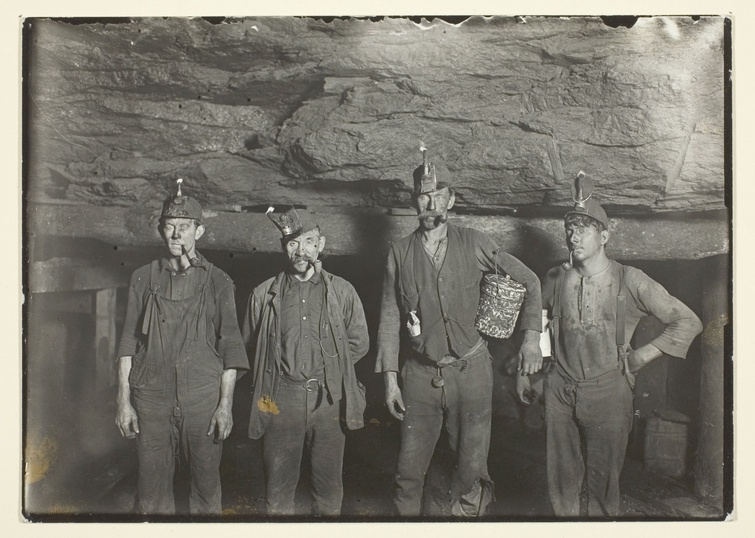
Lewis Wickes Hine, Deep Down In A West Virginia Coal Mine, Miners Going Home, 1909. Gelatin silver print. Art Institute of Chicago.
How do material conditions shape our interpretations of the past? Examining the labor of labor history in Lewis Hine’s documentary photographs of coal miners through contemporary labor actions at historic coal mining sites.
In September 2025, the Wakefield police department arrived at the picket line in Yorkshire, UK. Management claimed that they had called the authorities due to inappropriate behavior by the striking workers. The workers, in turn, accused their employer of illegal and unnecessary intimidation tactics. This bitter dispute would drag on for weeks, then months, as workers rejected a series of managerial proposals. In April 2026, workers finally accepted an offer that included 10.5% pay increases and managerial concessions regarding proposed disciplinary actions. Eight months of picketing had made history as one of the sector’s longest strikes.
While the region is no stranger to contentious labor disputes, the key players have changed. This historic strike was not mine bosses against coal miners, nor Thatcherism versus organized labor, but national charity leaders of the National Coal Mining Museum resisting around 40 of their guides.
During this time, a parallel situation was unfolding across the Atlantic. In January 2026, museum staff at the West Virginia Mine Wars Museum in Matewan, West Virginia, announced their unionization with the United Mine Workers of America, District 17 Local Union 1440. Reflecting on District 17’s historic role in the militant defense of mine worker rights, museum director Kenzie New Walker shared in a press release that “Appalachia is home to some of the most powerful union history in the country, and nonprofit workers deserve to be part of that legacy and to benefit from the protections and dignity of a union workplace.” (It’s rare for a manager to be so vocally in support of a union, but Walker, a descendant of generations of coal miners, says unions are “in her DNA.”1) Her assertion contributes to the shifting notions of work, and of what kind of labor warrants union structures. In my work supporting art museum unions, I’ve often encountered the old sentiment: “Unions are for coal miners.” In fact, as workers at the West Virginia Mine Wars Museum and the National Coal Mining Museum are demonstrating, unions are also for coal mine museum workers.
Mine work is central to our collective understanding of labor. The contemporary labor movement, currently experiencing a global revitalization across a variety of sectors, continues to broaden this limited definition. A more expansive understanding of labor includes the cultural and nonprofit workers who share, preserve, and steward our fraught and bloody labor histories. Visual culture has always played a critical role in these histories, with images serving to bear witness to events, express the emotional cadences of exploitation and resistance, and inspire and mobilize collective action. As art historian T.J. Clark writes, “The making of a work of art is one historical process among other acts, events, and structures—it is a series of actions in but also on history. It may become intelligible only within the context of given and imposed structures of meaning; but in its turn it can alter and at times disrupt these structures.”2 Many works in Curationist’s archive testify to the role of “the camera as a social weapon.”3 These works, put in conversation with the visual culture of contemporary labor struggles, can help disrupt the structures of meaning that shape our reality.
Lewis Hine, Labor Documentary Photography, and the Artist as Worker
The sociologist and photographer Lewis Wickes Hine (1874-1940) depicted the working conditions of laborers across the United States, including mine workers. His “photo stories” combined visual documentation with written testimony to raise awareness of widespread and deplorable working conditions, building public pressure for better labor standards. Notably, his work for the National Child Labor Committee from 1906-1918 directly led to national child labor law reform. Hine’s compositional tools—the purposeful arrangement of his subjects, their direct and confrontational gaze, the background attesting to their harsh circumstances—is evident in works like Deep Down In A West Virginia Coal Mine, Miners Going Home (1909) and West Virginia Coal Mine (1917). In discussing his methods, Hine stated, “The picture is a symbol that brings one immediately into close touch with reality. It tells a story packed into the most condensed and vital form.”4
Yet photographs are not quite so simple. The stories they convey are shaped by the circumstances of their making. Art historian Peter Seixas, for example, argues that Hine didn’t simply document workers—he was one himself. The photographer’s material conditions affected and constrained his practice as much as the material conditions of a miner or a factory worker. Seixas notes that Hine worked as a freelancer, subject to the instability familiar to most contemporary artists and journalists. “Because Hine was a photographer for hire, usually on the brink of insolvency,” writes Sexias, “his work was particularly vulnerable to changes in the outlooks and purposes of those who paid for it.”5 And who paid for it changed alongside larger social and economic shifts in the early 20th century. The development of the fields of scientific management and human resources altered the basic employment relationship, where workplace peace derives not from obedience out of fear of the threat or use of violence but from incentivized compliance arising from new workplace bureaucracies, hierarchies, and welfare capitalism, in which employers provided basic social services to employees to build loyalty.6 Seixas describes a clear political shift as Hine transitioned from regular freelance work for the governmental National Child Labor Committee to more precarious contracts within the private sector, governed by new and growing concerns around human resources management. While there was “no major break in his subject matter,” Seixas writes, “the sharp critical perspective which had informed his earlier projects would soon be blunted.”7 Hine still sought to educate the public about the conditions of workers through his photographs, but his arena shifted from NCLC-produced reports and exhibitions to management-sponsored employee magazines, and his emphasis shifted from workers’ objective conditions to the simple fact that “their work was not appreciated.”8 Seixas laments that Hine’s status as a wage laborer led him to shy away from structural criticism towards a more palatable message in pursuit of a stable paycheck.
The Labor of Labor Museums
This discussion of Lewis Hine and the nuanced effects of his work are not intended to diminish his legacy, but rather to emphasize the interconnections among cultural production and labor conditions. Just as Hine confronted difficult decisions in the pursuit of a livelihood, cultural workers today must contend with the economic and political pressures of selling one’s labor in a capitalist framework. Few are exempt. A recent report on working conditions from the American Association for State and Local History (AASLH), for example, emphasized the financial burden of a career in public history, which requires advanced degrees financed by student debt, also noting that these barriers disproportionately affect women, queer folks, and people of color.
Cultural workers are increasingly turning to collective action to demand more equitable working conditions and democratic participation in institutional decision-making around such topics as resource allocation. The museum union actions introduced at the start of this feature underscore the continuities among “intellectual” and “manual” labor, and demonstrate the potential of labor organizing to improve working conditions for cultural workers as well as for coal miners. These examples also illustrate the potential dissonances between an institution’s mission and its management practices. Hine’s career path, meanwhile, reminds us what is at stake should these workers be forced to align the labor of stewarding history with marketplace demands rather than the pursuit of justice.
Graham Hogg, The National Coal Mining Museum in Wakefield, England, 2000. The photograph depicts the exterior of the National Coal Mining Museum on a cloudy day in 2000.
The National Coal Mining Museum in Yorkshire is located in one of the UK’s former major industrial sites. As a registered charity, it is supported by a mixture of public and private funds. After the local mine shuttered in 1985, various stakeholders—including both local governments and British Coal—repurposed the entire site as a museum. Its mission is “to keep the stories of coal mining alive by collecting and preserving the industry’s rich heritage.” Among its public offerings are underground tours of the mine led by former miners with what the website describes as “a ‘reyt’ broad accent and loads of experience under his somewhat heavy tool belt.”
These same workers weathered upheaval and even violence during the disappearance of their industry from the UK in the 1980s. Recently, they went on strike—for over eight months, from August 20, 2025 to April 29, 2026. As members of the labor union Unison, the Mine Guides sought to secure equitable pay raises.9 The long strike action resulted in significant wins for the workers, but the museum has yet to resume underground tours as of this writing. Here, the contentious power dynamics between capital and labor, uncompromising bosses and exploited workers, are repeated and renewed in a setting of historic interpretation.
The union at the West Virginia Mine Wars Museum in West Virginia, on the other hand, indicates alternative possibilities for labor history work. Founded in 2015, the Mine Wars Museum sits in the former headquarters of the United Mine Workers of America Local 1440 in the small town of Matewan, site of the 1920 massacre of coal miners by private security forces hired by mine owners. This self-defined “people’s museum” acts, according to its website, as “a vital part of the legacy of human rights and justice in labor for working people, in Appalachia and globally.” Lou Martin, one of the museum’s founders, praises the museum’s “unflinching look at the role of power, conscious of the ways that power has shaped the historical narrative.”10 Critical to this work is the museum’s recognition of the contested, distorted, and biased history of the Mine Wars, a series of violent labor conflicts at these mines from 1912 to 1921. In the pervasive absence of critical labor history in most school curricula, sites like the Mine Wars Museum are essential in not only preserving these stories but also making them accessible to workers engaging in similar struggles today.11 The contribution of the West Virginia Mine Wars Museum to the contemporary labor movement goes beyond its exhibitions, programs, and educational materials, however: it is manifest in the announcement of January 9, 2026 that the museum had unionized and signed a collective bargaining agreement with the United Mine Workers of America Local 1440.
The museum’s voluntary recognition of its workers’ union was not merely uncommon in an industry that resists unionization.12 It was outright celebratory. Official communications abound with pride and excitement. This clear departure from the combative stance management usually takes towards labor organizing is perhaps due to this museum’s specific history: it was founded by Local 1440 members. Co-founder Lou Martin notes that “official histories typically come from the ranks of middle-class professionals and promote a nationalistic culture,” a trend exemplified in the UK National Coal Mining Museum, which was founded and funded by the national government and private coal. “Conversely,” Martin continues, “grassroots efforts [such as at the West Virginia Mine Wars Museum] are often led by working-class residents with a vested interest in preserving the history whose interpretations of the past are grounded in lived experience.”13 In other words, how history is told often has much to do with who is doing the telling—and who is paying for it.
Amanda Tobin Ripley, Ph.D., is a scholar, organizer, and educator whose research focuses on the intersection of contemporary labor organizing, cultural and professional work, and social justice. Her dissertation, “Another World is Possible:” Liberatory Unionism in the U.S. Art Museum Labor Movement, was the first major academic study of contemporary unionization in U.S. art museums. Amanda is currently based in Berlin, where she works with INPUT Consulting gGmbH to develop and conduct a participatory research project on migrant-to-migrant organizing initiatives at the German trade union ver.di.
Citations
Walker, Kenzie New. Personal communication, July 21, 2026.
Clark, Timothy J. Image of the People: Gustave Courbet and the Second French Republic 1848-1851. New York Graphic Society, Ltd., p. 13.
Buckland, Gail. Reality Recorded: Early Documentary Photography. New York Graphic Society, Ltd., 1974, p. 79. Internet Archive, https://archive.org/details/realityrecordede00buck.
In Smith-Shank, Deborah L. “Lewis Hine and His Photo Stories: Visual Culture and Social Reform.” Art Education, vol. 56, no. 2, 2003, p. 35. Zotero, https://doi.org/10.1080/00043125.2003.11653490.
Seixas, Peter. “Lewis Hine: From ‘Social’ to ‘Interpretive’ Photographer.” American Quarterly, vol. 39, no. 3, 1987, p. 381, https://doi.org/10.2307/2712885.
Seixas. 385.
Seixas, 394.
Seixas, 396.
This was not the first time pay disputes had led to industrial action at the National Coal Mining Museum. See “Workers win pay increase after strike at National Coal Mining Museum,” Museums + Heritage Advisor, 23 November 2022, https://museumsandheritage.com/advisor/posts/workers-win-pay-increase-strike-national-coal-mining-museum/. Accessed 8 October 2026.
Martin, Lou. “Public Memory and the West Virginia Mine Wars Museum.” Where Are the Workers? Labor’s Stories at Museums and Historic Sites, Robert Forrant and Mary Anne Trasciatti, eds., University of Illinois Press, 2022, p. 35.
Forrant, Robert, and Mary Anne Trasciatti. “Introduction: Uncovering Labor’s History.” Where Are the Workers? Labor’s Stories at Museums and Historic Sites, p. 12.
Only 24% of unions formed in private, non-profit art museums since 2019 have received voluntary recognition to date. See “Contemporary Union Movement (since 2019),” Museums Moving Forward, https://museumsmovingforward.com/research/projects/union-organizing/spotlight-contemporary-union-movement. Accessed 8 October 2026.
Martin, 29.
Amanda Tobin Ripley, Ph.D., is a scholar, organizer, and educator whose research focuses on the intersection of contemporary labor organizing, cultural and professional work, and social justice. Her dissertation, “Another World is Possible:” Liberatory Unionism in the U.S. Art Museum Labor Movement, was the first major academic study of contemporary unionization in U.S. art museums. Amanda is currently based in Berlin, where she works with INPUT Consulting gGmbH to develop and conduct a participatory research project on migrant-to-migrant organizing initiatives at the German trade union ver.di.