An Ecology of Satirical Art
By Camila Nader•October 2025•15 Minute Read
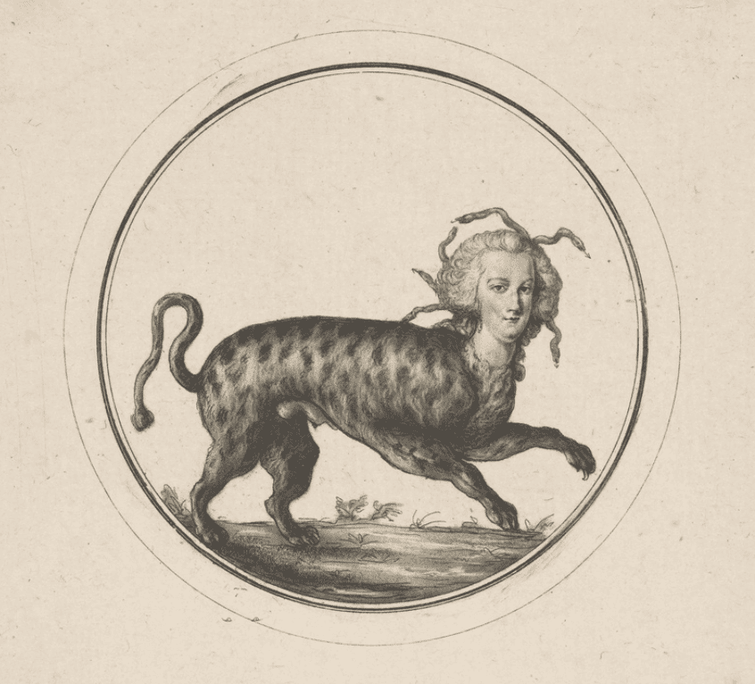
Anonymous, French, 18th century, Caricature Showing Marie Antoinette as a Leopard, 18th century, Metropolitan Museum of Art. Public Domain.
When satirists portray people as animals, the joke might be on humanity.
Introduction
In many cultures, it is common to find satirical metaphors that compare human behavior to animals as a form of insult. Pig may suggest gluttony, chicken cowardice, and donkey a lack of intelligence. But what do these animals really have to do with the human traits they are meant to describe?
This question touches on a core feature of the Western anthropocentric imaginary, in which the natural world is interpreted through a human lens. Perhaps someone once noticed that donkeys were less responsive to training than horses, and from there the animal became shorthand for stubbornness or lack of intelligence. The anthropologist Tim Ingold observes, “Every generation has recreated its own view of animality as a deficiency in everything that we humans are uniquely supposed to have, including language, reason, intellect and moral conscience.”1
In fact, our very ways of thinking and writing about animals are shaped by an imaginary constructed around the dichotomies of humanity/animality and nature/culture. Such dichotomies sustain a hierarchy.2
These reflections are part of a field of study that calls for a new ecological stance, born from the urgency of the climate crisis and the need to imagine ways of living together, recognizing nature as part of an ecology that transcends idealized models. Ecological thought engages not only science but also art, philosophy, literature, music, and culture.3 After all, if environmental collapse stems, at least in part, from a failure of the Western imaginary, it will take imagination to construct the kind of poetics required for ecological action.4
To explore this imaginary, this essay focuses on a specific chapter of visual culture: the use of satirical art in 18th- and 19th-century France and the United States, where nature became a means of ridiculing public figures. Rethinking the notions of human and animal, and the material and symbolic consequences of representations of nature in art, is essential to shaping new ecological thought within the human sciences.
Hierarchical Representations of Nature in French Rococo
Before turning to the satirical art produced in 18th-century France, it is useful to look at how the natural world was represented in French Rococo painting of the era. Two works by Jean-Baptiste Oudry offer compelling examples. The first, Still Life with Monkey, Fruits, and Flowers (1724), is a composition staging an opulent arrangement of fruit and flowers alongside a monkey. None of them are native to France, but grapes, figs, and pomegranates had been cultivated in Europe and across the Mediterranean since antiquity, while peaches and melons were introduced more widely in the early modern period. Other specimens point to more distant origins, such as orchids that came from tropical Asia and the Americas, which circulated as exotic rarities for aristocratic collections satisfying public curiosity and reinforcing personal prestige as signs of wealth and power.5 During this period, monkeys were imported mainly from Africa and Asia, along with other exotic species. They were kept as pets by the aristocracy, and sellers occasionally emphasized their resemblance to humans or their ability to perform human tasks, though they were often regarded as dirty and malicious.6
W
The monkey’s gesture in the painting, reaching for the grapes, is also significant. What could be read as spontaneous movement, even a sign of agency, is in fact carefully arranged by the artist, filtered through the human gaze and its expectations of animal behavior. The act of stretching toward the fruit reinforces stereotypes not of the species itself, but of human vices such as desire, mischief, and lack of restraint. In Oudry’s painting, the monkey becomes both an aristocratic amusement and a moralizing device, projecting human deficiency onto the animality of the monkey.
A more precise example is found in another of Oudry’s works: the portrait of _Henri Camille, Chevalier de Beringhen _(1722).7 In this scene, the chevalier is depicted just after a hunt, accompanied by a pointer and two dead partridges. The dog stares intently at a freshly captured bird dangling from the hunter’s fingers. Henri Camille demonstrates his control over both animals by restraining the dog’s predatory response with the gentle touch of his hand and asserting his triumph over the wildness of the bird by displaying its body.
This may be one of the cruelest facets of human domination and mirrors the functioning of human societies, where hierarchies are sustained through violence. In Oudry’s composition, this logic is embedded in the theatricality of the scene, as the chevalier’s composed expression and measured gesture transform the brutality of the hunt into an emblem of virility and aristocratic power.8
Art is a system of representation that reflects human subjectivity and imaginaries. In this sense, the gestures depicted in Oudry’s paintings—both of the monkey and of the Chevalier de Beringhen—reveal how nonhuman life was staged within hierarchies that determine who is granted agency and who is not.
To question this imaginary is to attempt a shift in perspective, and perhaps to unsettle the terms through which we imagine the relationship between humans and the nonhuman world.
Nature as Satirical Tool: The French Revolution and the Representation of Queen Marie Antoinette
Being compared to a storm might suggest intensity and autonomy, while being compared to a cat could imply a mysterious or unpredictable personality. In contrast, being compared to a dog might suggest someone is passive and compliant, easily controlled.
What shifts here is the degree of human control exercised. Natural phenomena escape human domination, which is why they are associated with intensity, autonomy, and power. By contrast, the more accessible an animal’s body, the more derogatory the metaphor tends to be. Comparisons to species that are commonly consumed in Western culture, such as cows or pigs, are especially offensive. When directed at women, these metaphors often carry sexual undertones or invoke the idea of bodily control, questioning purity and reinforcing harmful ideals of femininity.
When we look at how these representations appear in satirical art, particularly as critiques of public and political figures, it becomes evident that a reversal of power is being staged. Satirists frequently employ strategies such as metamorphosis and anthropomorphism, transforming powerful human subjects into animals like pigs, birds, or leopards or into mythological hybrids such as centaurs or Medusa.9 The subject is stripped of authority and made ridiculous, enabling a form of public critique.
During the French Revolution, satirical art played a significant role in shaping public opinion against Queen Marie Antoinette and King Louis XVI. The queen was an ambivalent figure, surrounded by suspicion due to her Austrian origin and rumors about her extravagant tastes. These tensions were effectively funneled toward her person and amplified through a steady output of pamphlets and prints that cast her as sexually promiscuous, politically intrusive, and ultimately disloyal to France.
Her body became public domain, scrutinized and symbolically dissected. The most effective visual attack was to depict her as an animal—or, rather, as several.
W
In Caricature Showing Marie Antoinette as a Leopard, the queen’s face appears on the body of a spotted animal, nominally a leopard, though the patterning suggests a resemblance to a hyena. Both animals were historically perceived as treacherous and beyond human control, subjugated only through hunting and killing. Hyenas live in matriarchal groups with females exhibiting elevated hormone levels that blur sex characteristics, which led to popular myths about their moral ambiguity.10 If we read the caricature as merging these two animals, it attributes to Marie Antoinette a set of negative traits like untrustworthiness, hypersexuality, and unnatural power while simultaneously asserting her disproportionate influence over royal affairs.
This interpretation is reinforced by a biblical proverb from the Old Testament: “A leopard can’t change its spots,” a phrase used to express skepticism about someone’s ability to change, especially when their character is deemed dubious.
The animal-human hybrid in this image is overtly sexualized, with swollen breasts and serpents in her hair alluding to the mythical figure of Medusa. Once a beautiful priestess, Medusa was seduced and violated by Poseidon and then punished by Athena, transformed into a beast whose gaze turned people to stone. She was decapitated by Perseus, who avoided her gaze by using his shield as a mirror. This association casts Marie Antoinette’s nature as monstrous and her death as inevitable.
W
In another example, La famille des Cochons ramenée dans l'étable (1791), the royal family is shown being returned to Versailles after their attempted escape to Montmédy. Their human heads are attached to the bodies of pigs, and they are herded back to the “stable” by French soldiers. The pig, traditionally associated with filth, gluttony, and immorality, becomes a tool to degrade the monarchy. The image of the stable emphasizes the loss of sovereignty and the family's repositioning as property within a system of domestication. Visually, this reversal of the social order reinforces revolutionary ideals. Yet it also demonstrates the arbitrary nature of these hierarchies, since pigs have been wrongly associated with impurity and uncleanliness, not because of any inherent traits but as a result of the conditions of their confinement and the moral meanings humans project onto them.
Nature as Satirical Tool: The Comic Natural History of the Human Race
These strategies also reverberated in the 19th-century United States, most notably in the city of Philadelphia in 1851, as seen in The Comic Natural History of the Human Race, a publication by Henry Louis Stephens.
Inspired by illustrated manuals of natural history, the book takes the form of a zoological catalog to humorously portray the social types that composed the urban society of the time. Lawyers, politicians, bankers, and other everyday characters are presented as local “species,” described in terms of their habits, gestures, linguistic behaviors, and social survival strategies. The illustrations once again combine human heads with animal bodies, while the accompanying texts adopt the formal and inflated tone of scientific treatises. This style creates ironic associations between the vocalizations of certain species and the regional accents or idioms of these urban characters, exposing the artificiality of social conventions through comic contrast.
Some of these species represent specific public figures; others portray generic social types. Stephens’s satire mirrors the techniques seen in French Revolutionary caricature but shifts its critical focus from the political realm to the moral and cultural codes of urban life.
Irony exposes American accents, mannerisms, and professional jargon, recasting linguistic features as biological traits. By appropriating the authoritative tone of science for comedic effect, the work offers a biting cartography of the codes of conduct that structured life in 19th-century Philadelphia, revealing not only the characters themselves but also the mechanisms of distinction and classification that defined them as social species. The use of pseudoscientific language parodies the detached authority of external observers, turning everyday social behaviors into objects of classification and ridicule.
In The Attorney, presented in Stephens’s Comic Natural History under the alternative title The Legal Bird and accompanied by a pseudoscientific Latin name, _Jurisperitus vox populi _(roughly, “the lawyer of the people's voice”), Max Rosenthal mimics scientific illustration.11 The emerald-green bird is perched on a branch with an upright posture, carrying a small green bag, reinforcing the satirical link between the bird’s habits and the lawyer’s appetite for money and interminable bills. The human face of the lawyer, along with part of his clothing, are rendered with great attention to detail. The species depicted resembles a parrot, suggesting a creature that talks excessively, repeats words, and can be made to say whatever is required.12
The Woodpecker (1850), identified in the book with the Latin name_ Picus gihonis major_ (Gihon’s woodpecker), refers to the illustrator and engraver William B. Gihon, active at the time of the book’s publication. Once again, a human face is grafted onto an avian body. The illustration draws a connection between the woodpecker’s habits and Gihon’s profession, featuring his working tools and a human skeleton carved into the branch the bird rests on. The bones may allude to the engraver’s controversial reputation, echoing the text’s punning references to “picking pockets” and “picking quarrels.”13
The Comic Natural History of the Human Race encompasses a wide variety of hybrids between animals and humans, ranging from birds and reptiles to mammals, fish, and insects. Initially produced as independent lithographs and later compiled into a single volume, the work was the result of a collective endeavor. Alongside Henry Louis Stephens, contributors included the writer Cornelius Mathews and the mayor of Philadelphia, Richard Vaux—often writing under pseudonyms—as well as the ornithologist John Cassin, vice president of the Academy of Natural Sciences of Philadelphia.
Unlike the French examples, produced in a context of sharp political critique, these illustrations targeted public figures in Philadelphia whose relevance was mostly circumscribed to that specific period. The use of animal metaphors, however, still relied on associations that persist in common sense today.
What emerges from these examples is not so much a reflection on human control over animal bodies, but rather on how animal behavior, once transposed into the human form, becomes a vehicle of ridicule. The humor does not lie in the woodpecker’s habit of pecking wood, but in how this action is absurdly mapped onto the figure of the engraver. At the same time, Stephens’s book offers a counterpoint to scientific natural history manuals, parodying their classificatory model by applying it to the idiosyncrasies of human society.
Who Was the Joke On, After All?
The use of animals in satirical art reveals more than strategies of ridicule: it exposes the hierarchies embedded in the Western imaginary, those that place the human above all other forms of life. More than aesthetic choices, these representations are part of a broader symbolic order that treats nonhuman beings as tools, metaphors, or caricatures, often reinforcing the notion that what is animal is lesser, laughable, or impure.
Such an imaginary does not come without consequence. The symbolic domination of nature, manifested in art, science, and language, precedes and enables its material domination. If the crisis we face today is ecological, it is also epistemic. It stems from a way of seeing and classifying the world that has justified extraction, confinement, and extermination.
Recognizing this is not merely an intellectual exercise or a punny joke; it is a call for art history itself to assume responsibility for shaping collective imaginaries, including understanding that rethinking anthropocentrism also means refusing to interpret the differences of other species as assertions of their inferiority or as signs of flawed human behavior.
If artistic representation has long reinforced hierarchies through symbols of domination, then rethinking these images means acknowledging that every pattern of meaning is produced through difference that should be embraced. To recognize the agency of nonhuman forms of life is not only to critique their subjugation, but to imagine their emancipation.
Camila Nader is a researcher dedicated to exploring new narratives within art history. Her work focuses on uncovering overlooked connections between artists, politics, and cultural geographies, seeking to challenge canonical perspectives and expand the ways we understand visual culture.
Citations
Ingold, Tim. “Humanity and Animality.” Companion Encyclopedia of Anthropology, edited by Tim Ingold, Routledge, 1994, p. 15.
Ingold.
Morton, Timothy. The Ecological Thought. Harvard University Press, 2010, p. 4.
Harvey, David. Justice, Nature and the Geography of Difference. Blackwell, 1996, p. 438.
Collecting and displaying such species was closely tied to elite culture and to participation in colonial trade networks. For more on the Mediterranean cultivation of grapes, figs, and pomegranates, see Zohary, D., Hopf, M., & Weiss, E. Domestication of Plants in the Old World. 4th ed. Oxford: Oxford University Press, 2012. On orchids as exotic specimens, see Preda, V. A History of Orchids – A History of Discovery, Lust and Wealth. Scientific Papers. Series B, Horticulture, LXIV(1), 2020, pp.519–530.
Robbins, Louise E. Elephant Slaves and Pampered Parrots: Exotic Animals in Eighteenth-Century Paris. Johns Hopkins University Press, 2002, pp. 147–148.
The art historian Amy Freund analyzes this genre of painting, particularly the work of Jean-Baptiste Oudry, arguing that its recurrence in 18th-century France symbolized a form of resistance to the monarchy during the waning years of Louis XIV’s reign and the regency that followed. She suggests that portraits en chasseur offered a reinterpretation of political power from the perspective of the elite, grounded in their contact with nature, instinct, and the violence of the animal world. See: Freund, Amy. “Sexy Beasts: The Politics of Hunting Portraiture in Eighteenth-Century France.” Art History, vol. 42, no. 1, Wiley, 2019, pp. 40–67, https://doi.org/10.1111/1467-8365.12413.
Freund.
McPhee, Constance, and Nadine M. Orenstein. Infinite Jest: Caricature and Satire from Leonardo to Levine. The Metropolitan Museum of Art, 2011, pp. 3–17, https://resources.metmuseum.org/resources/metpublications/pdf/Infinite_Jest_Caricature_from_Leonardo_to_Levine.pdf. Accessed 4 August 2025.
Glickman, Stephen E. “The Spotted Hyena from Aristotle to the Lion King: Reputation Is Everything.” Social Research, vol. 62, no. 3, 1995, pp. 501–37. JSTOR, http://www.jstor.org/stable/40971108. Accessed 4 August 2025.
Many of the lithographs by Max Rosenthal, including The Attorney, circulated as independent prints before being gathered into George Stephens’s A Comic Natural History of the Human Race (1851). This explains why the caricatures, such as The Attorney and The Woodpecker, are accompanied in the book version by pseudoscientific names and satirical texts, attributed to various authors writing under pseudonyms. See: Hunter Brooks Dukes. “The Comic Natural History of the Human Race (1851).” The Public Domain Review, May 6, 2015, https://publicdomainreview.org/collection/comic-natural-history/. Accessed 4 August 2025.
This idea is also suggested in the text accompanying the illustration: “The voice of the legal bird is worthy of note: it sings almost any tune.” Stephens, p. 20.
Stephens, p. 197.
Camila Nader is a researcher dedicated to exploring new narratives within art history. Her work focuses on uncovering overlooked connections between artists, politics, and cultural geographies, seeking to challenge canonical perspectives and expand the ways we understand visual culture.