Indigenizing the Archive with Yazan Kopty: Palestine in National Geographic Magazine
By Kristine Khouri and Yazan Kopty•December 2020•14 Minute Read
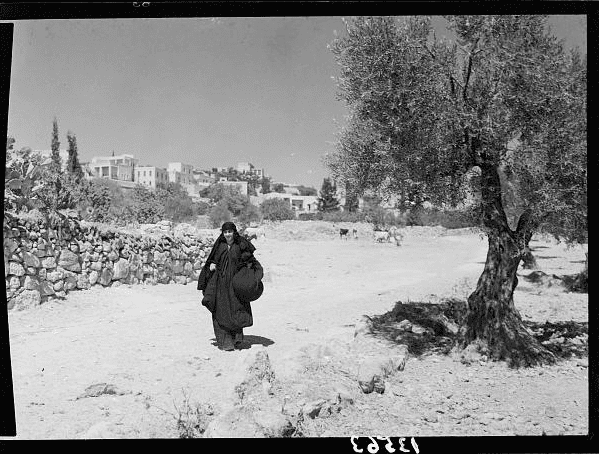
Matson Photo Service, "Ruth" story. "Ruth" carrying off wheat measured by "Boaz" (Sirvart), Bethlehem in background, 1940-46. From the G. Eric and Edith Matson Photograph Collection at the Library of Congress, no known copyright. Palestinian women often stood in for Biblical characters in photographs. In this image, the unknown woman is given the name “Ruth” and her actions are narrated as if they were an event from Biblical times.
Yazan Kopty discusses his efforts to indigenize the National Geographic Photographic Archives by integrating the voices, experiences, and knowledge of Palestinians into the presentation of photographs of historic Palestine.
Introduction
Writer and oral historian Yazan Kopty considers the many images of Palestine in the National Geographic Photographic Archives and outlines his efforts to increase access and encourage the evolution of the images’ meanings by inviting scholars and non-professionals from Palestine and the diaspora to share their knowledge. He also discusses the historic and political importance of photographic documentation of historic Palestine.
Kristine Khouri (KK): Can you introduce yourself and your project, Imagining the Holy?
Yazan Kopty (YZ): I'm a writer, an oral historian, and a National Geographic Explorer. The beginning of Imagining the Holy started when I was using National Geographic magazines to do research for a novel inspired by my family in Palestine. While I had family photographs and had seen pictures of domestic spaces and portraits, it was hard to find photos of public spaces and of festivals. The January 1921 issue of National Geographic included an article about the Samaritan Passover in Mount Gerizim and Nablus. I knew exactly where the photograph was taken in relation to my family’s house. I began collecting National Geographic issues with articles on Palestine and realized that they've been covering Palestine consistently for the past 130 years. I began noticing patterns in the representation of Palestine and Palestinians.
Matson Photo Service, ["Ruth" story. "Ruth" carrying off wheat measured by "Boaz" (Sirvart), Bethlehem in background, 1940-46. From the G. Eric and Edith Matson Photograph Collection at the Library of Congress, no known copyright. Palestinian women often stood in for Biblical characters in photographs. In this image, the unknown woman is given the name “Ruth” and her actions are narrated as if they were an event from Biblical times.
When Palestine was a part of the Ottoman Empire, for example, many stories linked Palestine to the Bible. During the period of British occupation, British colonialism and Jewish immigration from Europe became an important part of its “magical transformation” from an allegedly empty land into a modern, multicultural place. The “nation-state moment” following the British Mandate provided the lens through which Palestinians and Palestine were viewed for several decades. From this perspective Palestine and Palestinians only occupy the background of the image. In fact, Palestinians in Israel proper are tellingly called the “Arab Israeli minority.”
Talking about people as Biblical placeholders is still one of the main ways that writers, editors, and audiences think about Palestine. Today there is a focus on the intersection of Biblical stories with archaeology. For example, National Geographic ran a feature on a recent renovation of the Church of the Holy Sepulchre that was turned into an exhibition entirely focused on the building and religion. The narrative was completely divorced from the geopolitical situation of Palestine and its inhabitants.
KK: What made the magazine different or special?
YK: In the early years, the magazine shared many characteristics with the travelogues of Palestine, but it was the photography that made it successful and popular. Most of the stories about Palestine were published in December, in the Christmas issue. This was when subscriptions were up for renewal and, obviously, when Bethlehem, Jerusalem, and other localities in Palestine were on American minds.
KK: You eventually approached National Geographic to see what else they may have in the archive.
YK: When I approached the archive, I didn’t know that there was a photographic collection. I initially wanted to know how the stories were conceived, how decisions about captions were made, and what conversations occurred behind the scenes. The project was transformed when I was shown the thousands of largely unpublished photographs of Palestine. The first batch of material that I looked at closely was from the late 1800s through the 1950s and includes images taken or purchased by National Geographic staff on assignment, as well as amateur photographers and many aerial photographs from the US and British military, likely used for surveillance or mapping.
I wanted to investigate the way that Palestine has been portrayed in the magazine. The archivists were also interested in thinking about how to bring Indigenous voices into the archive. I applied and received a National Geographic Explorer grant—the first to focus on archives.
KK: What other places did you look for images of Palestine from that period?
YK: The other major source of photographs of historic Palestine is the Library of Congress's Matson Collection which was gifted by members of the American Colony of Jerusalem. This was a Protestant, utopian commune founded in Jerusalem by Americans and Swedes. The commune ran a photographic studio that produced images for sale as well as on commission. The American Colony lasted from the Ottoman period through the British Mandate and the Nakba and into the period following the founding of Israel in 1948. Today it is a very famous hotel. The Matson Collection has been digitized and is available online, but the images are decontextualized.
KK: The issue of existence or access to documentation of life in Palestine before 1948 reminds me of Golda Meir’s quote justifying the state of Israel as “a land without a people, for a people without a land.” There are images of Palestine in Israeli archives and other places that are physically inaccessible or controlled. Considering that the land and state of Israel remains contested, documentation of Palestine is central to counter the narrative that Palestine and its people did not exist prior to 1948.
YK: The ongoing religious, political, and economic interest in Palestine translates into a significant amount of material, such as travelogues and photographs. When compared to the rest of the non-Euro-American world, there is a disproportionate amount of documentation.
Many photographic collections were confiscated, stolen, or looted in 1948 and later. They have been kept by various Israeli institutions, such as the National Library, universities or other cultural institutions, and military and government institutions. Most Palestinians have never had access to this material. Israelis and other non-Palestinians, on the other hand, have access in varying degrees. Nonetheless, there may be a whole cache of material that we are unaware of. It’s important to return to questions of ownership and access—who has the material, who is keeping it, hiding it, who is making it accessible and to whom. This becomes particularly contentious and important when considering Palestine and the photography of Palestine.
KK: Can you speak a bit more about the history of photography in Palestine and photography by Palestinians?
YK: There are photographs in the_ National Geographic_ archive that were taken by Khalil Raad. His family was originally from Lebanon, but he lived and worked in Palestine. He is considered the first Arab photographer of Palestine even though photography by Palestinians begins with Armenian Palestinians. There’s a collection of his photography at the Institute for Palestine Studies (IPS). He was the only Indigenous photographer from that early period that I found in the National Geographic Archive. Only two of Khalil Raad’s photos were published even though there are hundreds in the archive.
I later discovered that the photos were purchased by Maynard Owen Williams, one of National Geographic’s photographers. Williams lived in Beirut at the time and would drive down to Haifa and to other parts of Palestine to photograph the country and purchase photographs from Khalil Raad and others. Williams would spend a few days taking photos or meeting with people, after which he would spend weeks writing the legends and captions. That is how we ended up with native images (Raad) captioned by an American photographer (Williams). I added my own reading as a Palestinian researcher.
I wanted to compare the Raad photos to pictures by foreign photographers to see if I could spot a difference. Raad and the American Colony both had photo studios where they took and sold pictures primarily to tourists, and their practices were very similar. Their catalogs were organized in a similar fashion. The subjects, their framing, and their use of biblical references were also similar. I couldn't find a visual difference between Raad’s commercial images and images by the American Colony photographers. The American Colony’s photography studio was mostly run by Americans or Swedes, but the staff who worked in the photo department included Palestinians. Furthermore, some of the Americans and Swedes were born and lived their whole lives in Palestine and spoke Arabic.These two collections form an interesting case study because they blur the line between indigenous and foreign perspectives. These are two of the most important collections of photographs of Palestine. The question is whether Khalil Raad’s pictures are more “indigenous” and “real” than the images from the American Colony or those by National Geographic staff photographers.
Khalid Raad's store at Jaffa gate, Jerusalem, ca. 1918-35. The Institute of Palestine Studies, Wikimedia Commons, user: Racconish, public domain. The studio of photographer Khalil Raad, known as "Palestine's first Arab photographer," which Raad opened in Jerusalem in 1890.
KK: You mentioned that local photographers in Palestine were often Armenian photographers, can you tell me a bit more?
YK: I am not an expert, but in the eastern Mediterranean and in Palestine specifically, photography as a practice had a relationship early on to the Armenian Church. Armenians were often the ones establishing photographic studios in the region. Raad was trained by Garabed Krikorian, one of the prominent Armenian photographers in Jerusalem at the time.
He and the Armenian photographic studio took family portraits of wealthier classes of Palestinians, sometimes as fellahin or bedouins. Those family studio portraits are another genre of images. In the case of Khalil Raad, there were times when his business was focused on selling Biblical imagery to tourists, and other times when it was focused on studio portraits.
KK: What was the process of working in the archive and what were the different elements of the project you developed?
YK: My first work with the photographs themselves was a cataloging exercise. It was to understand who donated or sold pictures to National Geographic, see which ones were published, and how the photograph was positioned by its accompanying text. The published caption was often completely different than the one on the back of the image. Often, the image was used to illustrate a written description that was unrelated to the photograph. For the first time, the archive had somebody looking at the photographs with specific cultural knowledge about that region.
We started to discuss how to best introduce a Palestinian perspective into the archive. I considered ways to approximate the subject’s voice. It's the multiplicity and layering of voices that ends up bringing us closer to something that can approximate the perspective of the subjects.
I decided to work with cultural heritage experts, field researchers, and academics who could bring their expertise to bear on the images. The textile expert could focus on images of textiles, the architectural historian on architecture, and so on. There were a number of people who could speak to social history and offer a more complete context for the images. These voices became the counterweight to the photographer’s caption.
I started posting images on Instagram under a new account, entitled “Imagining the Holy.” The purpose was to find new research leads through crowdsourcing. Just as I was able to recognize things in the photographs because of cultural knowledge that was passed down to me, I hoped that other Palestinians could do the same. It worked: people began recognizing details, places, and people. Once we knew a person's name we could ask family members for more information about the subject, transforming them from a type into an individual with a history.
Matson Photo Service, "Ruth" story. Bethlehem woman "Ruth" as Bethlehemitess, 1940-46. From the G. Eric and Edith Matson Photograph Collection at the Library of Congress, no known copyright. A 20th century Palestinian woman from Bethlehem, wearing traditional dress with embroidery, is used as a stand-in for the Biblical figure “Ruth.” This image doesn’t give any information about who she really is. Palestinians were often typecast as characters rather than depicted as themselves.
Take for example, a photograph by Maynard Owen Williams of a schoolgirl in Ramallah. In the magazine, the picture is used to invoke the biblical character of Ruth by suggesting that the veil she's wearing is similar to what Ruth may have worn. It was actually a picture of Regina Musa when she was fifteen years old and studying at the Friend’s School. When we learned her name, it was transformed from an ethnographic image into a portrait. Even though this doesn't fully address the imbalance of power between the subject and the photographer, it does something pretty remarkable in the context of an institutional archive. It allows for a new way for us to look at the image.
KK: What are some of the challenges you’ve faced in the course of the project?
YK: A major question is who gets to speak for the images. The critique that I had of the archive was that Palestinians weren't speaking for the material, but even when Palestinians are speaking in this project, they are often part of a Palestinian intelligentsia or academic world, which represents privilege and power. I try to acknowledge who is excluded. Ideally, the project is open to anyone who can speak for the images, but logistically it’s difficult. That’s one of the issues that's unresolved and one of the critiques that I have of my own work.
The National Geographic Society archive team has been digitizing various parts of their collection along with the Historic Palestine material. The online platform will allow access, but the way that the user experiences the metadata and hierarchy of information is critical. Where do we put the new captions with respect to the original captions, or future captions? Do they sit at the same level? What language are they in? How do non-English speakers access the material? We’re working together to figure out, in the spirit of the project, how to make it more accessible to Palestinians. Other major obstacles include copyright and privacy.
The most exciting thing is that this material hasn’t been seen before. I spoke before about the examples of archives that have been hidden by Israeli institutions on purpose as a way to exert power and support a narrative that serves the state. In the case of National Geographic, it's been more of a logistical and technological barrier.
This project will never be complete. As this material becomes more accessible to larger audiences, my hope, as well as that of the archive team, is that more information will be added to the images by non-professional Palestinians with personal relationships to the images.
KK: The question of who writes history and who has access to it is something that is being discussed actively today. How does this relate to the project more concretely?
YK: When we're talking about the 1920s, when photographers were most often white, presumed heterosexual, Anglo-Saxon American males shooting subjects from a wide array of classes and backgrounds, there is a very clear power dynamic that is easy to define, visualize, and critique. I want to use this to think about photographic practices at National Geographic and beyond. The photographer is still in a position of power. We want to bring the lessons from this older material to a contemporary audience of practitioners and challenge them to think critically about their work as photographers and writers at a moment when these power dynamics might be more opaque.
KK: Is there one image or story that you want to end with?
YK: The series of pictures of Regina Musa are important to me, since I connected with her granddaughter, Suzie Afridi. We had a special moment when we looked at the unpublished images which she had never seen of her grandmother. We met and she spoke at length about her grandmother and their relationship. To see family photos of Musa as an older woman was touching because it reminded me why I started this project and why the project is meaningful. History is always fraught and complex. Palestinians carry the additional burden of the explanations and confrontations that come with talking about our history. But the family is at the heart of this project—the fact that this is about our grandmothers is why these images are important to everyone, not only to researchers and academics. I imagine Suzie and her grandmother and Maynard Williams and his descendants. In this way the photograph is the site of an intergenerational meeting.
I prefer the term indigenizing to decolonizing when talking about the archives because we can’t remove the colonial by appropriating or reclaiming the image. The colonial is embedded in how the image was made. It's in the lens. It was, and continues to be, in the technology. It's in the moment of encounter between those two people. I think introducing Indigenous perspectives and elevating the Indigenous to a position that is equal to, or even greater than, the colonial is what needs to happen.
Kristine Khouri is an independent researcher and writer whose research interests focus on the history of arts circulation and infrastructure in the Arab world, and archival practices and dissemination. Khouri is a member of the board of the Arab Image Foundation, Beirut.
Yazan Kopty is a writer, oral historian, and National Geographic Explorer based in Washington D.C. His work focuses on acts of listening and narrating. He is interested in community-sourced history as well as the notion of memory as resistance. He is currently the lead investigator of Imagining the Holy, a research project that seeks to examine and connect thousands of images of historic Palestine from the National Geographic Society archive with Palestinian community elders, cultural heritage experts, and field researchers in order to add new layers of indigenous knowledge to the images.