Dynamic Metadata Deepens Cultural Knowledge
By Virginia Poundstone•March 2022•5 Minute Read
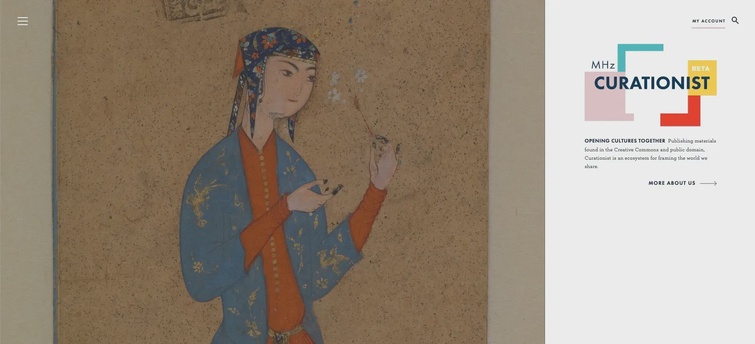
Screenshot of the homepage of Curationist.org retrieved March 4th, 2022.
From the Metadata Learning and Unlearning series
Participatory metadata creation increases access to cultural knowledge. It makes artworks and other artifacts more discoverable during research. It builds crucial skills in visual, cultural, and digital literacies. And as a practice, it is liberatory.
Cultural heritage institutions are part of the colonial, imperial, racist, sexist, homophobic, and ableist underpinnings of culture at large. As a sector, we are experiencing an upswell of interest in addressing these historical wrongs. Participatory metadata creation is a great place to start.
Many institutions have embarked on reparative projects to make their metadata more just, representative, and respectful.
The Anchorage Museum’s project Decolonizing Through Virtual Repatriation: A New Vision of Collections Access includes new metadata accessible through Chickaloon Native Village’s Mukurtu database. This metadata will include Traditional Knowledge labels which support Indigenous data sovereignty by signaling local protocols for access and use of materials that are digitally circulating outside of community contexts.
The Smithsonian Institution created the Because of Her Story Initiative to disseminate data, artifacts, and narratives that amplify the histories of American women.
Archivists at the Getty formed an Anti-Racist Description Working Group to share knowledge, examine their positionalities, and set updated metadata standards. The Anti-Racist Description Resources, published by Archives for Black Lives in Philadelphia (A4BLiP), were foundational to their practice.
Cooper Hewitt’s Guidelines for Image Description made by Sina Bahram and Anna Chiaretta Lavatelli is an invaluable resource for those of us tasked with describing artifacts for accessibility.
The Coyote Project, MCA Chicago’s partnership with Prime Access Consulting enabled the creation of alt text and visual descriptions for people who are blind or low vision for thousands of images on their website.
Three Big Problems in Need of Collective Solutions
There are many additional working groups, inspiring projects, open knowledge activists, and lone museum and archive workers chipping away at knowledge liberation one catalog entry at a time. With millions of open access works available, there remains a lot of work to do.
Venn diagram of open knowledge ecosystem with curation at the center.
There are three big hurdles that need collective solutions:
Cultural institutions are under-resourced, especially those within communities and geographies that are misrepresented or underrepresented online. There are huge backlogs of metadata to create or redress. And a plurality of cultural knowledges and digital skills are required to do so.
Design of a Participatory Metadata System
As the Director of Product and Content for MHz Curationist, I am working with cross-functional teams to build tools that facilitate participatory metadata work. Our goal is to deepen cultural awareness by making cultural heritage content from around the world accessible and dynamic as a way to address the imbalanced social systems at play in the sector.
Using the data and media files available through various museums’ open access programs, we are building a web app and database for participatory content curation and metadata layering. Our nascent platform reuses content from museum archives. This means the metadata challenges museums face are obstacles we share.
With so many records available, meaning making through added translation and additional context from community, scholarly, and specialist knowledge holders is a crucial component to helping people not only find the information and materials that they need, but deepen their cultural awareness through access to a plurality of knowledge.
Curationist’s metadata schema authored by Sharon Mizota.
As an early part of our process, we enlisted the help of DEI Metadata Consultant and arts writer Sharon Mizota to help us write our custom metadata schema and create a wikidata-based taxonomy standard for us to grow into. Sharon has an extensive list of resources on her website. Here are a few resources that have been particularly formative for MHz Curationist:
Cultural Humility as a Framework for Anti-Oppressive Archival Description, Jessica Tai, Journal of Critical Library and Information Studies, Vol. 3 (2020)
VRA Core Schemas and Documentation, Library of Congress
Minding and Mending the Gaps: A Case Study in Linked Open Data, Karen Li-Lun Hwang, The Design for Diversity Learning Toolkit, Northeastern University Library
As a nonprofit open educational resource (OER), we are committed to expanding Open Access. A large part of our responsibility as an OER is to improve outdated information, but we cannot do it alone.
Exploring the Needs and Building a Community of Practice
As new members to the open knowledge movement, we are part of a global effort to make access to knowledge not only available to all, but created by anyone who wants to participate.
This series of essays explores the possibilities of participatory metadata creation from critical analysis and research to use cases and case studies. The particular editorial focus of the series is on exploring how educators and learners can engage meaningfully with open knowledge movements through this work.
——
The Metadata Learning and Unlearning series was originally published on Medium.com and edited by Sharon Mizota, Virginia Poundstone, and Garrett Graddy-Lovelace. This series raises questions and makes proposals for what metadata can do to advance a broader dialogue about diverse worldviews within open education and openGLAM realms.